By 2050, the office may not feel like a place we “go” so much as an environment that reacts, anticipates, and sometimes even collaborates with us.
That’s the picture emerging from IWG’s Work Reimagined: The Office of 2050, a global study of HR leaders and employees that points to a workplace increasingly defined by AI, immersive technology, and early-stage neurotechnology.

Across responses, there is broad agreement on one point: by mid-century, workplace technology may feel almost unrecognizable compared to today.
Brain-computer links move from theory to workplace planning
One of the most striking findings is the growing expectation around neural interfaces, which is technology that connects the human brain directly to external systems.

In the IWG survey, neural implants ranked as the most anticipated emerging workplace technology by 2050, selected by 33% of HR leaders and 26% of employees.
The technology is still in early development, with companies such as Synchron and Neuralink exploring potential real-world applications, but respondents already see it as part of future working life rather than science fiction.
Alongside this, intelligent systems are expected to handle more complex workflows, personalize working environments, and speed up decision-making in ways current tools do not.
AI becomes a colleague, not just a tool
Artificial intelligence is expected to move deeper into day-to-day operations.

More than 70% of HR leaders and 73% of employees expect AI and automation to reconfigure most office roles. A similar share believes AI will help determine where and when collaboration should happen, based on tasks and team needs.
The report also points to a transition in how work gets done at an individual level. AI-assisted training and onboarding are expected to shorten learning curves, allowing employees to move into productive roles faster than previous generations.
As routine tasks become more automated, respondents expect a growing share of human effort to concentrate on problem-solving, creative work, and decision-making under uncertainty.
Virtual meetings start replacing physical presence
Immersive technologies are expected to become a core layer of communication.
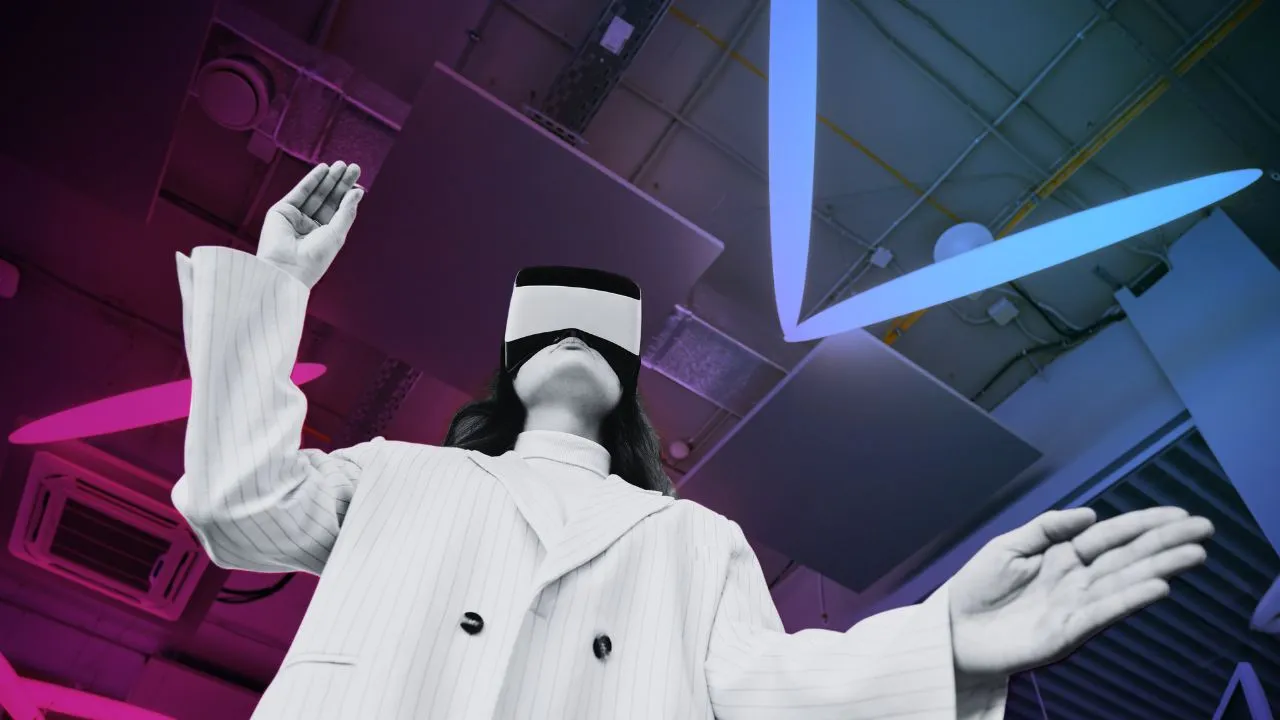
Around 70% of HR leaders and 69% of employees believe virtual and augmented reality will replace many traditional office interactions by 2050, including in-person meetings and desk-side conversations.
Instead of a single meeting room experience, collaboration could take place in shared digital environments where remote and in-office workers interact in real time.
The daily commute and fixed work hours lose relevance
The structure of the workday is also expected to change significantly.
Nearly seven in 10 respondents believe long daily commutes and the traditional 9-to-5 schedule will disappear by 2050 (69% of HR leaders and 68% of employees).
Work is instead expected to spread across networks of locations rather than a single central office, with 70% of HR leaders and 75% of employees expecting multi-site working to become standard.
Hybrid work is projected to deepen, with most HR leaders (78%) and employees (64%) expecting it to be the dominant model.
Strict return-to-office mandates are also expected to fade as flexibility becomes a baseline expectation.
Offices that respond to people in real time
Beyond how work is structured, the physical environment itself is expected to become more adaptive.
Respondents described future offices that adjust lighting and environmental conditions based on individual biological rhythms (28%), detect fatigue and prompt rest (30%), and use interactive surfaces where walls function as digital displays (24%).
These systems point toward workplaces that respond continuously to behavior rather than remaining static settings.
A return to human-centered design — alongside technology
Even with advanced systems, the report suggests a continued focus on wellbeing and human experience.
Future office concepts include:
- Multi-purpose environments used for work, learning, and rest (30% of employees, 23% of HR leaders)
- Family-friendly spaces such as on-site childcare (30% of employees, 23% of HR leaders)
- Nature-integrated design with greenery and natural light zones (28% of employees, 22% of HR leaders)
The direction is less about replacing human interaction and more about supporting different modes of work within the same environment.
Flexibility becomes the central requirement
Across all findings, flexibility stands out as a defining expectation of future work.
Three-quarters of both HR leaders and employees (75%) say flexibility will be essential for attracting and retaining talent by 2050. Respondents also emphasize wellbeing, autonomy, and the ability to choose how and where work happens.
Mark Dixon, founder of IWG, said advances in AI and emerging technologies are transforming the workplace faster than many organizations are prepared for.
A workplace that doesn’t exist yet, but is already being designed
While many of these ideas sound far removed from today’s office environments, the study suggests they are already influencing planning decisions in real estate, HR strategy, and workplace design.
The office of 2050 may emerge gradually, through AI systems that allocate work, rooms that adapt to people, and meetings that no longer require shared physical space at all.