

The transition from education into work is often presented as a natural next step, yet for many young people it is far more complex. The challenge is rarely a lack of capability; more often, it is unequal access to opportunity. Traditional career pathways tend to assume stability, professional networks, financial support, and familiarity with workplace expectations — advantages that are not universally available.
Many early barriers emerge before a young person enters employment. Recruitment systems can reinforce inequality through CV-based filtering, qualification requirements, and expectations of linear career progression, which often disadvantage those whose experiences fall outside conventional routes.

Job application processes often expect young people to be confident in interviews and able to communicate professionally, without recognizing that these skills are usually learned through experience and support from others.
Limited opportunities to gain work experience also make it harder for young people to show employers what they are capable of. As a result, valuable skills and experiences are often overlooked (a phenomenon known as skills invisibility).

These barriers sometimes sit alongside wider pressures such as unstable housing, health challenges, financial strain, and caring responsibilities, all of which directly affect access to work and progression.
Taken together, they show that entering employment is not just about individual effort but also about the conditions young people face in life.
Why Barriers to Work are Compounded for Care Experienced Young People
Research highlights persistent barriers to entering work, including inaccessible recruitment processes and limited employer awareness of the adjustments needed to support entry-level workers. These issues reinforce unequal starting points in the labor market.
Crucially, they are not limited to groups defined by protected characteristics, but also affect young people without stable support networks, including those with care experience, who face a significantly higher risk of unemployment and social exclusion.
In the United States, approximately 15,000 – 20,000 young people leave foster care each year by “aging out” of the system. Unlike many of their peers, they often enter adulthood without ongoing family support, which increases their risk of homelessness, unemployment, and economic insecurity.
In response, the U.S. system has increasingly moved towards extended foster care, providing support up to age 21 in recognition that successful transitions into employment depend on stable housing, access to education, financial support, and trusted adult relationships.
In England, around 10,000 – 11,000 young people leave care each year, but U.K. policy places greater emphasis on continuing support into early adulthood through personal advisers, pathway planning, and care leaver entitlements extending up to age 25.
Allwork.Space spoke to Bethaney Dixon, Founder & Director and Lived Experience Leader at Adelphi – Adulting, Together, a U.K.-based social impact organization supporting the transition of care experienced young people into adulthood.
Dixon explains that the term care experience is often assumed to refer only to foster care, when in reality it also includes those who have lived in residential homes, kinship care, supported accommodation, or other forms of state care before transitioning to “independence.”
Dixon highlights that many care-experienced young people are expected to become independent earlier than their peers, often without stable support, guidance, or financial safety nets, which directly affects their transition into employment. This is compounded by evidence that 45% of children in care experience a diagnosable mental health condition, rising to 72% in residential settings, creating additional barriers to entering and sustaining work.
Alongside these structural and health-related challenges, Dixon also notes the role of stigma, with many young people choosing not to disclose their care experience, leaving it largely hidden within workplaces and further limiting understanding and support from employers.
Dixon also notes that many workplace expectations are “unwritten,” including interview behavior, professional norms, and how to identify opportunities, which are often learned through family or informal networks that care experienced young people may not have access to. As a result, the absence of this informal guidance can make the transition into work more difficult.

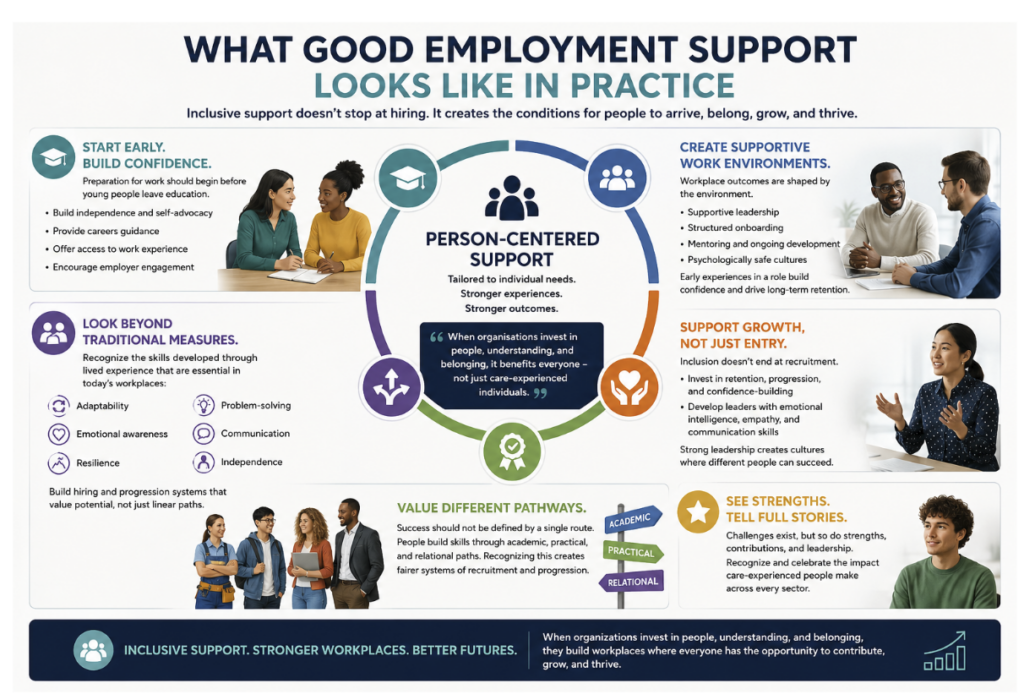
She highlights the importance of strong leadership, effective onboarding, mentorship, and psychologically safe workplaces where individuals feel able to ask questions and learn without judgement, all of which shape whether young people can access employment and progress within it.
However, exclusion is also embedded in organizational systems, with everyday practices such as next-of-kin forms or assumptions about housing stability and family support reinforcing disadvantage in subtle ways. Despite this, Dixon emphasizes that care experienced individuals often develop strengths such as “adaptability, emotional awareness, resilience, and problem-solving,” although these are frequently overlooked within traditional recruitment and assessment processes.
Alternative Pathways and Inclusive Employment Support
Traditional routes into employment often reinforce a narrow definition of employability by prioritizing higher education, formal work experience, and access to professional networks. Dixon challenges this focus on “perfect” CVs and linear career paths, arguing that it overlooks transferable skills and lived experience.
Alternative routes such as apprenticeships, vocational training, mentoring, skills-based hiring, entrepreneurship initiatives, and community-led programs can help broaden access to employment. These pathways shift the focus from credentials to capability, while also providing structure, paid experience, confidence-building and practical support for those entering work.
In a context of rising living costs, job insecurity, and sector change, Dixon argues that non-linear career paths should not be seen as a risk, but instead valued for the wider talent they bring, including diverse perspectives and approaches to problem-solving.
These alternative pathways include:
- Apprenticeships – paid, structured training that combines work experience with learning and leads directly to qualifications and employment.
- Vocational training – education focused on practical, job-specific skills for particular industries or roles.
- Mentoring – guidance and support from more experienced professionals to help build confidence, skills, and career understanding.
- Skills-based hiring – recruitment based on abilities and competencies rather than formal qualifications or traditional CV criteria.
- Entrepreneurship initiatives – support for young people to develop and run their own business ideas or self-employment pathways.
- Community-led programs – local initiatives that provide training, work experience, and support tailored to specific community needs.
However, access alone is not enough. Dixon emphasizes that inclusive employment must also focus on what happens once individuals enter work. Supportive leadership and psychologically safe environments are key to whether people stay in employment and progress. This requires leadership that is emotionally intelligent, communicative, and accountable in shaping inclusive workplace cultures.
“When organizations invest in people, understanding, and belonging, it benefits everyone — not just care-experienced individuals,” Dixon said.
Collectively, these factors show that employment outcomes are shaped less by individual capability and more by how systems recognize and value different forms of experience. This highlights the need for fairer recruitment and progression practices that support not only entry into work but also long-term development and advancement.
 Rethinking Opportunity and Equal Access in the Labor Market
Dixon explains that high living costs, intense job competition, and financial instability make it harder for many young people to enter the workforce and maintain secure employment. In response to these challenges, she argues that recruitment processes should recognize the valuable strengths developed through adversity, such as resilience, adaptability, and independence, particularly among vulnerable groups, including care experienced young people. This gap in recognition suggests that alternative pathways into employment, such as apprenticeships, should be recognized as equally credible routes, not second-tier options.
The experiences of care experienced young people highlight the urgent need to rethink how talent is recognized and valued in the labor market. This requires addressing unequal starting points at entry by changing how talent is identified, supported, and given the opportunity to develop.
In doing so, access to employment can be expanded in ways that benefit individuals, organizations, and broader social mobility.
Ultimately, inclusive employment is not about lowering expectations or standards, but about removing structural barriers and providing appropriate support so that more young people are able to enter, stay in, and progress in work.