
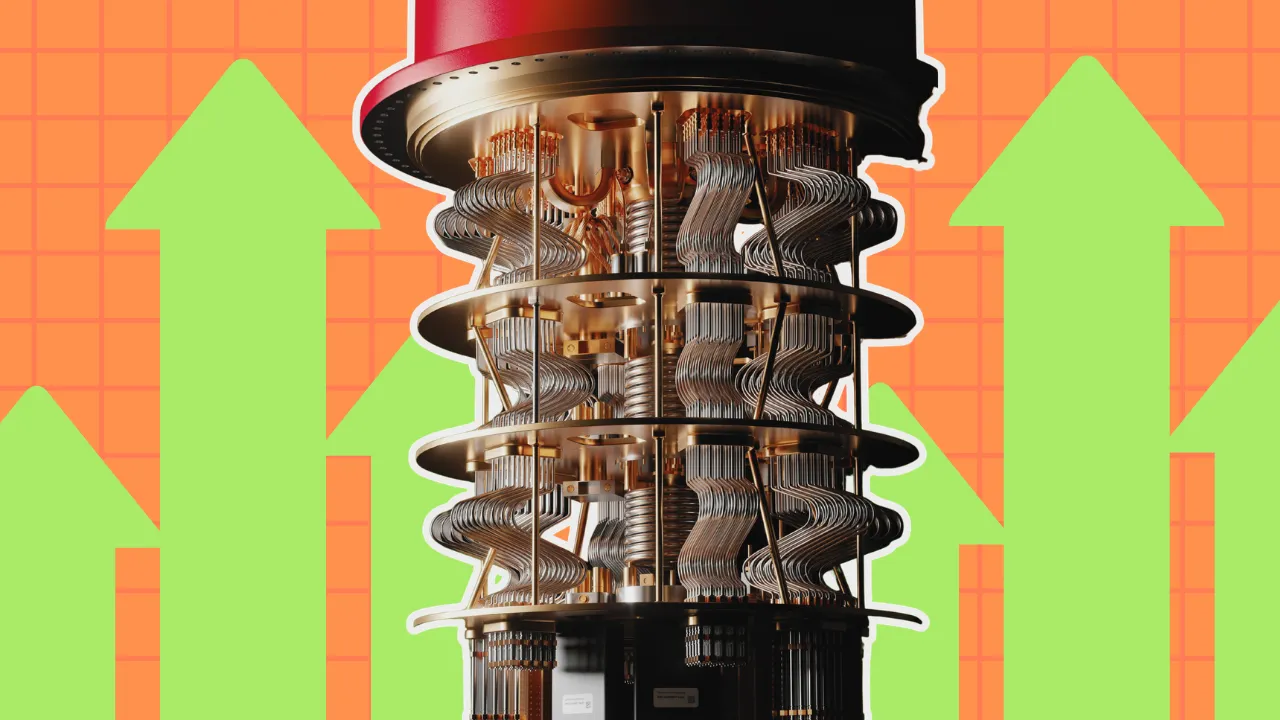
Quantum computing is entering a new phase. The field is moving from laboratory demonstrations into physical infrastructure that can support sustained quantum operations. Computation now depends as much on the environment around the machine as on the processor itself.
Quantum computing basic explanation
To understand why, here’s a short 101 on quantum computers. Three ideas explain why the building matters:

- Superposition describes a qubit that behaves like a 0 and a 1 at the same time until it is measured. A modest number of qubits can therefore represent many possible configurations in parallel.
- Entanglement links qubits so that outcomes measured on one relate directly to outcomes measured on another. This correlation structure gives certain quantum algorithms their advantage.
- Coherence is the length of time these fragile states survive before the environment scrambles them. Heat, vibration and stray electromagnetic fields reduce coherence and push qubits back toward classical behavior.
Quantum computers exist to create, manipulate and read out superposition and entanglement before coherence runs out. The facility exists to stretch that clock.
When the building becomes part of the computer
A quantum processor depends on its surroundings. Many leading systems operate within a fraction of a degree of absolute zero, with some reaching temperatures near 0.01 kelvin. That is colder than deep space.

To achieve and maintain these conditions, the chip sits inside a multi-stage cryogenic system, surrounded by layers of shielding and connected to racks of control electronics that send precisely timed microwave pulses and readout signals. Early large-scale setups from companies such as IBM and Google already resemble compact industrial plants: tall cryogenic assemblies, nested shielding and dense control racks wrapped around a single processor.
At this point, the facility stops being a neutral container. It functions as an extension of the chip. The building is engineered around the physics of the machine so quantum states can survive long enough to perform useful work. Floor vibration, power quality, stray radio noise and the way mechanical equipment is mounted all appear directly in qubit performance.
These constraints are now visible in where investment flows. JLL’s The future of quantum real estate research shows that regions with strong energy infrastructure, research universities and specialist manufacturing are becoming early quantum hubs. Chicago, Washington, D.C., and research corridors across Europe and Asia are turning quantum projects into durable physical assets: laboratories, campuses and repurposed industrial spaces designed to keep a small number of processors cold, stable and connected.
Miniaturization and new facility types
Computing has always evolved alongside physical footprint. In the early days, vacuum tube-based systems like the ENIAC (the first general purpose computer built in 1945) filled an entire room. Today we carry more capable computing systems in our pockets.
Quantum computing is beginning to find its own forms. Some platforms are shrinking as photonic and neutral atom approaches reduce reliance on heavy cryogenics. These machines may eventually run inside research labs, industrial test facilities or autonomous systems, close to where data is created.
Larger systems move in the opposite direction. Fault tolerant machines with thousands or millions of logical qubits will need dedicated campuses that support continuous cloud access, industrial workloads and collaborative research. The likely outcome is a spectrum: specialized local machines at the edge and large centralized environments that act as shared quantum utilities.
Where breakthroughs may land first
Quantum computing matters to the future of work because many difficult problems originate in quantum behavior. Interactions between atoms and molecules sit behind drug discovery, climate technologies, materials, energy systems and parts of finance.
1. Drug discovery at molecular scale
Developing new medicines requires an understanding of how complex molecules interact in the body. Quantum processors could simulate molecular structures and biological processes with higher fidelity than classical methods. Researchers could explore candidate drugs in computation before committing to long laboratory programs. Pharmaceutical and biotechnology teams already run pilot studies on protein ligand binding and molecular screening using today’s devices.
2. Climate technologies and carbon capture
Climate solutions often depend on catalytic reactions. Performance hinges on how efficiently a material binds, transforms or releases molecules such as carbon dioxide. Quantum simulation may accelerate the search for catalysts that capture carbon or convert it into useful products with lower energy requirements. Work on reactions that underpin ammonia production and carbon capture is becoming an early test case, because small efficiency gains at this level can propagate through global energy use.
3. Materials, energy systems and fusion
Many future technologies require materials that are hard to design with existing methods. Quantum computing could help identify improved battery chemistries, superconductors and structural materials by modeling atomic interactions at higher resolution. The same tools may advance solar and fusion research. In fusion, quantum and hybrid quantum AI approaches are starting to model the chemistry and materials around reactors, including molten salts that can breed tritium fuel and complex plasma behavior inside confinement devices.
4. Quantum and AI
Modern AI systems search enormous spaces of possible models and decisions. Quantum computing introduces new ways to sample and optimize over those spaces. Current efforts focus on hybrid approaches. Classical accelerators handle production models, while small quantum devices act as test benches for new optimization and sampling techniques that may change how models are trained or architectures explored.
5. Financial systems and quantum security
Financial markets already treat quantum as both tool and threat. On the trading side, early experiments show that hybrid quantum classical algorithms can improve predictions about whether a trade will execute at a given price using real bond market data. On the security side, banks and regulators are working toward quantum safe cryptography so that around 2030 new systems do not rely on algorithms that future quantum machines could break.

What this means for real estate and infrastructure
Quantum computing signals a different relationship between information and the built environment. Facilities for these machines are not generic shells. They behave as instruments tuned to keep matter in an unfamiliar state for as long as we need to think with it.
Many of humanity’s largest challenges involve shaping interactions between atoms, in energy storage, medicine, climate technologies, manufacturing and finance. Quantum infrastructure offers a path to examine and control those interactions with far greater precision.
The next era of computation will sit at the intersection of physics, engineering and architecture. Buildings that host quantum processors will not simply store technology. They will participate in it.
If that trajectory continues, decisions made at the scale of qubits, the smallest building blocks we can reliably manipulate, will influence how markets are traded, how fusion plants and grids are managed and how cities grow around the machines that help us understand them.
We are used to thinking of cities as the places where we deploy technology. Quantum turns that inside out. The machines we build for it will reach so far into energy, finance and materials that, over time, the city itself starts to look like an extension of the computer. The smallest particles we can engineer will begin to write the street grid.