

AI use among U.S. businesses rose from 17.7% in January to 21.7% in July 2026, but the latest data shows adoption is far from uniform. Larger companies and office-heavy industries are adopting AI much faster than smaller businesses, while some major cities have actually seen usage decline.
Businesses are becoming less confident about how quickly adoption will grow. In January, businesses expected AI use to increase by 4.7 percentage points over the following six months. By July, that expected increase had fallen to 2.8 points.

Bigger Companies Are Far More Likely To Use AI
Company size remains one of the clearest divides. Just 20.8% of businesses with one to four employees reported using AI in July, compared with 38.8% of companies with 250 or more employees, according to a new report from WeWork.
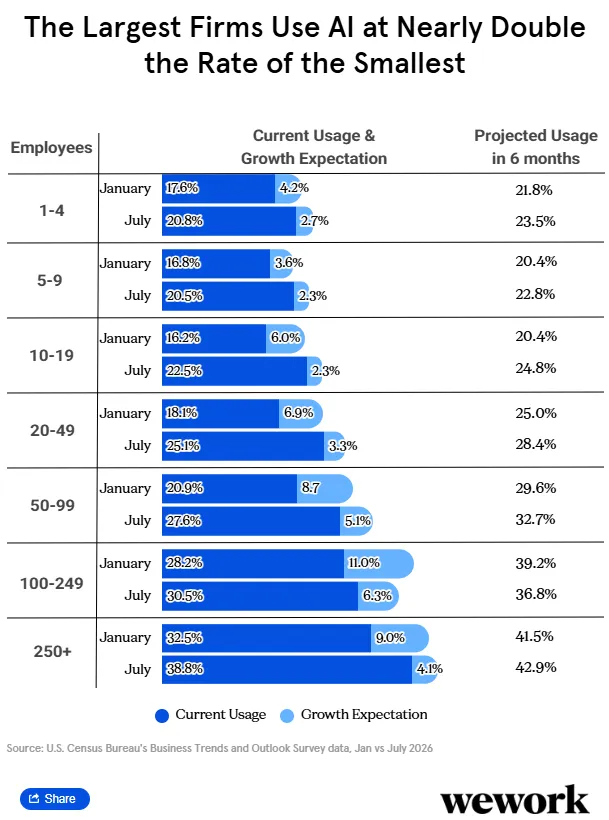
The difference is even more pronounced in certain industries. Among companies in the Information sector with at least 250 employees, 77% reported using AI, the highest adoption rate in the data.

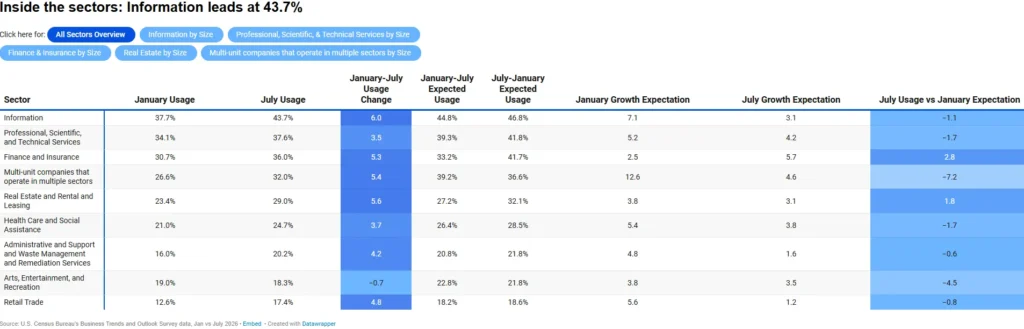
Information led office-based industries overall at 43.7%, followed by Professional, Scientific & Technical Services at 37.6% and Finance & Insurance at 36%. Real Estate stood at 29%, while Health Care reached 24.7%.
Some Cities Are Moving Fast While Others Cool Off
AI adoption is also varying considerably by location. Fifteen of the 25 largest U.S. metropolitan areas recorded usage above the national 21.7% rate in July.
Tampa posted the largest increase, with adoption climbing 14.9 percentage points to 32%. Detroit followed, rising 11.4 points to 24.5%.
Phoenix went in the opposite direction. After recording the highest adoption rate among major metros in January at 30.1%, its rate fell 8.6 percentage points to 21.5% in July. Baltimore, Houston, Portland and San Diego also recorded declines.
New York and Los Angeles remained below the national average, at 17.9% and 19.7%, respectively.
AI Is Mostly Being Used To Help Employees
For businesses already using generative AI, writing and editing is by far the most common application. About 85.4% said employees use it for documents, emails and other communications.
Information searches followed at 49.9%, while 44.6% said employees use AI to summarize or analyze documents.
Sales and marketing was the business function with the highest current AI use, at 14.3%, followed by strategy and business development at 12.4% and research and development at 11.2%.
The employment data also points more toward AI assisting workers than replacing them. Among AI-using businesses, 95.7% reported no change to total employment. Just 2% reported a decrease, while 2.3% reported an increase.
AI supplemented or enhanced an employee task at 43.7% of firms, while 10.1% said it performed a task previously done by a worker.
Most Businesses Still Don’t See A Reason To Adopt It
For businesses that don’t plan to use AI over the next six months, the biggest barrier is surprisingly straightforward: They don’t believe it applies to their business.
About 61.6% of these businesses cited lack of applicability as the reason they aren’t planning to adopt AI. Another 22% pointed to limited understanding of what AI can do, while 20.7% cited privacy and security concerns.

Smaller businesses were particularly likely to say AI wasn’t applicable, with 63.3% of companies with one to four employees giving that response.
The numbers suggest that AI adoption is growing, but the rollout is happening unevenly. Large companies, information-heavy industries and certain major cities are pulling ahead, while other businesses remain unconvinced that the technology has a place in their operations.