



Coworking is often associated with globally connected cities, startup hubs and digital nomads. It is easy to assume the model stops at countries where internet access, international business or private enterprise are heavily restricted.
That assumption does not hold up everywhere.

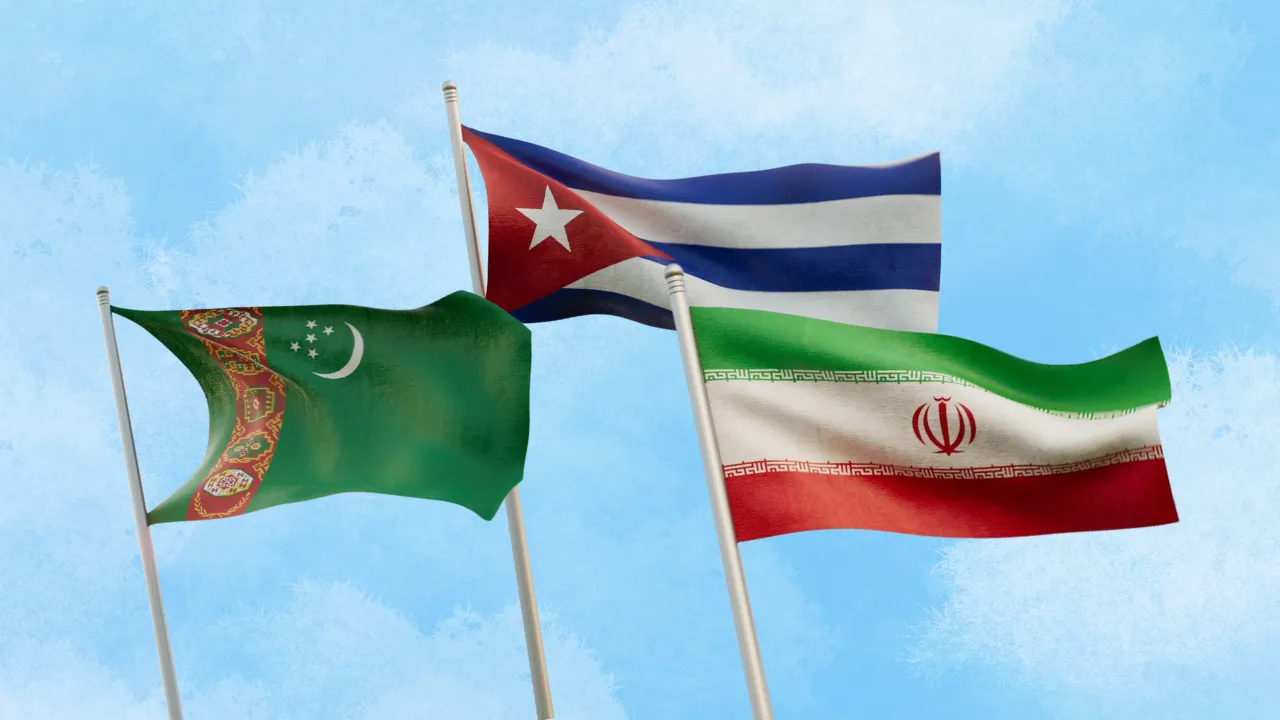
Coworking spaces operate in Belarus, Iran, Saudi Arabia, Cuba, Turkmenistan and more. That raises a more interesting question: how far can a business model built around openness and connectivity travel when the countries it enters do not always offer much of either?
Coworking seems to transcend requiring a particular political system — it requires a combination of demand, commercial real estate, connectivity and enough freedom for people and businesses to use shared space.

Russia: A Major Coworking Market Despite Geopolitical Isolation
Russia is perhaps the clearest example of why geopolitical isolation does not automatically eliminate coworking.
Moscow had 457,000 square meters of flexible workspace across 175 locations as of August 2026, according to Commonwealth Partnership. Network operators accounted for 88% of the market.
The market has cooled from its earlier growth, but it remains substantial. Russia has domestic operators and continues to support flexible offices for companies, entrepreneurs and other professionals. The model has also adapted to Russia’s changed international business environment, with domestic operators taking a larger role as some Western companies have left the market.
Belarus: Coworking Exists, Even Under Heavy State Control
Belarus also has a functioning coworking market, and Minsk has quite a few coworking spaces.
The existence of these spaces does not mean Belarus has the same entrepreneurial or internet environment as Western coworking markets, but it does show something more basic: shared workspace can operate within a tightly controlled political system as long as there is enough private and professional economic activity to support it.
Iran: Coworking Has Become Part Of Tehran’s Business Infrastructure
Iran may be another unexpected example.
Tehran has dedicated coworking and serviced-office providers. CO-HQ, for example, currently offers hot desks, dedicated desks, private offices and virtual offices in the city, including a coworking location at Kian Tower.
Iran’s internet restrictions and international sanctions create obvious limitations for businesses that depend on global connectivity. Yet those restrictions have not prevented shared offices from developing for domestic companies, entrepreneurs and professionals.
A coworking space can provide a physical workplace and local business community even when its members face limitations connecting to the international economy.
China: Coworking Thrives Inside A Highly Controlled Internet Environment
China is an even larger example: Beijing has dozens of coworking locations, including facilities operated by international companies such as Servcorp and IWG. The country has over 2,200 coworking locations across 200 cities.
China demonstrates that coworking does not depend on unrestricted access to the global internet. Spaces can serve businesses operating within the country’s own regulatory and digital environment, while international companies can provide flexible offices subject to local rules.
Saudi Arabia: Coworking Is Part Of A Major Business Push
Saudi Arabia is another country where the political system might lead outsiders to expect a very different workplace market. Instead, coworking is expanding as part of the country’s push to develop its private sector and attract businesses.
Saudi Arabia’s government operates Startup Hubs through Monsha’at that provide entrepreneurs and small-business owners with coworking space, business support, incubators and mentoring.
Private operators are expanding as well. Cloud Spaces currently operates coworking locations in Riyadh, while Servcorp lists multiple coworking facilities across the city.
Here, coworking fits into a government-backed effort to build an entrepreneurial and business ecosystem rather than operating as a counterculture to the country’s political system.
Turkmenistan: Yes, There Is Coworking In Ashgabat
Turkmenistan may be one of the most surprising examples. Bilelik Hub in Ashgabat describes itself as a coworking and creative center offering open workspace, meeting rooms, focus rooms, event space, high-speed Wi-Fi and flexible rates. The center also promotes community membership, networking and events.
That makes Turkmenistan particularly interesting because the country is known for its extremely restricted political and information environment, yet a commercial coworking concept can still exist within that system.
Cuba: A Small Coworking Scene With A Big Connectivity Problem
Cuba has coworking spaces, although the market is much smaller and more difficult to operate than those in Moscow or Beijing. There are spaces such as Amarillo Coworking in Havana’s Vedado district and a coworking facility at Parque Científico de La Habana.
The bigger challenge is infrastructure; internet access in Havana is considerably more limited than in established coworking markets, and electricity shortages can also disrupt work. That means a coworking space’s value can be tied as much to reliable connectivity and backup power as to desks, meeting rooms or community.
In Cuba, the basic coworking proposition exists, but the infrastructure supporting remote work is much harder to guarantee.

North Korea: The Closest Thing To A No
North Korea is where the conventional coworking model appears to run into a fundamentally different set of constraints.
There are offices available to businesses in Pyongyang. NK News previously reported on office space marketed to international businesses with communications and power infrastructure. But that is very different from an open coworking market where freelancers, startups and independent professionals can buy memberships and work alongside one another.
North Korea’s internet environment is another major barrier. Most people do not have unrestricted access to the global internet and instead use a tightly controlled domestic intranet. Global internet access is limited to certain institutions and organizations, with access subject to monitoring and controls.
International sanctions add another obstacle. The United Nations has imposed extensive restrictions on economic activity involving North Korea, while the United States maintains a separate sanctions regime. Those rules make the ordinary international coworking expansion model difficult to replicate.
Could Coworking Ever Work In North Korea?
A North Korean coworking model, if permitted to develop, would probably begin with a much narrower purpose than the typical global coworking brand.
It could theoretically serve approved domestic businesses, entrepreneurs or organizations in a controlled facility, with access to North Korea’s domestic network. Another possibility would be office facilities for foreign organizations operating under approved arrangements. But simply importing the standard coworking formula would not solve the underlying restrictions. A space offering desks, coffee and meeting rooms would still need to operate within rules governing internet access, business ownership, foreign activity, communications and financial transactions.
The physical office is the easy part. The difficult part is creating the open flow of people, information and businesses that gives coworking its value.
Why Coworking Can Exist In Some Unexpected Places
The examples point to several conditions that matter more than political labels alone; a coworking market needs people who have a reason to work outside a traditional employer-owned office, businesses willing to pay for flexible space, buildings that can be converted into shared offices and enough connectivity to make the space useful.
The level of openness can change what that coworking market looks like.
In Moscow, the market can support tens of thousands of workstations. In Ashgabat, a smaller facility can operate with community memberships and hourly bookings. In Havana, coworking is constrained by unreliable infrastructure. In North Korea, the restrictions on internet access, private enterprise and international business make a conventional coworking ecosystem much harder to establish.
That means coworking can cross geopolitical borders, but it does not necessarily arrive in the same form.
Coworking Is More Geopolitically Flexible Than It Looks
The surprising part is how often the same basic idea shows up in places where you might not expect to find it.
A coworking space does not need a Silicon Valley-style startup scene to have a purpose. It can give a small business somewhere to meet clients, give a freelancer reliable internet, give an entrepreneur an office without a long lease or simply give people a place to work around other people.
The markets in countries with restrictive political environments may be small, the business model may be different, and the services may be limited, but the underlying demand is recognizable.
For an industry built around people sharing space, coworking has turned out to be remarkably good at finding its way into unexpected places.