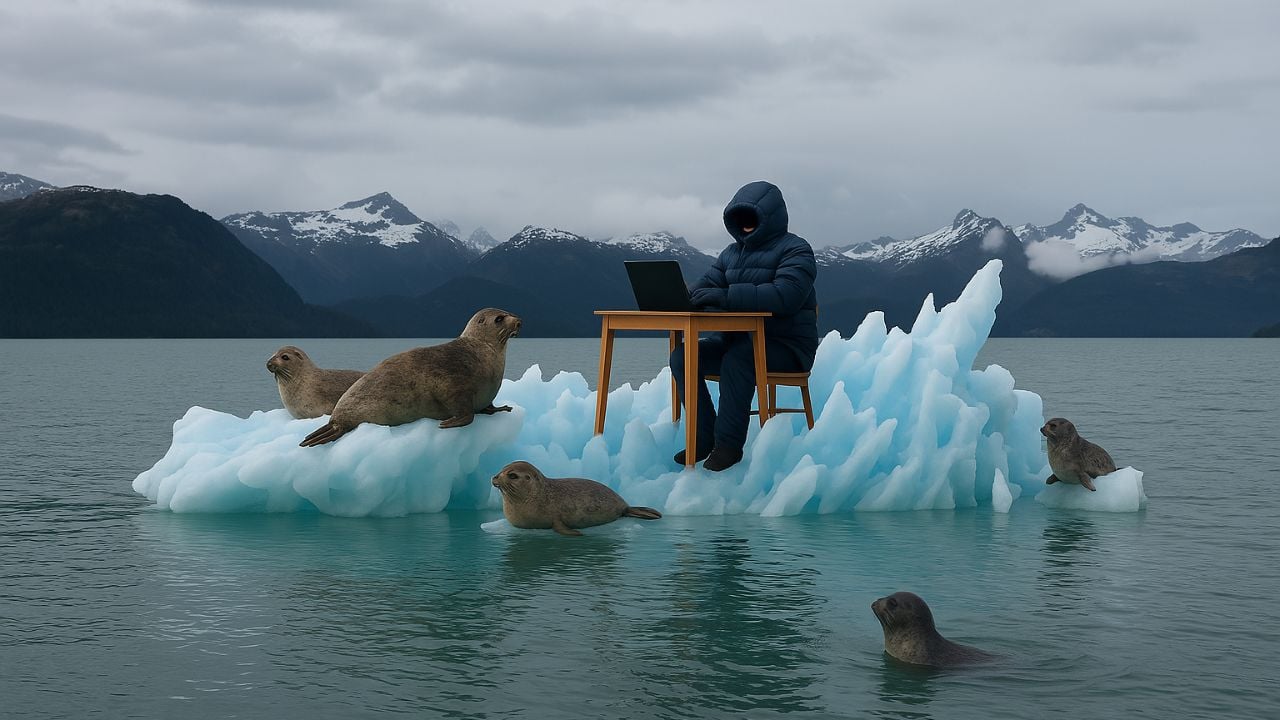
- Climate change could create one billion refugees, raising concerns about job availability.
- Extreme weather may render workspaces uninhabitable, shifting focus from office jobs.
- Survival and resource management might become key job sectors in a climate-impacted future.
What if we stopped limiting our views of what the Future of Work can be? In our What if…? Series, Allwork.Space is letting imagination run wild to explore what the world of work might evolve into, if we don’t limit ourselves with the trappings of the past. In these articles we explore how we might move into the future of work, and the impact those imaginings could have on those who want to thrive in it.
Have a wild idea that you are curious about? Shoot a note to [email protected] with the subject line “What if…?” and we’ll dive in.

Climate change is one of those issues that doesn’t always make it into the typical workday conversation. But when we zoom out and look at the bigger picture, it becomes clear that the future of work is deeply intertwined with the changing climate.
What if climate change gets so bad that we can’t work anymore? Not in the way we imagine it today, but in a much more fundamental sense. It’s a huge question — and one that we can’t afford to ignore anymore.

A Growing Crisis of Climate Refugees
You may have heard about the rising number of climate refugees. Already, people from South America, particularly in places like Venezuela and Honduras, are seeking refuge in the U.S., fleeing natural disasters, agricultural collapse, and rising sea levels that make their homes uninhabitable.
By 2050, it’s projected that there could be as many as 1 billion climate refugees globally, according to Zurich. And while the reasons for relocation are generally humanitarian, it’s also a pressing economic issue.
If climate change forces so many people to relocate, the question then is where exactly will they all go, and what happens to the workforce?
Many of these refugees will be seeking more than just shelter—they’ll be looking for opportunities to rebuild their lives. Will there be jobs for all of them, in any part of the world, when so many countries already face labor market challenges? In a future that’s increasingly unpredictable, it’s a hard quandary to address.

Can We Keep Working as Usual?
There may be a scenario in the future where climate change becomes so severe that even our work environments are no longer viable. What happens when entire regions of the world become too dangerous to live or work in?
Places that are now hubs for work, like Silicon Valley, New York, and parts of Europe could face extreme weather events, flooding, or even droughts that would make daily work life almost impossible.
Even now, big weather events like blizzards and hurricanes have companies scrambling to operate as normal.
Right now, the concept of “remote work” has been a saving grace for many, especially since the pandemic. But even that flexibility may not be enough to sustain business as usual if parts of the world are uninhabitable.
The traditional office or desk job may not hold the same value in a world where survival becomes the primary goal.
The Shift from Work to Survival
At what point does working a desk job become nonessential? We’re already starting to see signs that work can be a bit of a luxury, especially in times of natural disasters.
The power can go out, internet connections fail, and businesses halt. What happens if, one day, those kinds of disruptions become permanent? In a climate-ravaged world, the need for people to “work” could shift from the luxury of a 9-to-5 office job to essential roles in sustaining basic needs like food, water, and shelter.
In such an apocalyptic reality, a tech startup in Silicon Valley might suddenly seem trivial compared to people scrambling for resources in a flooded city or trying to secure safe land to live on. Basic survival skills, resource management, and infrastructure development may become the key to future job preparedness, and maybe even the new form of work that emerges in a climate-challenged world.
Reimagining Work in a Changing World
So, what does this mean for the future of work? One thing’s for sure: It won’t be business as usual.
Climate change is forcing us to think long-term, not just about the environment, but about our jobs, our economies, and the systems we depend on. Remote work, which we once thought of as a great perk, could be the baseline if more people are displaced by floods, fires, and other natural disasters.
Some people will be forced to seek work in entirely new industries, especially those focused on environmental recovery or climate resilience.
We’ll also need to be more flexible in how we think about work generally. In a world where resources are increasingly scarce, maybe the traditional idea of a “job” will evolve into something that better serves the planet and its people. For instance, jobs in sustainable farming, renewable energy, and disaster relief could be in higher demand.
Could the future of work look like a hybrid of the workforce and survivalist skills?
It’s an unsettling thought, but one that seems more possible with each passing year, unless something is collectively done by humanity to mitigate the impact of climate change (perhaps moving away from fossil fuels, which account for 75% of global greenhouse gas emissions and nearly 90% of all carbon dioxide emissions).
The Time to Act is Now
While it’s easy to push these thoughts aside in our day-to-day grind, the reality is that we’re already facing the early stages of this future. Climate change is happening now, and its effects are already visible in the form of floods, heatwaves, droughts, and more.
2024 was the first year to be more than 1.5°C hotter than it was before industrialization. This means the Earth’s average temperature has risen by over 1.5°C since the start of industrial activities in the 18th century, which is a key threshold for climate change impacts.
And as much as we’d like to believe that remote work or technology will save us all, the truth is, we may not be able to rely on the systems we have today forever.
It’s time to start thinking beyond the typical “office job” and understand that the future of work is going to look very different than we ever imagined. We need to prepare for a changing world — one where resilience, sustainability, and adaptability are the keys to surviving and even thriving.
In a world grappling with severe climate challenges, adapting to these changes could become the biggest job of all.