



Advertisements
Ergonofis
  • Marketplace
  • Resources
  • Business Directory
  • Events
  • Advertise
  • Publish a Press Release
  • Submit Your Story | Get Featured
  • Get the Newsletter
  • Contact
  • About Us
The FUTURE OF WORK® since 2003
Allwork.Space
No Result
View All Result
Subscribe
  • Submit Your StoryNew
  • More
    • Columnists
      • Dr. Gleb Tsipursky – The Office Whisperer
      • Nirit Cohen – WorkFutures
      • Angela Howard – Culture Expert
      • Drew Jones – Design & Innovation
      • Jonathan Price – CRE & Flex Expert
    • Get the Newsletter
    • Events
    • Advertise With Us
    • Publish a Press Release
    • Brand PulseNew
    • Partner Portal
  • Latest News
  • Business
  • Leadership
  • Work-life
  • Career Growth
  • Tech
  • Design
  • Workforce
  • Coworking
  • CRE
  • Podcast
  • Submit Your StoryNew
  • More
    • Columnists
      • Dr. Gleb Tsipursky – The Office Whisperer
      • Nirit Cohen – WorkFutures
      • Angela Howard – Culture Expert
      • Drew Jones – Design & Innovation
      • Jonathan Price – CRE & Flex Expert
    • Get the Newsletter
    • Events
    • Advertise With Us
    • Publish a Press Release
    • Brand PulseNew
    • Partner Portal
  • Latest News
  • Business
  • Leadership
  • Work-life
  • Career Growth
  • Tech
  • Design
  • Workforce
  • Coworking
  • CRE
  • Podcast
No Result
View All Result
Subscribe
Allwork.Space
No Result
View All Result
Advertisements
Nexudus - Is Your Space Performing?
Home Workforce

Shift Work Reimagined: How Micro-Shifts And Poly-Employment Are Reshaping Hourly Jobs

Frontline workers and those in hourly or part-time jobs are no longer just clocking in. They’re calling the shots on when, where, and how they work.

Nirit CohenbyNirit Cohen
June 2, 2025
in Workforce
Reading Time: 4 mins read
A A
Shift Work Reimagined How Micro-Shifts And Poly-Employment Are Reshaping Hourly Jobs

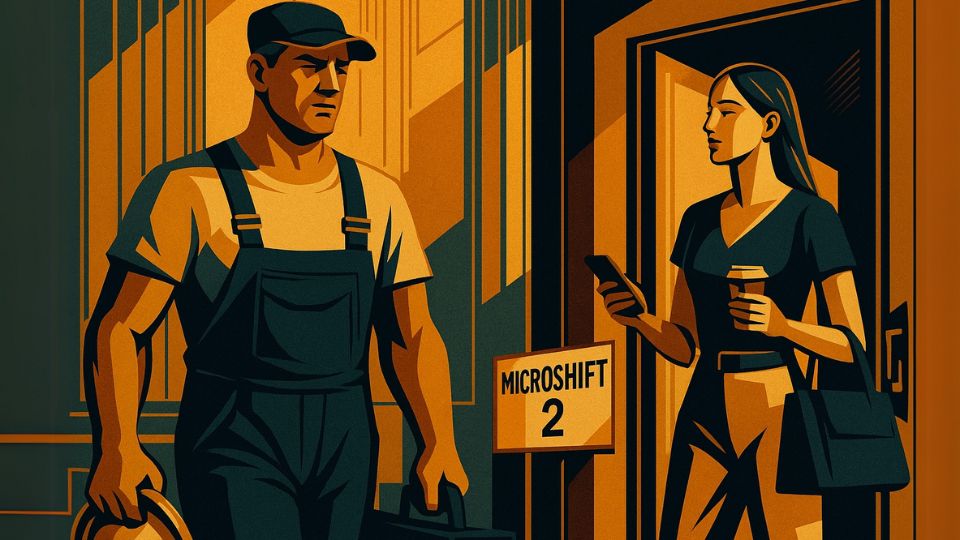
Workers are stitching together incomes by blending micro-shifts across multiple employers — reshaping what it means to have a job.

  • We’re witnessing a third phase in the evolution of labor that’s not only a shift in working hours, but a shift in power. 
  • Micro-shifts are compact work periods ranging from four to six hours, which are taking hold in many frontline settings.
  • To thrive in this new reality, employers must embrace modular employment models that prioritize participation over permanence.

The nature of work is changing — again. What used to be a traditional job has morphed into a shift, a task, or a freelance gig. Increasingly, people are contributing to businesses without becoming permanent parts of them.

The classic employer-employee relationship is fading, replaced by a model that’s decentralized, agile, and worker-centric.

Advertisements
Nexudus - Is Your Space Performing?

Back in 2014, The Economist’s influential article “Workers on Tap” forecasted this evolution. It highlighted how platforms like Uber, Handy, and TaskRabbit disrupted conventional labor by turning everyday individuals into on-demand service providers. 

These platforms didn’t just introduce new kinds of work — they challenged the very concept of job ownership. Employment began to unbundle, breaking away from the traditional, full-time model.

Advertisements
Deel - Upgrade your global team management

This transformation started with short-term, often low-wage jobs — perfect for those needing side income or who lacked access to full-time roles. At the same time, another independent workforce began to flourish. Highly skilled professionals — engineers, creatives, consultants — chose to forgo the 9-to-5 in favor of autonomy and flexibility.

Initially, these two groups, those driven by necessity and those driven by choice, seemed worlds apart. But that divide is closing. Today, the key distinction isn’t whether you’re a contractor or employee, but whether you depend solely on one employer. Increasingly, the answer is no.

We’re witnessing a third phase in the evolution of labor. The first wave fragmented full-time roles into gigs. The second gave knowledge workers flexibility. Now, the shift economy — those in hourly and frontline jobs — is undergoing a similar transformation.

From Clocking In to Custom Schedules

Holding multiple jobs isn’t a new concept. It once went by the name “moonlighting.” Then came the digital gig economy of low-barrier, flexible jobs in delivery, ride-sharing, and more. For professionals, the trend showed up as portfolio careers — a designer/writer/strategist kind of model — built intentionally to reflect a wider professional identity.

Advertisements
Yardi Kube automates flex & coworking operations

Whether you’re skeptical or supportive, there’s no denying that these shifts give workers more say; not just in where they work, but when, how, and sometimes even what they do.

Now, shift and hourly workers are demanding similar autonomy.

“In fact, Gen Z are now the predominant generation that works these shift jobs. And this generation has a very different relationship to work,” says Silvija Martincevic, CEO of Deputy, in a recent episode of The Future of Less Work podcast.

She points out that while return-to-office dominates the headlines, most of the global workforce is still working physically — in retail, healthcare, and food service. They, too, want greater flexibility. This demand is manifesting in new formats like micro-shifts and poly-employment.

More stories for you

Ditch The Cult Of Productivity How Leaders Can Move Teams From Survival Mode To Quiet Thriving

Ditch The Cult Of Productivity: How Leaders Can Move Teams From Survival Mode To Quiet Thriving

44 minutes ago
GM Invests $242M Over Five Years to Train Skilled Trades Amid Labor Shortage

GM Invests $242M Over Five Years to Train Skilled Trades Amid Labor Shortage

11 hours ago
U.S. Jobless Claims Fall to 224,000, Signaling Labor Market Stability in December

U.S. Jobless Claims Fall to 224,000, Signaling Labor Market Stability in December

11 hours ago
Overcoming Change Fatigue Why Leaders Struggle And How To Succeed

Overcoming Change Fatigue: Why Leaders Struggle And How To Succeed

1 day ago

Micro-shifts are compact work periods ranging from four to six hours, which are taking hold in many frontline settings.

“That Gen Z mom starts working and maybe works nine to 12 and then takes care of her kids, picks up her kids or does other things that she needs. And then she works another shift in the afternoon, three to six, for example.” says Martincevic.

This kind of flexibility isn’t about working less, it’s about aligning work with life. Once workers can segment their day this way, many begin picking up shifts from different employers.

The Era of Poly-Employment

Poly-employment marks a deeper shift in labor dynamics. Workers are no longer tied to a single paycheck. They’re stitching together incomes by blending multiple micro-shifts across several employers.

Advertisements
Get more revenue. Do less work - Alliance Virtual Offices

Deputy’s 2025 Big Shift report reveals that 5.4% of hourly employees are working more than one job at the same time, with young women in hospitality leading the trend. These workers aren’t picking between traditional employment and gig life—they’re carving out an in-between path.

Martincevic explains: “We saw this massive increase in poly-employment where you’re doing small shifts, but also you’re doing it across multiple employers. So they use it to stitch together your own flexibility.”

This points to a broader truth: employment is shifting from ownership to access. Companies no longer possess exclusive rights to talent—they share it and compete for it. Workers, in turn, decide how and where they contribute, balancing roles to suit their goals. 

To thrive in this new reality, employers must embrace modular employment models that prioritize participation over permanence.

Advertisements
UltraSoftBIS Work Smarter, Not Harder

Work, Redefined

For a long time, flexibility was synonymous with remote work for desk jobs. That’s no longer the case. The most groundbreaking labor innovations are now unfolding in frontline industries like restaurants, retail, hospitals, where remote work isn’t an option.

Flexibility today isn’t a benefit; it’s a baseline. It means the ability to shape work around life, set hours, and often, create a patchwork of income streams.

A Pew Research study found that just 43% of blue-collar workers are satisfied with their jobs, compared to 53% across other sectors. Many young people and women view work as a necessity rather than a passion. For them, poly-employment and schedule autonomy offer something more: control.

That’s the real revolution — not just a shift in working hours, but a shift in power. Increasingly, it’s workers, not employers, who are shaping the future of work.


Advertisements
UltraSoftBIS Work Smarter, Not Harder
Advertisements
Your Brand Deserves The Spotlight - Advertise With Us - Allwork.Space
Tags: WorkforceWorklife balance
Share27Tweet17Share5
Nirit Cohen

Nirit Cohen

Nirit Cohen is a leading HR strategist and thought leader on the Future of Work. With 30 years of global experience at Intel in senior leadership roles across HR and M&A, she bridges emerging trends with practical solutions to help organizations navigate the complexities of the evolving world of work. Nirit holds a master’s degree in Economics, specializing in Technology Policy and Innovation Management. For over a decade, she has written a widely read weekly column on the Future of Work, currently published on Forbes. She has also authored a book on career management in a changing world. Her expertise in workforce transformation, combined with leadership across multiple disciplines, makes her a sought-after speaker and consultant.

Other Stories Recommended For You

Ditch The Cult Of Productivity How Leaders Can Move Teams From Survival Mode To Quiet Thriving
Work-life

Ditch The Cult Of Productivity: How Leaders Can Move Teams From Survival Mode To Quiet Thriving

byFeatured Insights
44 minutes ago

The cult of productivity is burning workers out and pushing workplaces into permanent survival mode.

Read more
GM Invests $242M Over Five Years to Train Skilled Trades Amid Labor Shortage

GM Invests $242M Over Five Years to Train Skilled Trades Amid Labor Shortage

11 hours ago
U.S. Jobless Claims Fall to 224,000, Signaling Labor Market Stability in December

U.S. Jobless Claims Fall to 224,000, Signaling Labor Market Stability in December

11 hours ago
Overcoming Change Fatigue Why Leaders Struggle And How To Succeed

Overcoming Change Fatigue: Why Leaders Struggle And How To Succeed

1 day ago
Advertisements
Nexudus - Is Your Space Performing?
Advertisements
Ergonofis

Unlock your competitive edge in tomorrow's workplace.

Join a community of forward-thinking professionals who get exclusive access to the latest news, trends, and innovations that are shaping the future of work.

2025 Allwork.Space News Corporation. Exploring the Future Of Work® since 2003. All Rights Reserved

Advertise  Submit Your Story   Newsletters   Privacy Policy   Terms Of Use   About Us   Contact   Submit a Press Release   Brand Pulse   Podcast   Events   

No Result
View All Result
  • Home
  • Latest News
  • Topics
    • Business
    • Leadership
    • Work-life
    • Workforce
    • Career Growth
    • Design
    • Tech
    • Coworking
    • Marketing
    • CRE
  • Podcast
  • Events
  • About Us
  • Advertise | Media Kit
  • Submit Your Story
Subscribe

Welcome Back!

Login to your account below

Forgotten Password?

Retrieve your password

Please enter your username or email address to reset your password.

Log In
This website uses cookies. By continuing to use this website you are giving consent to cookies being used. Visit our Privacy and Cookie Policy.
-
00:00
00:00

Queue

Update Required Flash plugin
-
00:00
00:00