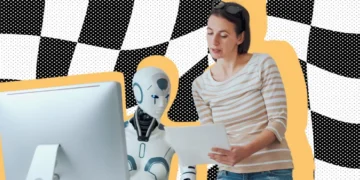





You log into Zoom for an interview, excited and expecting to see a human being. And instead you see… a bunch of wavy lines?
You barely got used to writing your resume to impress the AI gatekeepers. And now you’re being interviewed by one?

“Are you human?” you ask.
“No,” your interviewer responds.

“Now what?” you think. How do I WOW a bot?
While you’ve become accustomed to AI screening resumes and have learned a few tricks to help you make it through that initial screening, what do you need to do now to get through this added impersonal step?
You wonder whether it matters that you dressed professionally, or that you’re using your most upbeat voice. Who knows what criteria this faceless faux interviewer is using to rank you.
Should you feel miffed that the employer has off-loaded their applicant interviews to a virtual AI recruiter? Or do you roll with it because it may make your potential manager more engaged with candidates once the number of interviews has been significantly pared down?

AI Screening Interviews: What to Expect and How to Prepare
Here are some of the pros and cons to consider when encountering an AI screening interview:
Pro: It takes the bias out of interviews.
Humans are subject to unconscious bias that unfairly affects their perception of a job seeker. When someone doesn’t share a similar racial background, or socio-economic, cultural, educational, and so on, they may subconsciously eliminate them from consideration.
With an automated interviewer, you can be assured that such bias isn’t a factor — as long as the programmer didn’t embed bias into the algorithm.
Con: AI can’t assess soft skills.
Because AI is unable to evaluate a person’s emotional intelligence or interpersonal competencies, these important attributes aren’t considered. And as you know from your own life experiences, technical skills are only a minimal requirement in team dynamics.
You can only hope that, if you make the cut, you can portray your poise, positivity, and resilience during a person-to-person interview.
Pro: You showcase your ease with cutting-edge technology.
This type of interview could be a benefit if you’re actually someone who’s unaffected when interacting with bots. In fact, some people may be more at ease chatting with an AI interviewer than a real live person.
If you’re eager to show your comfort with technology and take pleasure in the banter with your automated interviewer, you may have a leg up among the competition.
Con: You’re unsure how to act with a faceless bot.
That same impersonal separation that could put some job seekers at ease, has another side to it: Automated AI interviews can feel dehumanizing. You don’t know how to interact with the voice behind the wavy lines.
Do you inject any humor into conversation, which has always been a strength in your conversational style, or will it be confusing or too off-topic for the bot? Is being deadpan a better strategy? How can you know?
Pro: Interview times are more flexible.
Interviewing using AI eliminates scheduling conflicts as it defers to a time that works best for you. Afterall, the AI-powered interviewer can work 24/7 without the need for a break.
Con: You don’t get to ask questions.
The AI interviewer takes the lead in asking basic career questions and will have you repeat what you’ve already provided in your resume. You’re basically at the mercy of this scripted interrogation. The bot is unable to tell you anything about the company or its culture, or when (and if) you’ll hear about a next round of interviews.
Pro: It lets the company quickly cull through a large volume of applications.
Now that job seekers can blast out a high number of applications with a click of the send button, hiring managers are inundated. Using this new automated assessment tool, they can be more efficient at assessing skills and save themselves — and you — time in the process.
Con: Technology can go awry.
As with all things technological, it’s not out of the question that your interview session will backfire. There have been accounts of bots repeating questions over and over and other annoying malfunctions — and then what do you do? You can only hope that there’s a human at helm somewhere within the process.
Tips to Ace an AI Job Interview
While you can’t charm a bot with a joke or your perfect handshake, there are ways to speak its language — and make sure it notices you. Here’s how you can navigate a faceless interviewer.
Stick to clear, concise answers.
AI systems scan for keywords and structured responses. Avoid long-winded stories; give answers that are easy for a bot to parse and rank.
Mirror the job description language.
AI is often programmed to look for specific skills, experience, and phrases. Sprinkle in terms directly from the posting to show you’re a match.
Highlight measurable achievements.
Numbers and results stand out. “Increased sales by 20%” or “managed a team of 10” signals capability more clearly than vague adjectives.
Maintain consistent energy and tone.
Even if the interviewer isn’t human, your enthusiasm and professionalism are still being scored. Smile, keep your voice upbeat, and speak clearly — it helps AI detect confidence.
Prepare for repetition.
Some AI interviewers may ask the same question in slightly different ways. Answer each instance fully, but stay consistent in what you say.
Be ready to transition to human interaction.
Think of the AI interview as the first gatekeeper. Once you pass, the human interviewer will want to see your interpersonal skills shine. Practice your storytelling and humor for later rounds.
Now that you know some of what you can expect to “face” with an automated interviewer during your job search, be ready for this step in the hiring process. And keep your fingers crossed that AI doesn’t replace humans when it comes to the final hiring decision.