



About This Episode
What does it mean to build a business that’s good for both people and the planet — especially when AI is part of the equation?
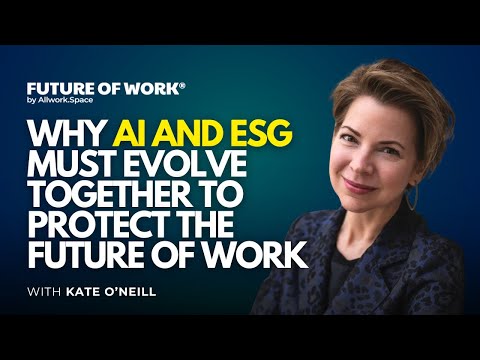
In this episode of The Future of Work® Podcast, Frank Cottle speaks with Kate O’Neill, CEO of KO Insights, a digital transformation strategist and author of What Matters Next. With decades of experience advising governments and Fortune 500 companies, Kate offers a compelling case for aligning AI adoption with ESG goals and the United Nations Sustainable Development Goals.

This conversation unpacks the risks of lip service ESG, the strategic role of meaningful data, and how companies can rethink success metrics to create value beyond profit — while staying competitive. If you’re curious about how innovation and ethics can co-exist, this one’s for you.
About Kate O’Neill
Kate O’Neill is a digital innovator, chief executive, business writer, and speaker. She is the founder and CEO of KO Insights, a strategic advisory firm which improves human experience at scale — especially in data-driven, algorithmically-optimized, AI-led interactions. Her clients and audiences include Adobe, the city of Amsterdam, the city of Austin, Cambridge, Coca-Cola, Colgate-Palmolive, Etsy, Getty Images, Google, Harvard, IBM, McDonald’s, Microsoft, the United Nations, Yale, and Zoom.

Kate has been named “Technology Entrepreneur of the Year,” a “Power Leader in Technology,” a “Woman of Influence,” and more, and was featured by Google in the launch of their global campaign for women in entrepreneurship. Her insights have been featured in The New York Times, The Wall Street Journal, and Wired.com, and she has appeared as an expert tech commentator on the BBC and NPR. She’s written four books on business strategy and technology: Tech Humanist, Pixels and Place, A Future So Bright, and her latest book, What Matters Next (Wiley 2025).
What You’ll Learn
- Why most companies are measuring the wrong ESG metrics — and what to focus on instead
- How the UN’s SDGs offer a better roadmap than traditional ESG models
- The difference between augmenting vs. replacing workers with AI — and why it matters
- How to lead ethically at speed in a world where tech change outpaces policy
Transcript
Kate O’Neill [00:00:00] I think most people’s perception though, is that the world is moving faster than they ever remember it moving before. And I don’t think they’re wrong. I think there are ways in which that’s demonstrably true, right? The technology pace of change is demonstrabely faster than it’s ever been.
Frank Cottle [00:00:17] Kate, welcome to the Future World podcast. Thank you. Your background, but your background, thank yous aside. Your background is so amazing. I should be the one thanking you. So we’re really grateful to have you on the program today.
Kate O’Neill [00:00:31] Well, thanks. You guys do such great work and you cover such a great range of topics, so it’s fun to get to apply that to the work I’ve been doing. So it’ll be fun to see where the intersections are.

Frank Cottle [00:00:42] It’s the future of work. Yeah. Everything, everything that has to do with the future work. Where are we going? Not where we’ve been, but where we’re going. That takes me right into something that I think you could probably deal with pretty well. Artificial intelligence is embedded into everything these days. How do we keep ESG, environmental, social, and governance still valid? And manage it in a way to actually improve outcomes. How do we not lose whatever progress we’ve made so far in that particular area?
Kate O’Neill [00:01:18] Yeah, I think ESG as a concept, right, is valid. It’s not the principles that are wrong. It’s that we’ve been measuring the wrong things. I think we get caught up in the environmental social governance. What are we talking about? How are we measuring it? And the fact that there is a rubric is wonderful, but I don’t think that it’s that really connect our environmental and social goals to measurable improvements in human experience and business out.
Frank Cottle [00:01:56] Well, you have to have one before you have the other. You have to define your goals, obviously your objectives, before you can put the metrics in place to determine if you’re going to accomplish them. So with ESG, have we actually put universal metrics together that people can understand so they know how they’re working towards those goals instead of it be this mythical thing that somebody in the corner office says we’ve got to do and we don’t really I understand it.
Kate O’Neill [00:02:26] Yeah, I think you hit the nail on the proverbial head there, Frank.
Frank Cottle [00:02:32] I am a carpenter.
Kate O’Neill [00:02:35] It’s the understandable part, right? It’s part where everybody kind of understands the same metrics and is using the same sort of rubric to gage what they’re doing and how they’re doing it, and that doesn’t necessarily align with sort of real, practical, lived experience for people in many cases. So I think that’s where we have the most opportunity, is really sort of backing this out and thinking. I personally am a fan of aligning AI with the United Nations Sustainable Development Goals. I think the SDGs give us far more, sort of, it’s 17 dimensions, 17 levels along which we wanna try to improve what we’re doing. There are measurable characteristics, benchmarks and so on. And it seems far more reasonable to me to assume that if we try to improve life on the planet for everyone along one of those dimensions, like reduce inequality or gender equality or, you know, better education or improve water and things like that, that we’re going to improve holistically the overall systems that we live with. So to me, that’s a better approach.
Frank Cottle [00:03:52] Um, I’m a data freak. It has said something that terrifies me 17 different metrics to measure objectively in order to determine whether we’re accomplishing our outcome desired outcome.
Kate O’Neill [00:04:10] Well, it’s 17 different goals, not 17 different metrics. There are actually a lot more than 17 metrics because each of those goals has a lot of metrics.
Frank Cottle [00:04:17] You just took me from fear to sheer terror.
Kate O’Neill [00:04:20] Yeah, I thought I might. Sorry about that. How are we?
Frank Cottle [00:04:25] It’s hard to get people to focus on three things. Yeah. How do we get people to focus 17 things with maybe two or three variables each and say, this is our objective and this is program? It seems too broad.
Kate O’Neill [00:04:43] Yeah, I can see what you’re saying. I think for most organizations, all 17 are not going to be relevant to their day-to-day operations. So most organizations are going to align with one of the 17 goals. So if you’re in educational technology, then probably quality education is going to be your goal. You’re one of SDGs that you align with. And then there are metrics and benchmarks within that quality education goal. That you’ll want to see how you can align. So the thing is that I think most businesses are doing something, if they’re doing a valid business model and they’re something that’s not destroying society, they’re actually doing something that could be furthering the SDGs, they just don’t necessarily…
Frank Cottle [00:05:28] We’re not moving backwards or we hope we hope so. I guess just from a gut point of view, how do you think it’s really working? Do you think people are truly embracing this or do you fear that people are giving it lip service and then looking at other business priorities differently and just not including this, not to achieve its own goal, but to not understand that it helps them achieve their overall goals?
Kate O’Neill [00:06:07] I think that people give lip service to anything. There’s a number, there’s a set of people who are going to give lip services to whatever they think is the right thing to do or to measure by. That doesn’t, that shouldn’t slow us down from identifying for the people who objectively would like, or who would like to have something to measure by that there are some things that are easier or better measures than others. And for now, It seems to me, so what I hear from executives when I do keynotes at conferences and such is many executives will come up to me after and say, you know, A, first of all, like you gave us the vocabulary we’ve been needing and you explained the frameworks in such a way that, you needing to be able to talk about this. But also, they’ll say Now what I need is a way to, a roadmap, a way to do this in a framework and an approach. And I don’t have that, that’s kind of holistic, that works within what we’re already doing as a business and that we can just kind of wiggle ourselves there, you know, kind of guide it incrementally toward where we need to go. And that is what to me, the SDGs are because you are already doing something, let’s say it’s a… You’re doing smart city work or infrastructure work or you’re a concrete contractor or something like that, infrastructure is one of the SDGs, like meaningful infrastructure. So you can be thinking about what is the one metric that you can impact with your business that is going to be that one additional dimension. You’re going to think about what your organization exists to do when you’re trying to do it scaled, you know, how you want to optimize, of course. Onto yourself, true to your own business. And you’re gonna think about your customers and you wanna align there and make sure you’re providing good customer service. And then as you think kind of holistically about that relationship and how to better optimize, better strategize around your business strategy and how you connect with customers, then you can think, you know, the one dimension of the SDGs that we think we could actually fulfill on Is this one where, you know, we’re helping to, uh… Offset carbon with certain percentage component of recycled materials or whatever it is. And so you just add that in to your dashboard and you start moving your business in that direction along with all the other strategic levers that you’re already.
Frank Cottle [00:08:34] OK, I’m going to ask a couple of hard questions here. Not to be argumentative, but just a couple hard questions. I’ve got some gray hair. I’ve been around sea level executives.
Speaker 3 [00:08:44] I do too, you just can’t see it.
Frank Cottle [00:08:46] Dope. Okay, but I’ve been around sea level executives since about 1979, 80. Okay. And before that, I just raced yachts and didn’t do anything. I was. They have quarterly reports. They have shareholdings, profit demands that impact their own personal lives as well. All of these on the surface, things that you’re suggesting have a cost, person has a cost et cetera. How does the C-level executive, in order to put these things in place in a permanence, what do you see working, I guess I’ll say is a better way to ask the question, what do see working that C-Level executives are doing and using on whatever chosen metric they choose? That’s really working to where they can identify a better shareholder return so they remain competitive in the capital market.
Kate O’Neill [00:09:54] I mean, it’s a fair question because not everyone is oriented to, you know, just do this to make the world a better place, right? That’s not how it’s.
Frank Cottle [00:10:02] I would say the C-level executive that wants to keep their job through a 36-month cycle of shareholder meetings. They change their attitudes very quickly. Yeah, we’ve seen that. We’ve seen that.
Kate O’Neill [00:10:21] Sure, you’ve seen that. And also, I think there’s a sort of cyclical process there, because after you have endured enough of those cycles, then you start feeling like, all right, now I feel like I need to think about legacy and I need to think of the impact of this company and what I’m doing to make this world a better place. And then you just start seeing people weave back in some of these questions and some of these considerations. I see that with some of the more senior executives that I consult with. Um, and so I think it is a little bit of cycle, a little, maybe a pendulum you could say, but I think that what happens is there are ways to, to, uh, think about this and talk about it in a holistic strategic way that aren’t about, you know, the feel good of it. It’s nice to have the feel-good. Everybody wants to feel good, but it’s, this is about, you know, protecting the downside. There are, uh there are aspects of risk management and containment. That talking about making sure you’re not causing additional polluting, for example, or that you’re going to be compliant with regulations that may emerge because you can see the writing on the wall, that we’re moving in the direction that governments are going to start putting environmental regulations in place and we want to be prepared, we want to be future ready in the terminology I would use to make sure we’re there when it happens. You may be thinking about how brand recognition, you may be talking about how people talk about your brand and what kind of brand affinity you want to have, what customer segment identifies with the responsibility aspect of putting these things together.
Frank Cottle [00:12:00] Mean-spirited. I’m going to ask you a mean- spirited question.
Kate O’Neill [00:12:02] Oh no.
Frank Cottle [00:12:03] Name me just one company where the public says I like the way that company is run, disregarding their product, but I like to way it’s run in terms of ESG. Therefore, I’m going to buy their product which may be equal or even more costly than another company’s product.
Kate O’Neill [00:12:29] Yeah, I mean, there’s a there’s a subset of companies like you can go. You can do the Unilever’s, the Patagonia’s, the Tom’s of Maine, the, you know.
Frank Cottle [00:12:38] Patagonia could be a good example of that right go out of there by Patagonian. Okay, that’s a good
Kate O’Neill [00:12:45] There’s a subset of companies that I think are typical, the sort of classic consideration set for that, the ethical chic sort of market of consumer that the consumer wants to demonstrate their eco consciousness or their their sort of progressiveness by having and consuming that brand that certainly exists. And there’s also It doesn’t have to be progressive values. It could be aspirational values that have to do with design, like Apple, or it could be aspirational of values that had to do with world travel or cosmopolitanist, which Starbucks originally had. You can kind of think through a lot of different aspects or attributes of what we might be trying to signal. You could say virtue signal as consumers, right?
Frank Cottle [00:13:36] Gonna be both. It’s gonna be both, right? Tell you one that comes to mind for me too, it’s Ben and Jerry’s. But I have to count them. Because if I consume their product, I gain weight, and I just don’t want to do that. It’s kind of rolling on this a little bit. We talked a little about AI and how it permeates everything we do. How can organizations use AI to augment the workforce that they have rather than replace the workforce that they had? And do so with an ESG perspective. And I’ll name one company that I happen to know. I won’t name the company because it’s not gonna be polite. I happen know a company that’s very kind of ESG snarky. Okay, a little snark you might say, oh yeah, we practice ESG. We’re gonna get rid of half our employees. Therefore we don’t consume as many resources so we’re gonna use AI. So we’re really ESG oriented. Okay, and I’m going, eh, that’s a little bit not quite down the right path. Right. But will companies go that way? Will they think that way as like, oh, I’m gonna step right over this and maximum by using technology instead of people, therefore I consume less resources. Now we all know AI is very resource loaded in a lot of other ways, but corporate reports that talks about total allocable overhead of resources inside of the company. That’s not felt necessarily.
Kate O’Neill [00:15:17] Right, I think that we’re at probably a pivot point on that, though. I think it’s only a matter of time before the existing ESG model and other kind of quarterly reporting starts to include those kinds of metrics. Like, we have to start accounting for the environmental cost of AI. We can’t write it off as, well, we replaced all these oxygen breathing resources with all of these resources that consume vast amounts of water to cool data centers. So we’re doing real well. That clearly won’t hold water. No pun intended.
Frank Cottle [00:15:52] The new mega centers that are being built are all closed-loop systems on their cooling anyway, so they require an initial load-up just like your car does in its radiator. But after that, they don’t consume the water resources that the older data centers have, and so I think we’ll see a re-engineering redesign. To a newer, better model overall, for everything, not just because of AI, but for everything.
Kate O’Neill [00:16:22] I think that, you know, my general philosophy is we’re living in the worst version of whatever we’re looking at is usually, we usually figure things out. And, you know, we may retrograde on some of these things. We sort of may say, oh, well, let’s go back to a version that was. We were getting away with earlier, but usually we’re just figuring things out. So yeah, to your point, I think we’ll do better on some of this stuff and data centers of the future. Hopefully, we’ll have more of the self-contained types of modeling and resources. However,
Frank Cottle [00:17:02] What I’ve seen at looking at some of the future plans for data centers and actually being involved in the planning and development of one of the large mega centers here in Texas is that their shift in energy consumption is driving a massive development of renewable energy versus consumable energy. Um, and so that in itself, as a driver is a beneficial additional beneficial outcome of the way they’re rethinking and rethinking overall. Uh, let’s see that to be, that’s just has to be energy consumption. You know, you, you destroy a small city. If you put a mega center next to it, then try and suck it off the grid. I’m seeing renewables and location decisions for mega centers, a lot of those decisions to be based around renewables number one, number two. Access to an underground aquifer that relates to the location of the center itself. Not assumption, but for that initial load up. But that’s kind of interesting when you think about it. I guess it comes down to real estate, right? Location, location, location.
Kate O’Neill [00:18:25] Sure, sure. I did some consulting work with a water group last year and this was a consideration that they were looking into as well. It’s not, I don’t think that we’re at the most sophisticated evolved version of this that we are going to be. But I do want to address, I’m a big believer in the idea that the climate remediation and mitigation and combat that we going to need to do in the years to come. It will benefit so much from AI. We just have to figure out the ecosystem. We need to figure out the trade-offs and the balance and how we build these systems right, to your point, in these kind of closed system types of ways, how we offset the work we’re doing. And some of this is about training executive leaders in large enterprise organizations. That replacing human labor in some cases like a call center with AI isn’t necessarily the right move and it isn’t the right move not only because of the job displacement that it causes, that certainly is one of the factors that need to be part of the discussion. But it is probably not the right moves on an ESG level and we would have to take that into I have to sort of bring that into the overall assessment. It may not be the right move on a regional or community impact perspective, you know, what are we doing to the local communities in terms of employment? We know all about what happens to steel mill towns when the steel mill goes out of business and this kind of thing. It may be the wrong move from the standpoint of thinking about the company itself, about its long-term. Feasibility and about culture and about sustainability of knowledge and about, you know, kind of morale and being able to create teams that are able to effectively navigate and flow and get through the unforeseen future scenarios that they inevitably will face. So I think these are things we’re not really modeling very well or measuring very well are talking about in a discourse that is really rigorous. And brings these things at equal weight to be able to say, yes, you could save some cost by replacing some human workers with some conversational AI. Let’s make sure, though, that we’re talking about all of these other ecosystem impacts that that decision has. Let’s be sure we’re making the right decision.
Frank Cottle [00:21:05] Yeah, I think that’s right. We have a call center, a call center, a contact center in another company. And we made a decision to add AI to, first, our existing operators themselves, their capabilities, but also an additional layer of agents. In our decision, we don’t have, and by the way, we don’t have a formal ESG policy as a company. We have two main policies, however, that we’ve been using for 45 years to guide us. One says, members first. Members, a company, are inclined to us. The other says, family first. So when we apply AI into the contact center, it means we improve services and timing of services as opposed to reduce staff. But it also means that as we grow, we don’t need to hire as many new staff. Yeah. In the community, I’m not growing the community’s capacity as much as I am on our own, but utilizing AI allows us to give our own staff more security because we can do better services and be more competitive, is our view. That’s the way we’re handling our human needs is sort of based on the family first and member first concepts. And to us, it seems to work pretty simply.
Kate O’Neill [00:22:40] I think that is a sound approach generally speaking that using AI in an additive way to the capabilities and the capacity of your organization, and not in a replacing way where you’re necessarily replacing human labor. There are going to be cases where replacing certain kinds, certain aspects of human labor are called for, but I think this additive approach you’re talking about and doing it from a purpose-centric, values-based approach is entirely in line with what I advocate for in my book.
Frank Cottle [00:23:14] I think when you add things, there are certain tasks, we’ll say, that everybody wants to get rid of, especially the people that are doing them. There are things that are repetitive, that are boring, that don’t add up, that make the job less desirable, etc. There’s a lot of that. Yeah. Opportunity there for us to change tasks.
Kate O’Neill [00:23:44] Right, he worked his tasks, right?
Frank Cottle [00:23:47] But when it comes down to it, we’re a service company and AI can help us provide service, but it can’t provide it directly. AI can’t directly understand the tone in somebody’s voice that says I need help versus what’s your question. And maybe it will one day, but today it doesn’t. And so you have to make change. You know what they say that corporate success creates a company religion, and religion itself is not very adaptable. Okay, they just name a religion. How often do they change? Not very often. Okay, so when companies success doing one thing one way becomes the company’s religious format, if you will, then that company’s ability to adapt is reduced. And that’s what we’re talking about here as it relates to AI, whether it’s the ESG or anything else.
Kate O’Neill [00:24:52] Yeah, dogmatic approaches to process and bureaucracy and so on become institutionalized. That’s pretty normal in this in the maturity model of corporations. But I think I was going to say you brought up you said something that I really want to make sure that your listeners and viewers are picking up on because the word tasks is doing a lot of work in what you just said. Right. And I’m sure you talk about this. I know I’ve seen enough of your of your episodes that I know this comes up. But I do think that for the occasional listener or viewer, it’s important to call this out, that the future of tasks is inherently different from the future jobs, which is inherently different from the feature of work, and the future workplaces, and the feature workflows, and all these different sort of facets and the sort of taxonomy that we could create of what these different approaches or different concepts within work and jobs and how we create these economies around companies and services and products and so on. That I think is a really important point because when you start from, give me one moment to sort of set this up because I think there’s a really key concept and you brought it up and it was so great that you did, but it really ties right into my work. So the difference, the fundamental difference between humans and machines is that humans are sense making beings. We go around the world and we sort of with our senses gather a bunch of information and out of that information we make meaning and we use that, we understand what matters around us. We have context and judgment around how we survive in that world in embodied ways in a lived in experience. Artificial intelligence, robots, machines, any of that sort of way you want to talk about it, all starts from data and prediction and the statistical models that it’s using to try to, using the data that it has fed in the case of sort of large language models, for example, large language sets, large data sets of language. To be able to predictively model what the next word will be or where recommendation engines are concerned, you know, predictively recommend a set of options. Those are going to converge more and more as time goes on. We’re going to be more and more convinced that the, you know, the sort of Turing test that we’re interacting with a machine that, boy, it can sure do a lot of human-like things, right? But I think when you fundamentally, if you philosophically break this down and say, look, if you started. From bundles of tasks that a sense-making being is best disposed to do versus the bundles of tasks, that a predictive machine is best exposed to do, you’re invariably going to build those up into different types of job roles. So what I think is really important for people to remember as we ponder the future of work and the future jobs. Is that yes, jobs 100% change as time goes on and we introduce more machine learning, more algorithms, more AI. But that doesn’t necessarily mean that we have completely done away with the need for the human glue, in a sense, around what machines are so, so equipped to do. Because we are also so, so equipped to do certain things. And it’s really important that we are well aware of how those things coexist together and that we optimize our organizations for both of those sets of traits. When we do that, that’s where I think, to get back to your question about augmenting the workplace for AI and humans to thrive and work together really well, that’s how we do it. So thank you for indulging my rant or my monolog there. I think it’s so.
Frank Cottle [00:28:46] You went on the rant, but that’s the passion of what you do, and it’s funny, when I think about what you’ve just said and I try and apply it to ourselves and other companies that I know, we don’t want to hire more people, but we’re absolutely willing to to pay more for the people that we hire. Because their skill set is greater as a result of not having to do certain tasks which consumes time and time takes away from service and services where we create our value. Right. So I think that if you do augment as you’re talking about and you do weave it and then you mentioned workflows, you know most workflows there’s two or three things that AI can do just fine. So if you can cut 20% out of your workflow in terms of time effort of your team, and then train your team to a higher sense of empathy or something, a higher level of service, then you’re going to get better results as a result of which the team is more valuable as a results of which they have more security as well. So go through that process, I think, pretty easily.
Kate O’Neill [00:30:01] Yeah, one of my favorite examples of what you’re talking about is the illustration that a doctor, a human doctor, can hear the difference between a teenager saying, I’m fine and an elderly person saying, I’m, fine, right? There’s a very big range of different meanings that are potentially there in what’s being implied by both of those answers that unless we specifically program. A language model to be able to recognize that isn’t necessarily going to be able to be picked up. Yet, of course, the ability of, uh, ambient listening systems in doctor’s offices to be able to record conversations, do transcriptions and make patients feel assured.
Frank Cottle [00:30:47] Yeah, yeah, damn.
Kate O’Neill [00:30:49] Yeah, and analyze them and do diagnostic analysis on them. What helps patients feel assured that they’re being listened to, if not in the moment by the doctor, then at least by the system and then passively in the future by the Doctor being able to query against what was captured in the transcript and then something that you mentioned in passing like, oh yeah, I had a cold last week and blah, blah, it turns out that that cold is the medical mystery that we’ve and trying to figure out, you know, whatever it might be. But I hear this consistently. I’ve been working a lot with hospital associations over the last year. And this is something that keeps coming up when they think about AI in in medical practice is that doctors. I just had my doctor, my annual physical yesterday, and I had to sort of reassure my own doctor that there’s still a role for the human doctor going forward for a while. He was like, you’re the technology expert. Do I have a job? I think so.
Frank Cottle [00:31:45] Probably in the morning, right?
Kate O’Neill [00:31:46] Yeah!
Speaker 3 [00:31:46] Ha ha ha.
Frank Cottle [00:31:52] One more question, two more questions real quickly. How can leaders make these decisions to lead in this changing environment fast enough? How can they do it at speed overall? And. If you can’t do it at speed, will you be replaced yourself? There’s such a massive amounts of data to consume right now and such nuance to everything. Speed is good, it’s not the big that eats the small, it’s the fast that eats slow. So, how do people work this at speed?
Kate O’Neill [00:32:37] Yeah, so you’re not wrong, you’re not lying, things are getting faster. And that is something that, in the subtitle of my book.
Frank Cottle [00:32:47] And you had to do that, didn’t you?
Kate O’Neill [00:32:48] Have to because I want to point out that in a world that’s moving too fast is the part of the title that I think most people when they get to that they laugh and they go like oh yeah it really feels like it’s moving to fast.
Frank Cottle [00:33:00] Well, is it moving too fast or are we moving too slow? It is our inability on an emotional level to accept change what holds us back rather than our mental capacity in cerebral cells.
Kate O’Neill [00:33:21] Perhaps. I think most people’s perception, though, is that the world is moving faster than they ever remember it moving before, and I don’t think they’re wrong. I think there are ways in which that’s demonstrably true, right? The technology pace of change is demonstrabely faster than it’s ever been.
Frank Cottle [00:33:40] Yeah, it’s accelerating, but it always has been accelerating.
Kate O’Neill [00:33:44] It always has been accelerating. It’s just now reached this sort of frenzy that leaders feel trapped in. They feel, and I think one of the things that holds people back from making good decisions, I think you’re right about speed being incredibly important. There’s definitely a bias toward, in the marketplace, toward making high-quality decisions fast. But what are high- quality decisions? And that’s where I think leaders get hung up is because they are aware that the decisions that they make today could feel dated by weeks from now, right? That if we decide to pivot toward this platform or that platform, maybe that isn’t the dominant platform. Maybe the rest of the industry goes a different way. They’re hamstrung by the sense that they’re going to make the wrong decision, that it’s going to be a decision that scales in ways that create unforeseen circumstances, that locks them into a way they don’t want to go. These are all the concerns I hear about on a daily basis from executive leaders. What I do want to say though, I think I have a model, a proposal in this book that I will be happy to unpack here a little bit, but there’s also the sense that if you are moving, you’re better off. Moving, right? Like, I think that’s the number one basis of the advice that I often give is, in order to be able to be nimble, digital transformation sort of requires that you be in motion. Like, it’s harder to get from inertia into innovation than to get from, you know, whatever you were trying to put in motion into the next version of whatever you try to put in motion. It’s definitely harder to get off from a stop start, right? Like you gotta get moving. You gotta start making some decisions. And that’s because it’s a cultural problem. It’s a behavioral transition and people need to be bought in.
Frank Cottle [00:35:46] Honestly, it’s fear based on a lack of confidence, based on the lack of understanding. And the fear is what, in most cases, causes people to waver in their decision making. I don’t know what’s right or wrong. I’m afraid I will make a mistake. Therefore, I’ll think about it and decide tomorrow. And tomorrow is where ideas go to die. But tomorrow is where your competitor passes you Yeah Someone else either they had better understanding or they weren’t fearful or they were just reckless and didn’t give a damn All those things come into play Here it is a times. Well, where do you where do see this? So we’re running along on time here ourselves. Where do you see this in 2030 the ESG element? The AI blended into it, the human condition, fear. Where do you see this all? What does your crystal ball tell you realistically about the future of work by 2030?
Kate O’Neill [00:36:53] It’s hard to be that crystal clear about, but I think there are certain things that we can see the trends manifesting, right? I think by 2030, it’s only five years from now. It’s really not, it sounds so far off, right. Right. It’s easy to imagine some, at least a few really big examples of companies making outsized replacements of human labor with AI and then having to roll that out. So we get to see that error play out in real time over the next five years, more than likely more than once. And I think that’s going to be very instructive. We’re going to learn a lot from watching that happen. I think we’ll get to see, you know, get to sea is kind of a privilege thing to say, but we’ll to see certain industries completely disrupted by that type of eager transformation and what that will mean for vast numbers of people who will find themselves looking for different types of work or work somewhere else. It’s going to be challenging and we’re going to have to figure out economically what that means. What it means to create new. Opportunities for people who have found themselves, whether that’s truckers or whether that is cashiers, you know, we’ve had this conversation for so many years that we’ve predicted which of those roles is likely to be it, but we don’t know at this point. There’s so many other types of job functions that are now better suited to the kind of replacement or displacement that we’re seeing that it’s harder to predict. But I think what we’ll see is not so much that the industry or that vertical is ready for the kind of replacement that is going to happen, but that it’s going to happen anyway. And then we’re going to see the fallout and the need for people to react and respond and create new opportunities and figure out government intervention programs and all sorts of things up and down the cycle, up and down the chain of. Of sort of hierarchy and ecosystem within society. That’s going to be, like I said, very instructive and I think it’ll give us a chance to have maybe more data-informed conversations about concepts like universal basic income or other types of modalities and mechanics that probably need to be part of a whole system of mechanics and modalities. But I don’t think we’re going to get to those conversations in any kind of nuanced, you know, rigorous discourse until we have to, unfortunately.
Frank Cottle [00:39:40] It’ll be an issue of evolution versus revolution in that regard. One comment that I want to add, and then I’d love to talk about this a second time, you know, let’s get together in a month or two and play this again, okay? Here’s what I’d like to unpack. You and I have said company, company, industry, industry 50 times in this conversation. Mm-hmm, we forgot to say the changes that will be required by government to consider each required by government to allow so many or to accelerate them. And I don’t mean by a particular agency, working more efficiently one way or another, I’m thinking more of the policy level overall. And that’s something I’d love to really think about Myself and maybe correspond with you on a little bit, and then unpacking another discussion down the road.
Kate O’Neill [00:40:44] Yeah, yeah, it’s definitely part of the work that I’ve done and continue to do. I’ve been able to be part of discussions in the United Nations AI advisory body that have been very relevant and part of this discussion spoken at the World Government Summit around the future of work and the future the workplace and the interventions that may be necessary to support different places as work evolves. So there’s a lot of fashion, I’ll be speaking in November. Yeah, in November I’ll be speaking at the Smart Cities Congress in Barcelona to do with the future of work and so on. So there’s a lot of, I think, intersecting ideas here that do definitely relate to government and regional interventions that will make sense as time goes on.
Frank Cottle [00:41:32] Let’s do that do me a favor do me favor hold your book up one more time and i’ll pitch it for you because it’s a great read what matter is next what matters next i usually don’t pitch somebody’s book but this is a great reading i’ve looked it over and and i think next is the biggest word the the boldest word.
Kate O’Neill [00:41:52] Right.
Frank Cottle [00:41:53] Absolutely the most important. Thank you, Kate, very much for joining us today. Really lovely having you here, and we’ll look forward to the next time we chat.
Kate O’Neill [00:42:04] Thank you, Frank, and thank you, Frank’s team, and thanks to all of the viewers and listeners. I’m sure you’ll have in show notes where to find me, but I welcome people to reach out, and anything that struck your interest or any questions that you have, I really welcome hearing that. Thank you.