
When an all-hands meeting is announced and the invitation says “New Project Management Processes,” is your reaction panic, or just an eye roll and a sigh?
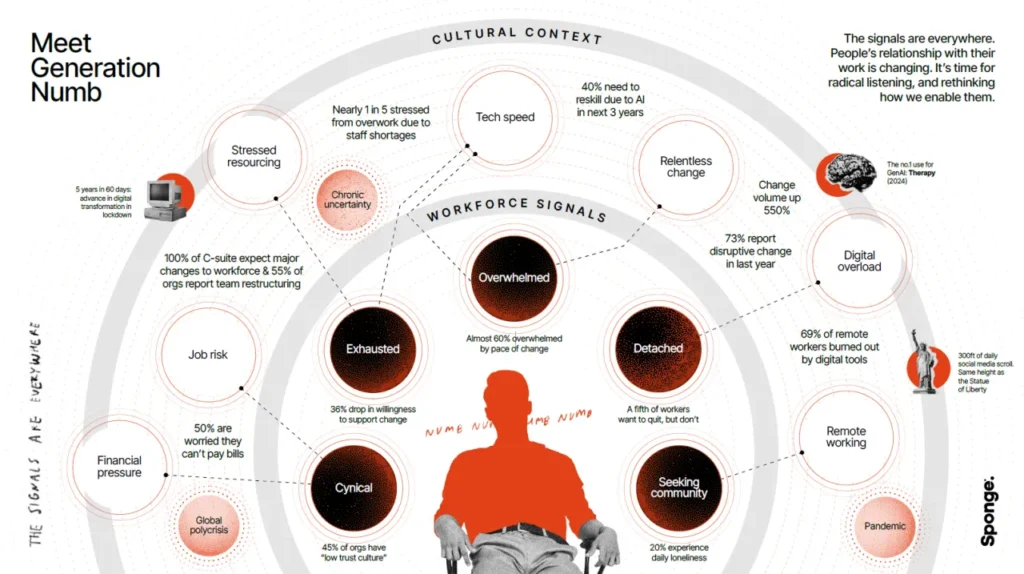
Increasingly, people are doing the latter. Nearly half of employees feel indifferent or numb when organizational changes are announced. Over 60% report feeling disconnected from colleagues, and around 40% describe work as something they are merely surviving.

This is not occasional dissatisfaction, but a widespread emotional flatness driven by years of uncertainty, digital overload, and relentless change.
Generation Numb spans all ages, reflecting a collective response to environments that have gradually eroded meaning, trust, and connection. Traditional engagement metrics fail to capture it, but the consequences are clear: disengagement, burnout, and significant productivity losses threaten both organizational culture and performance.

What are the forces behind Generation Numb? What do employees need, and how can leaders respond to rebuild engagement, trust, and purpose in today’s workforce?
Generation Numb: A Workforce Defined by Shared Strain, Not Age
Mobilising Generation Numb from Sponge Learning is a research-backed workplace report that presents a growing trend across generations of employees who are emotionally drained and disengaged at work due to prolonged uncertainty, digital overload, rapid change, and sustained disruption.
The report notes that employees often talk about being on autopilot or just here to get paid. Estimates suggest that 46% of U.S. workers have considered quitting because of emotional exhaustion.
Additionally, more than half feel undervalued or unenthusiastic, and only 39% say someone at work cares about them personally.
Allwork.Space spoke with the report’s authors, Olivia Haywood, Chief Marketing Officer, and Josh Cardoz, Chief Creative and Learning Officer at Sponge. Cardoz emphasizes that traditional engagement metrics, such as surveys, do not fully capture the depth of employee detachment, which is influenced by a mix of workplace design and broader social pressures.
He highlights a “collision of culture, geopolitics, and ongoing polycrises” that places employees under sustained stress.
“People bring that version of themselves to work, whether it’s consciously or subconsciously. At the same time, work itself is digitally overwhelming. Just about everyone works with technology today,” he told Allwork.Space.
Cardoz identifies three key indicators of this state of numbness:
- Job anxiety: Ongoing concern about global events, economic uncertainty, and their potential impact on employment and daily life.
- Change fatigue: Years of organizational change, including digital transformation and transitions, have desensitized employees of all ages, leaving them emotionally braced for what’s next.
- Hybrid isolation: A loneliness epidemic. Hybrid work makes forming genuine connections challenging, as employees are expected to feel part of a team even when they have never met coworkers in person.
What does Generation Numb need from its Leaders?
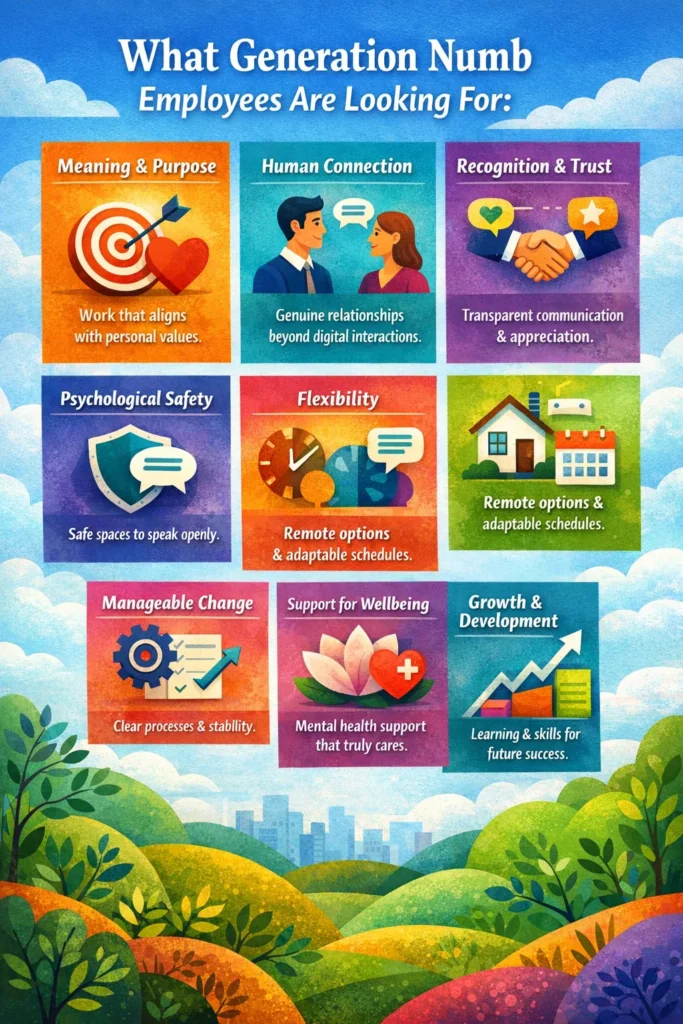
Generation Numb expects more than a paycheck. They want work that is meaningful, purposeful, and aligned with their values, along with opportunities for growth, learning, and collaboration, all within supportive environments that prioritize wellbeing and mental health.
There are wide-ranging consequences for leaders who fail to address these challenges.
Olivia Haywood emphasized, “Infamously, 70% of change initiatives fail, with people-centric issues being the most prevalent cause.”
Over the past decade, employees have faced increasing rates of change, leaving many with limited capacity for additional demands. Haywood notes that traditional leadership approaches often feel inadequate, and messaging that relies on corporate vision statements can come across as tone-deaf. Leaders often sense this instinctively because they experience it themselves.
She adds that attempts to rally workforces around pressures such as AI transformation, economic volatility, or organizational change are likely to fail if leaders do not understand current workforce dynamics.
“With such an existential need for organisations to evolve, they can’t afford to lose their grip on the emotional and energetic state of the workforce that is ultimately going to drive that evolution,” she said.
The stakes are high. Gallup reports that disengaged workers cost the global economy an estimated $438 billion in lost productivity in 2024, with U.S. losses alone approaching $1.9 trillion. Addressing disengagement is therefore both a human and economic imperative.
 Guidance for Leaders to Re-engage Generation Numb
The authors of the Sponge report highlight a human-centered approach for re-engaging Generation Numb, structured around three stages: Me, Us, It.
Stage 1: Me – Empower Individuals
Leaders should turn knowledge into simple, daily habits that employees can practice in their roles. Practical learning experiences, such as mentoring, coaching, job shadowing, or small project teams, demonstrate real investment and show how new skills can support career growth.
At this stage, enablement works best when it feels tangible and human. Cardoz notes that change also resonates more when it comes from trusted peers rather than top-down communication.
Stage 2: Us – Build Connection and Belonging
This stage focuses on restoring a sense of belonging. Small, inclusive spaces where employees can share experiences help build community, as do in-person events and workshops that reduce screen time and encourage conversation. Leaders who are approachable in informal settings make employees feel valued, while ambassador groups can model new behaviors.
Cardoz emphasizes that these practices support trust and transparency across the organization.

Stage 3: It – Reinforce Mission and Purpose
Once individual and team connections are restored, leaders must rebuild belief in the mission. Tangible markers — such as printed playbooks, mailed recognition notes, or safe opportunities to explore and take risks — remind employees that they are part of meaningful change. Purpose becomes visible, actionable, and motivating, helping teams “see the future taking shape, one meaningful step at a time.”
Cardoz notes that employees progress through these stages at different speeds, but all ultimately aim to operate in the “It” phase, where purpose and mission are clear.
He stresses that this is not solely a people issue or something that can be delegated to HR:
“Getting the most out of your team is part of your job,” he explains.
Implementing this three-stage model helps create workplaces where employees feel empowered and connected, and work feels purpose-driven.
Generation Numb and the Future of Work
Cardoz believes this emotional fatigue is unlikely to disappear anytime soon, but remains optimistic that organizations will eventually move past it. He emphasizes that understanding how this condition influences the workplace is essential for influencing what comes next.
Haywood notes that organizations often respond to the research with relief: “Finally, someone is talking about this.” She observes that the rapid spread of AI and the growing difficulty of trusting online content have intensified the workforce’s sense of strain.
In her view, the future of work will be defined by whether organizations acknowledge this reality or ignore it. Leaders who take Generation Numb seriously can create environments where employees reconnect with purpose and deliver their best work.
She contrasts this with the “Bro-CEO” mindset, which celebrates the attention-grabbing but unsustainable grind (hustle) culture.
Cardoz emphasizes that the Generation Numb phenomenon is not a temporary disruption, and while there is no universal playbook, progress is possible. Leaders must be deliberate about rebuilding connection, particularly in hybrid settings, by creating opportunities for genuine collaboration rather than relying on complex programs:
“Put simply, taking Generation Numb seriously isn’t about doing more. It’s about doing the right things with intention. When leaders address it directly, trust and connection can thrive in their workplace,” states Cardoz.
Generation Numb presents both a challenge and an opportunity for the future of work. Leaders who address it can support more human and sustainable ways of working, and by investing in employees’ emotional and developmental needs, they strengthen engagement, trust, belonging, and job satisfaction.
Ignoring it carries real risks: emotionally detached employees are less innovative and contribute to higher rates of presenteeism, turnover, and quiet quitting.
Generation Numb should be viewed as a warning signal, not a collapse. The future of work depends on a clear choice: leaders can either intensify pressure or redesign work to restore meaning, trust, stability, and human connection.