




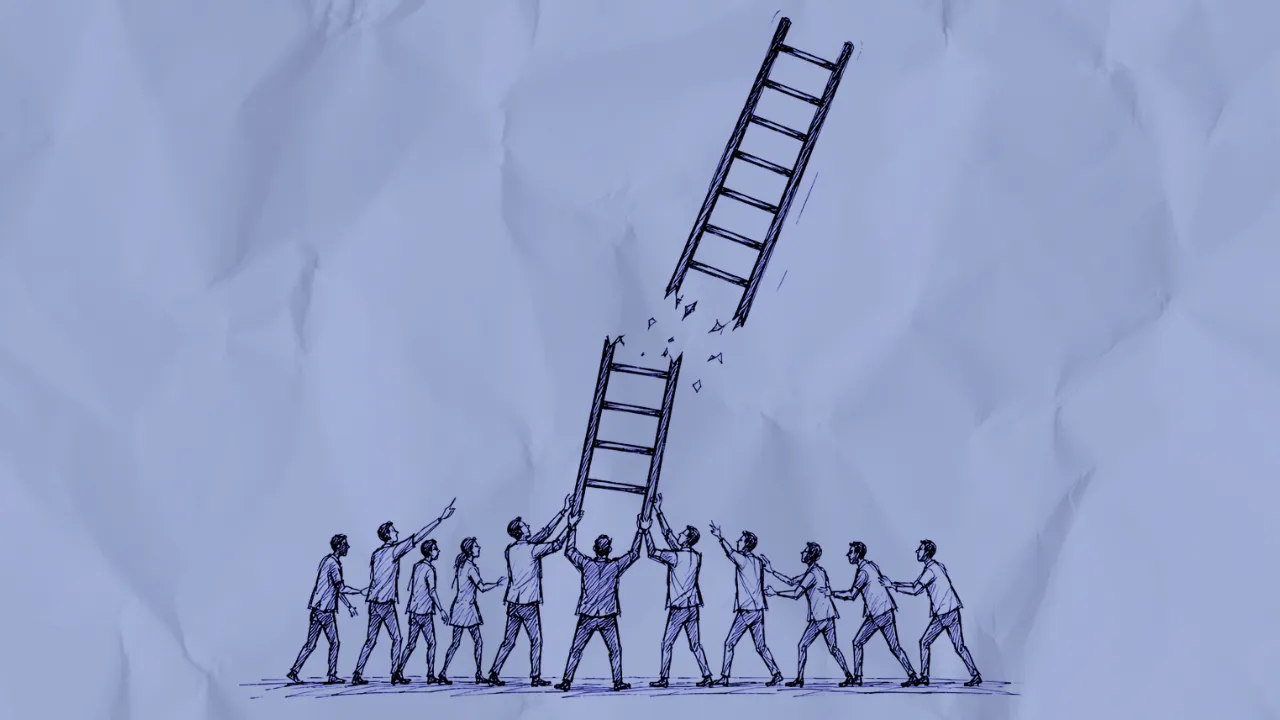
The disruption caused by the rapid adoption of AI is extending from routine task automation into the foundations of professional and knowledge-based roles. Organizations view technology and AI through the lens of productivity and growth, while employees ask a more personal question: where do I fit in this changing world of work?
The uncertainty employees feel across sectors is eroding confidence in the future of work, as they question whether their skills will remain relevant and whether there will be any jobs for them at all. While many business leaders are confident that AI will create new economic opportunities, employees, in contrast, are more concerned with what those changes mean for their career stability and earning potential.

For many people, identity is tied to profession, and a sense of belonging comes from being part of a company or organization. What happens when all of that is under threat?
We have reached the stage where the question is no longer whether AI will transform work, but how people can respond to this disruption in their careers. People are always better off in communities when times are hard, so it is only natural that having a community offering support and connections helps workers find their footing again.

This is where coworking communities can come in: a group of people from different backgrounds, all helping each other adapt to AI-driven change.
Adapting to AI Disruption Will Require More Than Job Creation
The traditional idea of a job — one title, one role, one fixed set of responsibilities — is becoming outdated. As technology and AI accelerate change, work is moving toward flexible, project-based models where people are valued for their skills, adaptability, and ability to take on different challenges.
Workers will need places and communities that help them build skills, relationships, visibility, and opportunities to succeed in this more fluid labor market. Coworking spaces and professional communities can help displaced workers respond to these changes by connecting people with networks, resources, and environments where they can apply their skills.
They can also provide the mentorship, encouragement, and shared problem-solving displaced workers need to respond to change, rebuild professional confidence, and discover new directions when traditional career paths become uncertain.
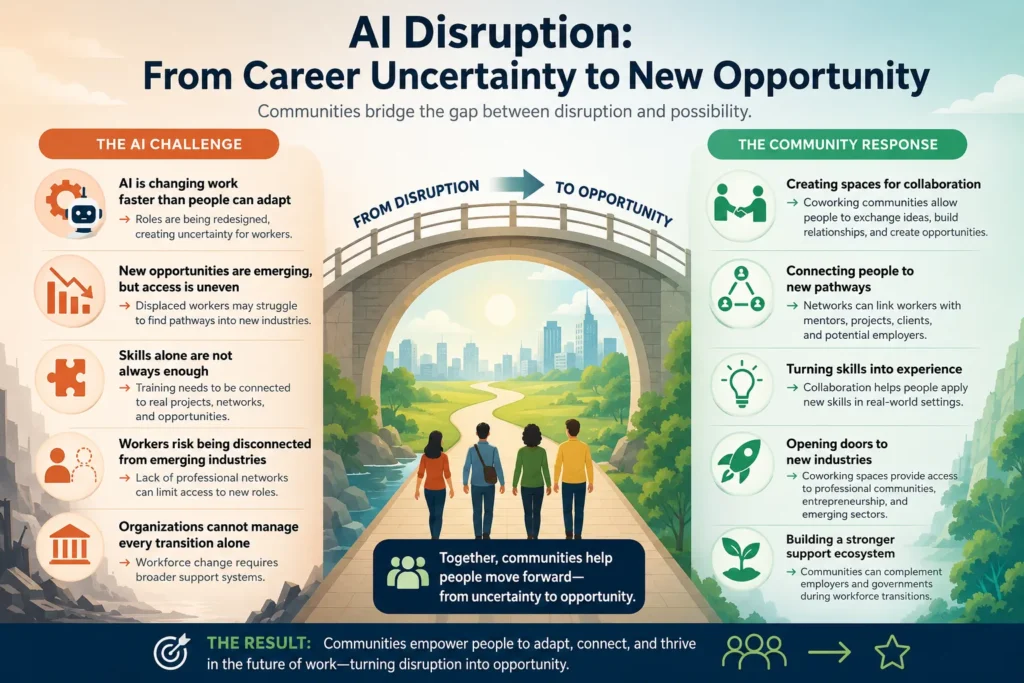
AI disruption creates a series of workforce challenges — from keeping pace with changing roles to accessing new opportunities. Coworking communities cannot solve these challenges alone, but they can provide important infrastructure to support career transitions in the following ways:
- Jobs are changing faster than many workers can adapt. Coworking spaces can provide environments where people collaborate, exchange knowledge, and continue building their careers.
- New roles may emerge, but displaced workers may struggle to access them. Professional networks and coworking communities can connect people with resources, relationships, and pathways into new areas of work.
- Learning new skills alone may not lead to new opportunities. Coworking communities can help people apply their skills through real-world projects, collaborations, and professional connections.
- Workers risk being excluded from emerging industries. Coworking spaces can provide access to networks, projects, and communities that support entry into new fields.
No single organization can manage this transition alone. As these changes accelerate, coworking operators will need to collaborate with external parties (employers, educators, and governments, for instance) to strengthen the networks and pathways workers need in a labor market experiencing constant flux.
A Community-Based Alternative to The Traditional Job-Loss Cycle
The traditional response to job loss follows a familiar sequence: job loss, unemployment, retraining, new job. It is a linear model, built around the assumption that the path back to work relies on formal qualifications and a fixed job search.
Coworking communities operate according to a different model: instead of retraining in isolation, workers become part of a professional ecosystem. Connections within that ecosystem can lead to collaborations, collaborations can develop into real projects, and those projects can create new career pathways, income streams, and ways of working beyond the traditional job model.
Rather than delivering formal training programs, most coworking spaces provide an environment where people can apply their expertise and exchange valuable knowledge through everyday interactions. This can take practical forms: peer-led skill-share sessions where members teach each other software or techniques, informal feedback groups where freelancers review each other’s portfolios, or simply the daily proximity of working near people in different fields who can offer a fresh perspective on a stalled project.
The role played by coworking could become increasingly important as careers become less linear. Coworking communities can support less traditional career paths by offering people access to professional networks, potential collaborators, shared resources, and opportunities to showcase their expertise.
A displaced marketer, freelance designer, and AI specialist, for example, could meet through a coworking community, combine their expertise, and develop a new service or venture. Similarly, a worker between roles might use a coworking membership to maintain a professional routine, attend skill-building sessions, meet potential clients, or access a credible workspace while building an independent career.
Some coworking spaces support this through structured introductions, such as member directories organized by expertise or regular “show and tell” sessions where members share current projects with the wider community. By making people’s skills, ideas, and needs more visible, these activities create connections that can develop into collaborations, client relationships, and new sources of work that may not emerge within a traditional workplace.
As employment structures become less predictable, coworking spaces can also serve as transition hubs — helping people maintain professional momentum, rebuild networks, and turn new skills and relationships into projects, businesses, and career opportunities.
AllGoodWork.org: Turning Workspace Access into Career Opportunity
AllGoodWork.org connects flexible workspace providers and individuals and organizations seeking affordable places to work. Beyond access to physical space, the platform helps people connect with the communities, networks, and opportunities within those spaces — enabling displaced professionals to rebuild relationships, explore new possibilities, and create new career pathways.
Coworking as Infrastructure for a Changing Labor Market
Frank Cottle, Chairman and CEO of Alliance Business Centers Companies and Executive Publisher of Allwork.Space, believes coworking operators have an important role to play in supporting workers affected by AI disruption. Many coworking spaces currently operate below full capacity. Opening that spare capacity specifically to professionals experiencing career displacement, Cottle argues, could create both social and business value at once, filling empty desks while giving displaced workers a stable base during a period of change.
Many coworking spaces are already positioned as launchpads for entrepreneurship and start-up ventures. That same infrastructure could take on a wider role: supporting workers whose careers have been upended by AI, and becoming part of the broader system that helps the workforce adjust.
If AI disruption turns out to be a lasting feature of working life rather than a temporary shock, access to communities such as those found within coworking spaces may matter as much as access to technology itself. The future of work will not be defined by new tools alone. It will depend on whether the networks and environments are available to help people put those tools to use and keep contributing to the economy around them.