

While economists estimate that automation could affect up to 300 million jobs worldwide by 2030, they also expect only a small fraction of roles to vanish completely. The real transformation lies in the reorganization of work, with humans and machines sharing tasks in new ways instead of entire occupations becoming obsolete.
However, for many workers, headlines about automation get distilled into a single, alarming message that sinks in: jobs are disappearing. Constant exposure to developments in AI can cause people to overestimate both the pace and extent of workforce disruption, even when their own positions are relatively secure.

When this perception becomes overwhelming, it can evolve from a reasonable concern into a source of chronic stress and anxiety.
Much like cyberchondria, where excessive searching turns minor symptoms into major fears, constant exposure to worst-case narratives about AI can magnify fears about being replaced at work. Over time, this anxiety can erode employees’ confidence, concentration, and belief in their future career prospects.

How can employees differentiate between hype and reality in the context of automation, and how can leaders help build confidence amid persistent narratives of job displacement?
AI Job Displacement Anxiety and Its Drivers
AI job displacement anxiety refers to the psychological strain that arises when individuals perceive artificial intelligence (AI) as a potential threat to their professional future. While not a clinically defined condition, it reflects a growing workplace reality influenced by how people interpret rapid technological change and public narratives around automation.
Crucially, this anxiety does not depend on actual job loss. It often emerges in environments where roles remain stable, but perceptions of stability change.
When speaking to Allwork.Space, Dr. Sharon Grossman, a psychologist specializing in workplace behavior and burnout, describes it as “the stress people experience when they perceive AI as a threat to their professional future.” In her view, it is a response shaped less by AI itself than by how an individual interprets that technology.
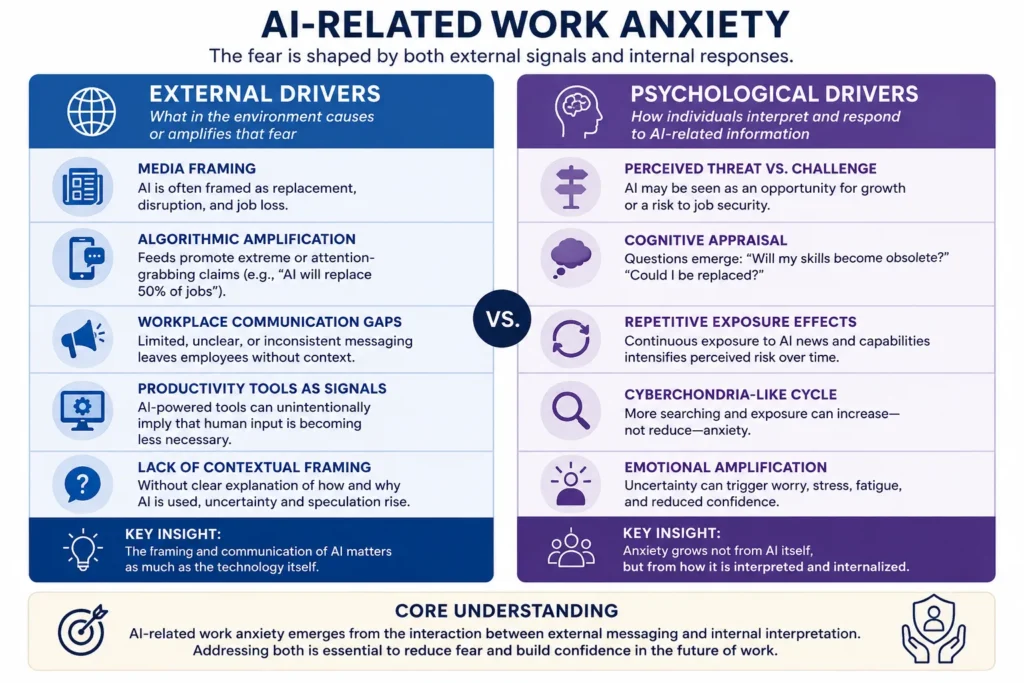
A key factor is the way AI is encountered in daily life. Many employees do not form their understanding of automation through structured organizational communication, but rather through sensational news headlines, social media commentary, and predictions about large-scale disruption. These narratives tend to emphasize scale and speed, which can amplify perceived relevance to one’s own role, even when direct impact is unclear.
Media systems and digital platforms can further intensify this effect. Algorithm-driven feeds often prioritize content that is dramatic or emotionally engaging, making worst-case projections of job loss more visible than nuanced explanations of gradual job restructuring. Over time, this can skew perception of how immediate or inevitable automation risks actually are.
Within workplaces, the absence of clear communication can compound this uncertainty. When organizations introduce AI tools primarily as productivity enhancements without explicitly addressing implications for roles and responsibilities, employees are left to interpret the significance themselves. In that space, assumptions can form quickly, particularly when external narratives are already strong.
Dr. Grossman notes that individuals often respond to this ambiguity by “mentally rehearsing worst-case scenarios,” with outcomes ranging from increased efficiency demands to complete role replacement.
This cognitive pattern can lead to heightened attention on AI developments, reinforcing a cycle in which uncertainty drives further information-seeking.
However, Dr. Grossman also emphasizes that reactions vary significantly depending on context. Some employees engage with AI tools proactively, treating them as opportunities for skill development and increased efficiency. Others may experience heightened hesitation or disengagement, particularly when access to tools or training is uneven across teams.
This divergence creates a second source of anxiety: not only fear of being replaced, but also fear of falling behind within one’s organization. As AI becomes more visible in everyday workflows, differences in skill and familiarity with AI tools can create a sense of reduced relevance, even when job roles themselves have not changed.
Overall, these factors suggest that AI job displacement anxiety does not stem from a single cause. Instead, it is created by a mix of external narratives, organizational communication, and workplace inequalities in access to and confidence in using AI tools, as well as by how change is perceived, interpreted, and experienced.
 The Impact on Employee Confidence and Workplace Behavior
The effects of job displacement anxiety are becoming increasingly visible in knowledge-based roles, where employees may question how their expertise remains relevant alongside rapidly evolving tools. Even in the absence of structural job loss, concerns about long-term relevance can weaken confidence in current performance and future career direction.

For some employees, this creates a persistent background distraction. Attention shifts toward tracking AI developments, reading updates, or monitoring new tools. Over time, this can reduce engagement and make long-term planning feel less certain.
Dr. Grossman explained how responses can vary widely. Some employees withdraw from conversations about AI or avoid experimenting with new tools, while others become highly vigilant, continuously comparing their output or efficiency against what AI systems can produce.
Both patterns reflect attempts to manage changes in their professional environment and cope with uncertainty, rather than simple resistance to change.
In some cases, this creates a feedback loop in performance: reduced confidence affects engagement, which then impacts output quality, further reinforcing self-doubt. Over time, this can contribute to fatigue, reduced motivation, and a sense of professional stagnation, which Dr. Grossman describes as “downward efficacy spirals.”
These effects are often more pronounced in remote and hybrid settings. In physical workplaces, informal exchanges and peer observation provide reassurance and context during periods of change.
When these cues are less available, employees may have fewer reference points for how others are adapting, increasing their susceptibility to self-doubt and anxiety.
How Organizations Can Respond
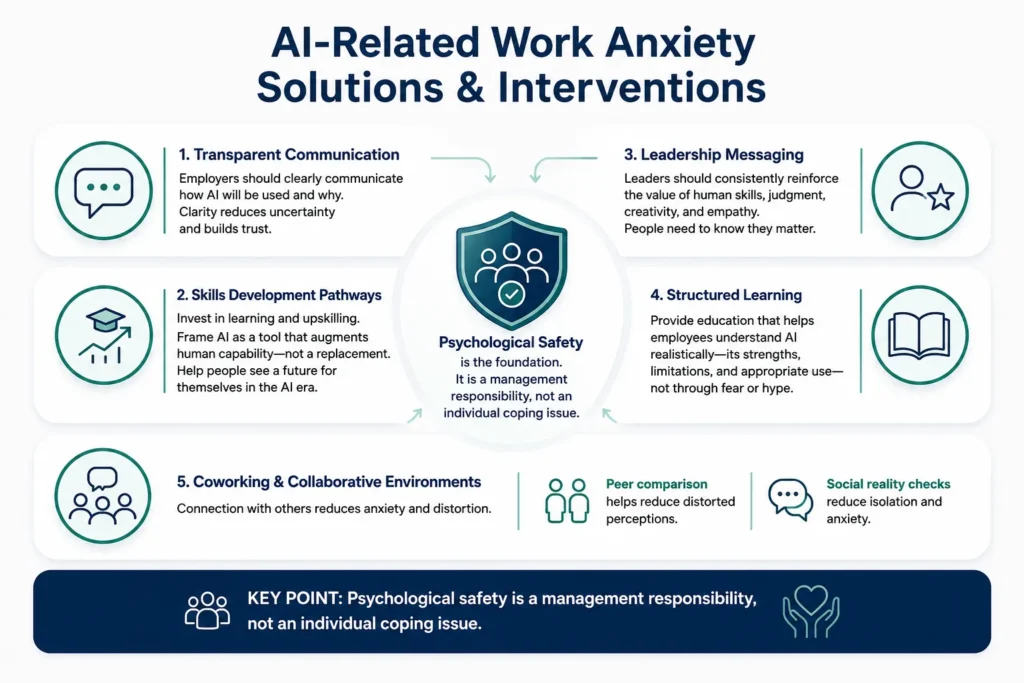
Leadership plays a decisive role in influencing how AI is integrated into the workplace experience. In the absence of clear communication, employees are left to infer how new tools will affect roles, responsibilities, and expectations.
Clarity is therefore essential — not only about which AI tools are being introduced, but why they are being implemented and how they are expected to change day-to-day work. When organizations fail to articulate this, employees may struggle to understand where they fit within evolving workflows.
Alongside communication, access to training is critical. Reskilling and upskilling initiatives help employees build familiarity with AI tools in practical contexts, reducing hesitation and improving confidence in their use. This is most effective when learning is structured around real tasks rather than general guidance.
Dr. Grossman emphasizes that confidence is built through applied experience rather than reassurance alone. Opportunities to use new tools in low-pressure environments allow employees to develop competence gradually, which strengthens engagement more effectively than abstract messaging.
Equally important is the need to strengthen uniquely human skills within organizations. Dr. Grossman emphasizes that skills such as “judgment, creativity, collaboration, and ethical reasoning” should remain central in AI-integrated environments. She argues that making this explicit helps stabilize employees’ professional identity as roles change.
Workplace culture also plays a role. Environments that encourage open discussion about technological change tend to support smoother adaptation. Informal peer learning helps normalize the transition and reduces the sense of individual pressure to keep up.
“Uncertainty creates a vacuum, and people naturally fill that vacuum with assumptions. If leaders don’t provide a clear narrative, employees often default to the most alarming one,” Dr. Grossman said.
In remote and hybrid workplaces, this requires more deliberate design. Without spontaneous interaction, organizations need intentional spaces for shared learning, feedback, and experimentation.
 The Takeaway
AI-driven change in the workplace is not only a technological transition but an organizational and human one. Its impact depends as much on communication structures, access to training, and workplace culture as on the tools themselves.
The most effective responses are not those that attempt to eliminate concern, but those that translate uncertainty into capability. When employees understand how AI fits into their work and have the opportunity to build confidence through use, adaptation becomes more sustainable.
As Dr. Grossman puts it, the goal is not to remove concern entirely, but to ensure it does not dominate how people experience change. In that space between uncertainty and capability, employees are more likely to see AI not as a replacement force but as a collaborative tool in the modern professional landscape.
Cyberchondria Definition
Workplace Cyberchondria: When doomscrolling about AI job loss and workplace disruption magnifies a reasonable career concern into persistent anxiaty, self-doubt, and fear of becoming obsolete.