



“The mid- to late 20s freaking sucks man. There’s no other way to put it. It freaking sucks. I’m just praying that my 30s are a lot better,” one Gen Zer told CNBC.
For years, employers assumed Gen Z would enter the workforce ready to shake things up. Turns out, they are shaking things up—but not in the way anyone expected. Instead of marching confidently into 2026, a large share of Gen Z is quietly wrestling with something older generations know all too well: the quarter-life crisis.

And the way they navigate it could significantly impact the future of work.
The Quarter-Life Crisis Is Hitting Earlier — and Harder
By 2026, Gen Z will be between 14 and 29 years old, meaning millions are right in the “What am I even doing with my life?” phase. FlexJobs’ new findings reveal just how widespread that feeling is: more than half of workers overall say they’ve experienced a quarter-life career crisis, and younger employees are feeling it intensely.
They’re looking for clarity, mentorship, flexibility, and remote options — not as added benefits, but as survival tools.
When they don’t get those things they start to question whether they’re in the right role, the right company, or the right career path at all.
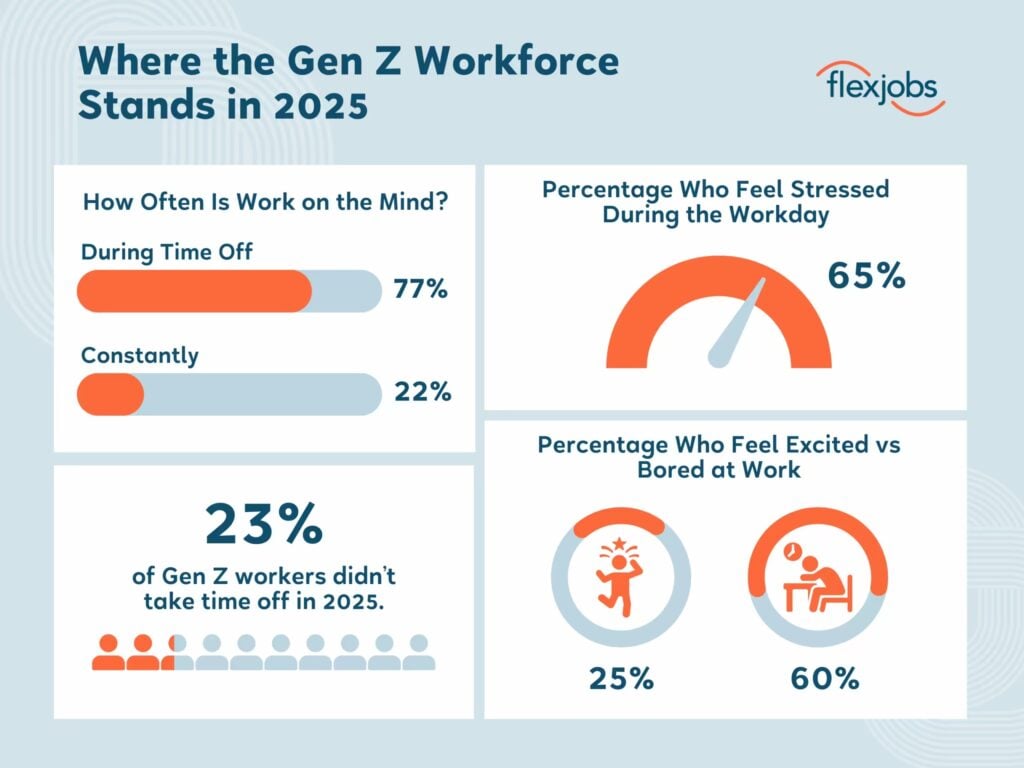
And with 65% of workers feeling stressed during a typical day and 60% saying they’re bored, they aren’t imagining the problem. Work really has gotten more chaotic and less energizing.
Why Their Crisis Matters for Everyone Else
You might be thinking: Isn’t this just a Gen Z thing?
Short answer: no.
Gen Z’s early-career pressure is spotlighting issues that affect every generation. FlexJobs found that 77% of workers think about work even during time off, and a surprising 22% can’t turn their brains off at all.
On top of that, almost a quarter of workers didn’t take any time off last year.
Gen Z is simply the first group loudly saying, “This doesn’t feel sustainable.”
And in a multigenerational workplace, their reaction will influence company culture, leadership norms, and HR priorities.
Their crisis is basically the canary in the cubicle.
The 2026 Workplace Will Look Different Because Gen Z Demands It
So what does this mean for the future of work? In 2026, expect a noticeable alteration in how companies approach early-career employees — and, by extension, everyone else.
Here’s what Gen Z’s quarter-life crisis is pushing employers to consider:

1. Flexibility Is a Lifeline
Remote and hybrid options are still at the top of Gen Z’s wish list. They see flexibility as proof that an employer trusts them, and they draw a sharp line between autonomy and burnout.
2. Mentorship Will Be a Retention Strategy
Younger workers are asking for guidance early and often. Companies that build real mentorship pipelines (not one-off career chats) will keep talent longer and create healthier team dynamics.
3. Job Design Will Finally Get an Upgrade
With so many employees bored, overwhelmed, or stuck, job roles will need to evolve toward creativity and skill-building—not just task lists.
4. PTO Will Become a Culture, Not a Benefit
Nearly a quarter of workers took zero time off last year. Gen Z wants companies to normalize rest, not quietly discourage it.
5. Psychological Safety Goes From Buzzword to Baseline
If employers want engaged young talent, they’ll have to create environments where it’s safe to ask questions, admit uncertainty, and explore new paths.
Gen Z Is Raising the Alarm
The reality is simple: Gen Z isn’t fragile. They’re observant. They see workplace stress, confusion, and stagnation as warning signs, not just “how it is.” And they’re pushing employers to respond.
If organizations take this seriously, 2026 could be a turning point toward jobs that energize people instead of draining them, workplaces that support growth instead of ignoring it, and cultures where taking a vacation isn’t treated like a confession.
In other words, Gen Z’s quarter-life crisis might just be the push the workplace needed.