




Coworking was originally a niche solution for startups and freelancers. Today, coworking spaces provide essential professional infrastructure for remote and hybrid workers, entrepreneurs, and even large corporations.
As the coworking industry continues to mature, so too must our framework for assessing these dynamic workspaces. Modern coworkers seek environments that reduce isolation, support health and productivity, promote a genuine sense of community, and help balance the demands of everyday work and life.

To meet these expectations, many coworking operators have evolved beyond basic facilities management into becoming active stewards of member well-being. This raises an important question: what do coworking spaces truly owe their members? Is it enough to offer free coffee and ergonomic chairs — or should wellness programs, mental health resources, and intentional community-building be core to the membership experience?
Well-being as the Foundation of Member Engagement
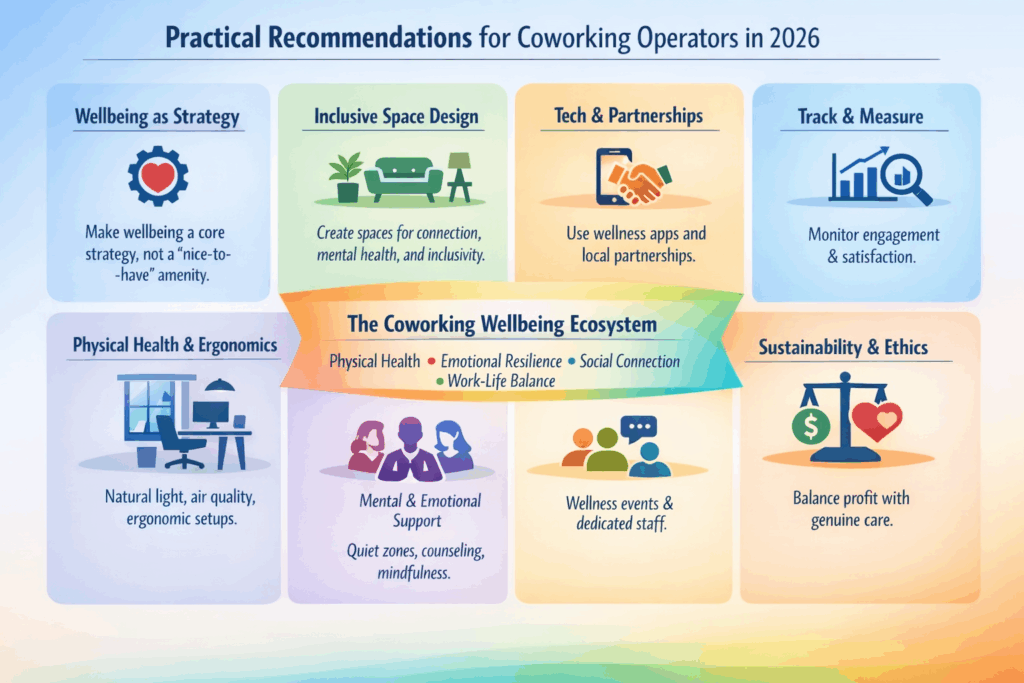
Forward-thinking coworking operators view well-being as essential infrastructure rather than an optional benefit. This perspective shows the evolution of coworking spaces into ecosystems where physical comfort, mental health, social connection, and work-life balance intersect.

In these environments, how members engage with their work, interact with peers, and utilize the space directly impacts how each person feels in that workplace.
Research on coworking shows a clear link between well-being and member engagement. Members who feel supported are more likely to participate in events, collaborate with others, and contribute to the culture of the space.
This engagement not only strengthens connections within the community but also improves retention, generates referrals, and reinforces a more resilient business model. Social and professional networks within coworking spaces are particularly important, as they provide members with consistent interaction that many remote or freelance workers often lack.
Coworking operators occupy a unique position to influence well-being. While most cannot offer conventional corporate employment benefits or healthcare plans, they can design environments that promote wellness (while combating stress and burnout).

Thoughtful space layout, flexible membership options, community events, and long-term initiatives all reinforce members’ sense of support. This approach enables coworking space operators to turn the abstract concept of well-being into daily experiences that drive engagement and satisfaction.
Allwork.Space spoke with Gal Leslie, Director at 2-Work, a flexible office space provider with five locations across West Yorkshire, U.K., to explore how coworking spaces reinforce well-being and engagement from the first point of contact, which practices make a measurable difference, and how operators can translate intention into meaningful impact.
Leslie emphasizes that first impressions matter, particularly in coworking environments where a sense of belonging directly influences engagement.
“Listening is key,” she says. According to Leslie, taking the time to understand not only a member’s business needs but also their individual preferences and goals helps establish trust from day one.
This approach includes welcoming a coworker at their first point of engagement, offering guided tours, introducing them to relevant community members, providing personalized onboarding sessions, and conducting regular check-ins to ensure they are settling in.
These intentional actions set expectations for inclusion and well-being from the outset. Leslie emphasizes that, over time, this early investment pays off because members who feel acknowledged and supported are more likely to engage with the community, attend events, and commit for the long term.
Integrating Well-being into the Coworking Model
Many coworking operators now recognize that well-being is a strategic priority. Members increasingly choose coworking spaces not just for convenient locations or quality amenities, but for how well the environment’s design and the culture within the space support well-being over time.
Thoughtful workspace design can have a direct impact on members’ day-to-day energy and concentration levels. Access to natural light, high-quality air circulation, ergonomic furniture, and layouts that encourage movement can reduce fatigue and discomfort while supporting long-term health.
Today, these design elements have become baseline expectations. Many coworking spaces also offer quiet zones, meditation or reflection spaces, mindfulness programming, stress-management workshops, and access to coaching or counseling resources to support members’ mental and emotional well-being.
Allwork.Space asked Leslie for her views on how coworking centers should embed well-being into their core strategy. Leslie informed us that at her company (2-Work), well-being is integrated into the business model and considered at every stage of the member journey, alongside the other core pillars, community, and collaboration.
“It’s something you genuinely have to believe in, not something you bolt on as an optional extra,” emphasizes Leslie.
This commitment is reflected in simple, thoughtful design decisions that have the “biggest impact” on how members actually feel and work each day. Leslie notes that open layouts, breakout zones, and informal spaces encourage members to step away from their desks, supporting both concentration and social connection.
Elements such as natural greenery and favorable lighting further contribute to an environment that feels open, welcoming, and conducive to sustained well-being.
An integrated approach, like the one Leslie outlines, represents a positive departure from most formal, employer-led wellness programs. Rather than corporate benefits packages, well-being in coworking is experienced through everyday interactions with the space and the community.
Allwork.Space also spoke with Vika Zhurbas, Founder of Tech Connect and a community and coworking expert. Zhurbas observes that coworking spaces are evolving in their role of offering well-being, but not in the way many assume.
“I would say coworking centers are becoming community hubs first, and only then potential wellness hubs,” she explains.

This aligns with research showing that meaningful human connection at work is essential for well-being.
Leslie shares this view. She believes that community is the defining feature that sets coworking apart, with well-being at the heart of that experience. Zhurbas also agrees with Leslie that wellness strategies must be intentional and embedded into operations to be effective.
She observes that some coworking operators mistake isolated activities, such as yoga or massages (without adequate infrastructure), for genuine well-being programs:
“Well-being today is less about ‘activities’ and more about mental clarity, emotional support, and human connection. When coworking spaces focus on community, trust, and psychological safety, the wellness follows naturally,” says Zhurbas.
For operators, embedding well-being into daily operations requires consistency, appropriate facilities and support infrastructure, and trusted partnerships. Strategic external partnerships — such as collaborating with established gyms rather than offering in-house exercise classes without showers or changing rooms — further enhance the member experience.
In this sense, community-led well-being becomes a competitive advantage, not because of the number of initiatives offered, but because of how supported and connected members feel in the coworking space.
Aligning Financial Sustainability with Member Well-being
Coworking operators face ongoing financial pressure as economic markets fluctuate and member expectations become more sophisticated. This makes embedding well-being into the core business strategy even more essential, as a strong well-being offering can support long-term revenue by boosting engagement and satisfaction levels, leading to longer member tenure.
Well-being initiatives have an impact only when supported by structured programs and consistent member engagement. Regular wellness events, paired with clear participant feedback mechanisms and dedicated community-focused roles — such as community managers or wellness coordinators — ensure that support is visible, accessible, and embedded into daily operations.
An effective wellness program does not necessarily require a large budget: peer-led workshops, partnerships with local wellness providers, and volunteer-driven initiatives can deliver meaningful impact while remaining financially practical.
Evaluating impact is essential for ensuring well-being initiatives remain both effective and financially sustainable. Engagement metrics, renewal rates, and satisfaction surveys provide tangible insights into what resonates with members.
Operators can monitor attendance at wellness events, changes in average membership length, referral activity, and feedback tied to specific programs. These insights help refine offerings, justify current and future investments, and maintain accountability.
We asked Leslie which approaches help operators create well-being initiatives that both support members and contribute to long-term sustainability. She emphasizes that a member’s long-term commitment is determined by how valued they feel and how connected they are to the space.
Leslie believes that this sense of belonging often derives from simple, human actions, such as inviting members to share input on the space, incorporating regular events into the weekly rhythm, or taking a moment to ask members about their business in passing.
Leslie notes that at 2-Work, meaningful initiatives support members’ well-being while also strengthening retention and contributing to long-term growth.
“We design our well-being initiatives so that they enhance the member experience while remaining manageable and sustainable,” she explains. “These activities encourage participation and loyalty without overextending resources, creating a balance where members benefit, and the business thrives. When members feel part of the community, they are more engaged, more likely to use the space, and more likely to recommend it to others.”
Leslie’s insights ultimately reinforce the idea that the most resilient coworking models are those in which financial performance and member well-being strengthen one another. Spaces that invest in thoughtful, well-designed programming (with clear outcomes tracking built in) tend to attract members who value both connection and stability, resulting in stronger communities and more predictable revenue over time.
Emerging Trends Shaping the Future of Coworking Wellness
Coworking wellness is increasingly shaped by technology, intentional community design, and evidence-based practices that genuinely enhance engagement and health outcomes.
Digital wellness tools now help operators support mental health, track fitness, and strengthen community connections, providing members access to well-being resources anytime, anywhere.
Looking ahead, coworking spaces may routinely deploy service robots and digital assistants to handle administrative tasks, freeing operators and community managers to focus on relationship-building and fostering community well-being.
Leslie says she anticipates that hybrid programming and digital wellness tools will play an increasingly essential role in supporting members, both on-site and remotely, in the future of work. Leslie stresses, however, that simple, human elements will remain paramount, including community-led practices such as networking mornings or informal conversations over coffee. She believes these features will continue to reinforce community ties, while technology will extend and strengthen those bonds.
As member expectations rise, it is clear that coworking operators are accountable for creating shared environments where coworkers can achieve optimal well-being, connection, and professional growth.
“Ultimately, while coworking is a competitive industry, long-term success comes from ensuring members feel cared for and supported,” states Leslie.