

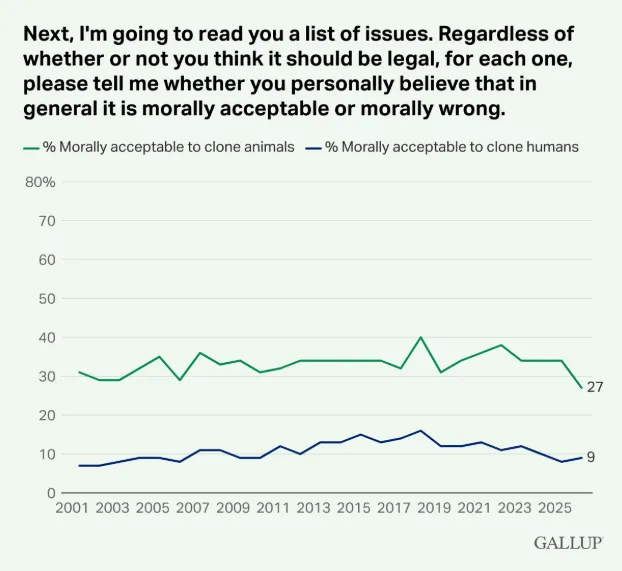
For decades, cloning has occupied a special place in public debate. Few scientific ideas have generated the same level of moral discomfort. Gallup’s latest moral acceptability survey shows that sentiment has hardly changed.
Cloning humans remains one of the least morally acceptable practices Americans can imagine, while even cloning animals has fallen to a record low in public acceptance, with just 27% saying it is morally acceptable. The number is even less for cloning humans: 9% of Americans think it’s acceptable.

At first glance, those views seem disconnected from the AI revolution unfolding inside workplaces. Businesses are racing to deploy generative AI, automate knowledge work, and build digital assistants. But look more closely and an interesting contradiction emerges.
While society remains deeply uncomfortable with creating biological copies of living beings, organizations are increasingly investing in technologies designed to copy something else: human expertise and behavior.

That distinction may explain why AI has generated far less ethical resistance than cloning ever did. But it also raises a question that few companies are asking. If we object to replicating people, how comfortable should we be with replicating the very knowledge, judgment, and decision-making that make people valuable at work?
AI Isn’t Cloning Bodies, But It Is Cloning Expertise
Human cloning has always been about biology; AI is attempting something very different. Rather than reproducing DNA, it reproduces behavior. Large language models learn how people communicate. AI meeting assistants learn how teams collaborate. Sales copilots absorb years of customer conversations. New “digital twin” technologies promise to preserve the expertise of experienced employees long after they leave a company.
The workplace has surreptitiously changed from asking whether AI can automate repetitive tasks to asking whether it can replicate professional judgment. Increasingly, organizations want AI systems that can draft documents in an executive’s voice, recommend decisions based on a manager’s past behavior, or answer technical questions using years of institutional knowledge.
In other words, companies are trying to build another version of your work.

Knowledge No Longer Leaves When Employees Do
For much of the industrial era, work was tied to physical labor or individual presence. If someone left the organization, much of their knowledge went with them. Companies documented processes, but experience itself remained difficult to capture.
AI changes that equation, as every email, meeting transcript, proposal, presentation, customer interaction, and project document can become training material. As organizations accumulate more data, they become better able to recreate how experienced employees solve problems, communicate with clients, or make decisions.
That doesn’t mean AI becomes the employee. Human judgment, creativity, and accountability remain difficult to replicate. But it does mean that pieces of someone’s professional identity can increasingly exist independently of the individual. The knowledge that once walked out the door every evening can now remain inside the organization indefinitely.
For employers, that’s an enormous opportunity. Institutional knowledge no longer disappears with retirements or resignations. New employees can ramp up faster. Expertise becomes more accessible across the business.
For workers, however, the implications are more complicated.
Digital Twins Blur Questions of Ownership
The idea of digital twins is expanding quickly beyond manufacturing, where virtual replicas of machines have long been used to predict maintenance needs and improve performance. Today, companies are experimenting with digital versions of people. Some executives have created AI avatars capable of answering common questions. Other organizations are training AI systems on internal experts so specialized knowledge remains available around the clock.
These developments introduce questions that employment law and workplace norms have barely begun to address.
If an AI system is trained on years of an employee’s work, who owns that digital version? Should employees have a say in how their expertise is used after they leave? If an organization builds an AI capable of performing many of someone’s responsibilities, where does knowledge management end and workforce substitution begin?
Why AI Doesn’t Trigger the Same Moral Reaction
Part of the reason society reacts differently to AI is that the technology doesn’t appear to threaten individuality in the same way biological cloning does. A cloned human immediately raises questions about personhood, autonomy, and human dignity. A digital assistant trained on workplace knowledge feels far more practical. It is framed as software, not as another person.
That framing matters. People generally accept technologies that preserve or extend human capability. We back up photos, record conversations, and document processes without much concern. AI appears to be another step in that progression, preserving expertise rather than creating another human being.
But the line becomes less clear as AI systems become more sophisticated. When a digital twin can communicate like an employee, make recommendations based on their experience, and perform meaningful portions of their role, the distinction between preserving knowledge and replicating professional identity begins to blur.
The ethical debate shifts from “Can we clone people?” to “How much of a person can we copy before it starts to matter?”
Deepfakes are already creating chaos in corporate environments. From fake resumes to deepfake executives approving million-dollar transfers (one scam cost an engineering firm $25 million) generative AI is turning workplace trust into a vulnerability — and forcing companies to rethink how they verify who’s real.
The Workplace May Be Rewriting an Old Ethical Debate
Most discussions about AI focus on productivity, cost savings, or automation. Those are important conversations, but they overlook a larger cultural evolution. Organizations are no longer using technology simply to help employees work more efficiently; they are increasingly using it to preserve, replicate, and distribute human expertise at a scale that was impossible only a few years ago.
Gallup’s findings suggest Americans remain uncomfortable with cloning because it challenges deeply held beliefs about individuality and uniqueness. Yet workplaces are embracing technologies that copy many of the qualities organizations value most: knowledge, communication, judgment, and experience.
That doesn’t mean AI and human cloning are morally equivalent. A digital twin is not another human being, nor does it possess consciousness or identity. But the comparison highlights an inconsistency in how society thinks about replication — we reject copying people while becoming increasingly comfortable copying the capabilities that define their professional lives.
As AI continues to advance, that distinction may hold…or it may become one of the defining ethical questions of the future of work. Companies have already begun building systems that can preserve human expertise long after employees leave. Gen Z employees are already harboring guilt about using AI. The next challenge may be deciding where organizations — and society — believe the boundaries should be.