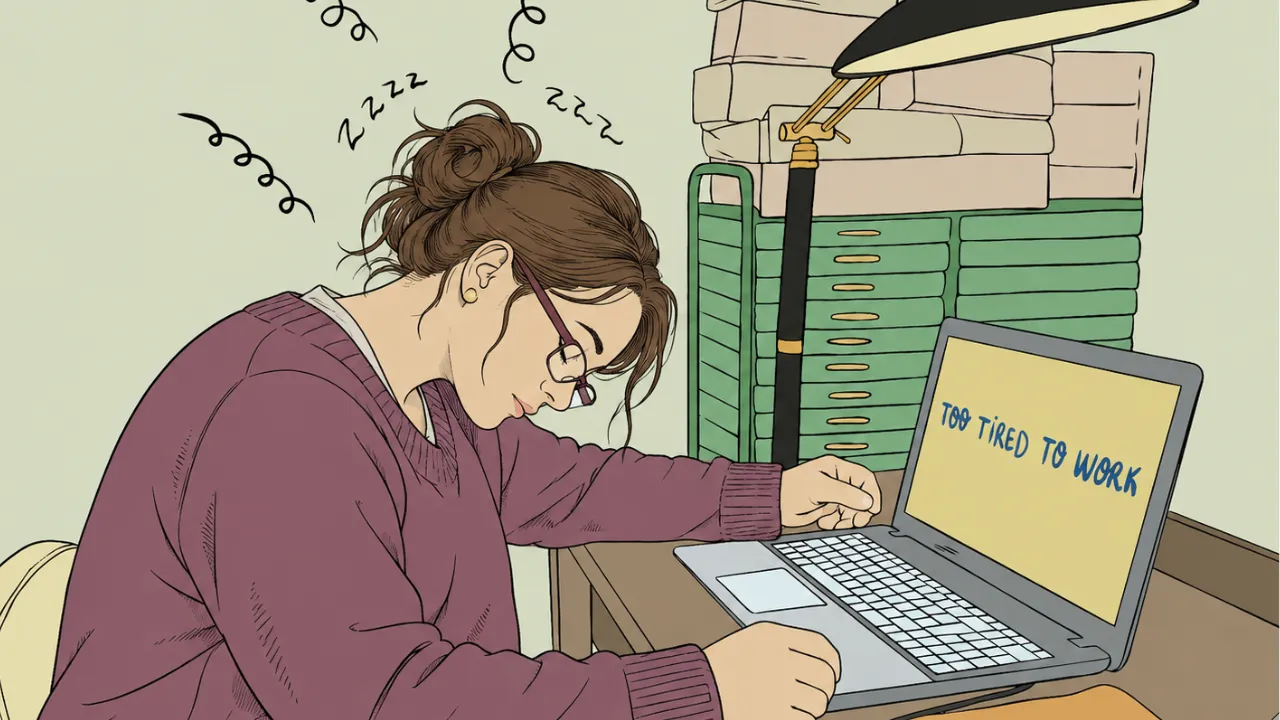
Most working Americans are catching up on rest in the middle of the day, and they’re doing their best to make sure no one notices. A new Amerisleep survey found that over 9 in 10 workers nap at least once during the workweek, yet most keep the habit hidden from managers and coworkers.
Who Is Sleeping on the Job and Why They Are Not Talking About It?
Whether it’s heading to the car between calls, claiming an open couch in an empty conference room, or closing their eyes at their desk for a few minutes before a meeting, workers have found resourceful ways to fit in a reset without announcing it.

Amerisleep found desks and meeting rooms are the most common hideaways for tired employees. In the new survey, 70% of nappers leave their workstation entirely, seeking out another room, a dedicated rest area, or even stepping outside the building, while the remaining 30% simply put their head down at or near their desk.
A dedicated rest space, like a couch, bed, or recliner, is the preferred option for 30% of nappers, while 22% skip the building altogether and head to their car or a public space. Women are more likely to seek out a couch or rest area than men (36% vs. 23%), while men are more likely to nap right at their desk (22% vs. 15%).

The car, in fact, is where 38% of respondents say their most unusual workday nap took place, ahead of the desk (29%), break room (11%), and bathroom (7%).
Timing follows a predictable rhythm tied to the post-lunch energy dip. The most popular nap window falls between 1 p.m. and 1:59 p.m. (29%), followed closely by noon (27%) and 2 p.m. (21%). A 2021 meta-analysis of daytime napping found afternoon naps improve alertness and cognitive performance, with the strongest benefits tied to naps taken before 1 p.m.
The Habit Most Workers Won’t Admit To
Despite how common napping has become, secrecy still rules. Fifty-nine percent of workplace nappers have hidden the habit from a manager, coworkers, or both, and 42% have kept it hidden from everyone at their job.
Generationally, Gen Z is the most comfortable being open about napping, with just 53% concealing the habit, compared to 61% of millennials and 59% of Gen X.

Culture, Not Just Habit, Drives the Secrecy
In workplaces that push employees to power through fatigue rather than rest, 80% of nappers hide the habit. In workplaces considered recovery-friendly, that number drops to just 50%.
That gap tracks with general findings on hustle culture, where treating exhaustion as a badge of honor makes rest feel like something to apologize for rather than a normal part of the workday.
There’s also a disconnect between how managers and individual contributors view napping. Thirty-nine percent of manager-level nappers see it as a productivity tool or healthy habit, compared to just 26% of individual contributors.
Part of that gap may come down to how rested managers already are: a separate Sleep Junkie survey found well-rested supervisors earned about $5,000 more annually than poorly rested peers and were more likely to stay focused throughout the day, suggesting managers who prioritize their own rest may be more inclined to normalize it for their teams.
Getting caught rarely carries consequences. Only 15% of nappers have ever been caught by a manager, and among those, 46% said nothing happened, 39% said their manager joked about it, and just 9% said it affected how they were perceived at work.
A Habit Workers Already Believe In
Whatever the stigma, workers are convinced napping works. Eighty-six percent say naps improve focus and concentration, 84% say they reduce stress and burnout, and another 84% say they boost productivity. Only 1% of workers view midday napping as a sign of poor work ethic.
The science backs up the instinct, within limits; naps under 60 minutes maximize cognitive benefits and reduce fatigue while lowering the risk of chronic disease, but naps over an hour were linked to higher rates of coronary heart disease, diabetes, and obesity. The sweet spot for performance benefits lands around 20 to 30 minutes, with both too-short and too-long naps diminishing the payoff.
By industry and generation, attitudes vary widely. Tech (37%) and finance (33%) workers are the most likely to view napping positively, while education (24%) and government (22%) workers are the most skeptical, a divide that may connect to those same industries reporting some of the lowest sleep quality overall. Gen Z is the generation most likely to call napping a productivity tool or healthy habit (35%), ahead of millennials (30%), Gen X (28%), and baby boomers (25%).
The data paints a workforce that has quietly normalized napping as a personal strategy while still treating it as a professional liability. Nearly everyone is doing it, most believe it helps them perform better, and yet the majority still feel the need to hide it.
For employers, the widening gap between recovery-friendly and fatigue-driven cultures suggests that how openly people rest may say as much about company culture as any wellness policy on the books.