


What if the office wasn’t just where work happens, but a place that energizes you the moment you walk in?
Gensler’s legal workplace experts recently interviewed an anonymous panel of 250 lawyers each in the U.S and the U.K. We asked them to share the qualities that make up an ideal workplace, their experiences working in their offices, and what kinds of spaces would inspire them and motivate them to work at their best. Our goal was to create an easy-to-digest reference for firm leaders seeking to supercharge their workplaces.

Below are some of our most significant findings from the U.S. and U.K. Gensler Legal Workplace Survey.
Lawyers are spending less time working alone and more time learning and socializing.
Our data reveals a notable shift since the COVID-19 pandemic. While working alone remains the dominant work mode, time spent in this mode has decreased by 17%. Conversely, time spent learning and socializing during a typical workweek has increased, in some cases more than doubling — a trend that’s repeated across three years of data.

This shift is consistent across all roles, from junior associates to partners, reflecting an evolving legal workplace that is increasingly focused on collaboration, connection, and professional growth.
Partners come to the office to connect. Associates prioritize a broader range of reasons.
For partners, the office serves as a space for connection, driven by leadership visibility and in-person meetings with clients and colleagues. In contrast, associates have a broader range of motivations for working in the office.
Senior associates prioritize scheduled in-person meetings with their team and colleagues. Both senior and junior associates highlight the importance of focus work and accessing necessary technology.
This spectrum of office priorities, which varies by career stage, underscores the need for legal work environments that support connection, focus, and professional development at all career levels.
To increase connectivity between partners, associates, and administrative support, we’re finding that clients are increasingly leaning towards a design that incorporates distinct ‘hubs’ that offer customized opportunities for solo work, informal collaboration, and respite.

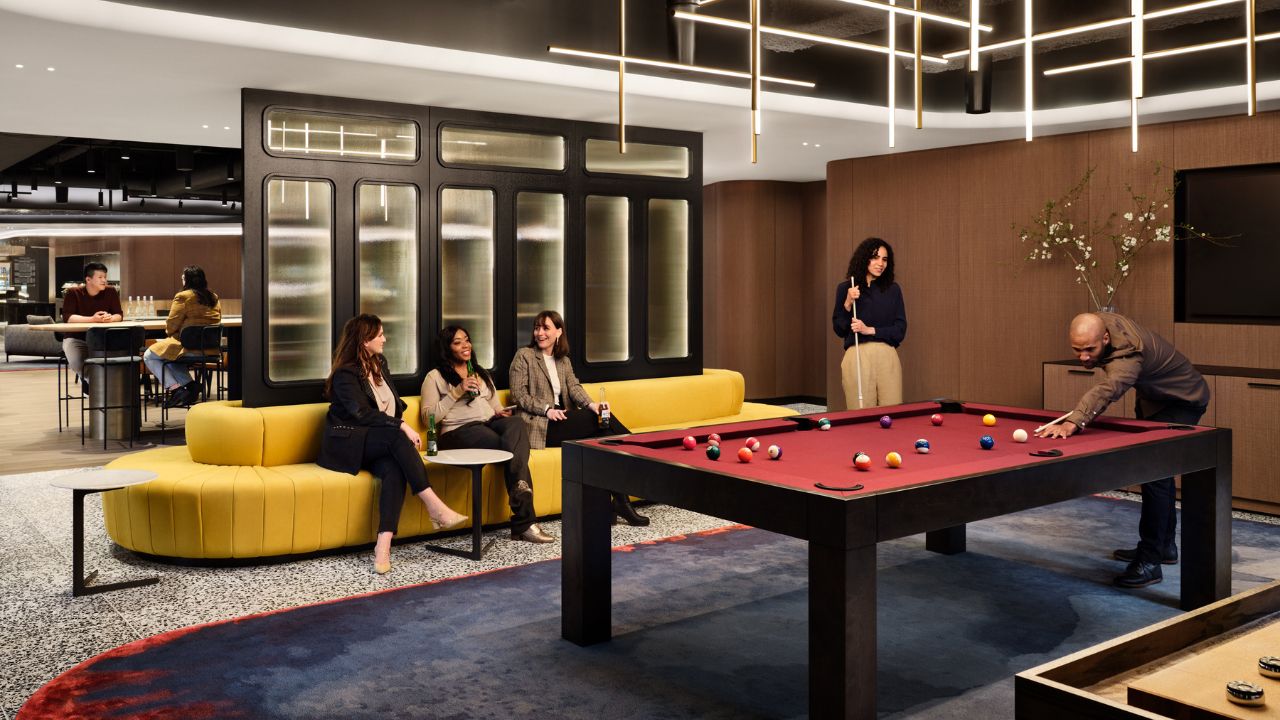
These are complemented by a variety of amenities to encourage community and gathering – think day-to-night bars that transition from barista-staffed coffee spot by day, to happy hour hub by night.
This vertical community of distinct destinations fosters chance encounters and serves to invigorate the strong culture of legal professionals.
Lawyers are looking for spaces that are professional, but also dynamic, collaborative and restorative.
Athletes at the top of their game know to invest in the environments in which they train.
A high-performing workplace goes beyond space effectiveness and efficiency, however, and offers an inspiring and uplifting everyday experience. While many lawyers describe their current workplace environment as feeling like a business hub or a library – that is, professional, focused, and studious – this differs from their ideal workplace setup.
Today’s lawyers want their workplaces to provide choice and variety. While quiet, focused environments remain essential, we see a desire for settings that feel dynamic and restorative.
Floor-to-ceiling glass at the perimeter, full-height glass office fronts at the interior, and oversized glass sliding doors allow light to filter into all offices while encouraging interaction and supporting connection.
Finishes and materials play a large part in creating a hospitality-esque workplace that positively impacts how an employee feels when they’re in the space. For example, specifying contrasting textures in the floor and ceiling finishes anchor each part of the space and guide circulation. Unexpected upholstery colors can create visual interest that feels more high-end residential than typical law firm.
Employers are also integrating outdoor amenities seamlessly into the work environment. Some landlords are offering the opportunity to create loggias within the footprint of the tenant space. And previously unused rooftops are being converted into terraces with pergolas, plants and lounge seating. Fresh air, sunlight, and greenery can all contribute to improved employee performance and happiness.
A great workplace experience for lawyers allows them to choose environments that best suit their needs throughout the day.
Spaces that promote positive social connections can improve how employees work together.
Law firms and lawyers need to collaborate across functional roles to tackle client problems that transcend disciplinary silos.
Within project teams, we found a divide between senior and junior lawyers. Partners have significantly greater awareness of work within their teams and across their firms. They also feel more appreciated and cared about. They see their firms as more innovative.
Junior lawyers could benefit from an intentional approach to relationship building and sponsorship. Physical spaces that are designed to encourage interaction can actively pull people of different backgrounds and generations into professional networks. People are more likely to make a connection if they can easily run into others.
Additionally, a lot of observation and training can happen in amenity rich workplaces that provide spaces to mingle. Spaces that knit partners and associates closer together, promoting a culture of apprenticeship, are vital to building relationships and career success.
Lawyer engagement, innovation, and retention all benefit from exceptional workplaces.
Gensler measures the Workplace Performance Index (WPI) as a combination of how well spaces support work and how people feel about their workspaces. The benefits of creating exceptional workplaces that powerfully support work are clear. Higher performing workplaces impact people’s behaviors and attitudes. Lawyers in higher performing workplaces get away from their assigned workspaces more often, and feel more supported to work in a variety of spaces in the office beyond their individual workspaces. Lawyers in higher-performing workplaces are more engaged, more committed to their firms, and more likely to recommend them as a great place to work.
In closing, Law firms have a real opportunity to reimagine the office as more than just a place to work—it can be a space that energizes, connects, and supports lawyers at every stage of their careers.
The firms that invest in thoughtful, inspiring workplaces will be the ones that attract top talent, spark innovation, and build stronger cultures from the ground up.