About This Episode
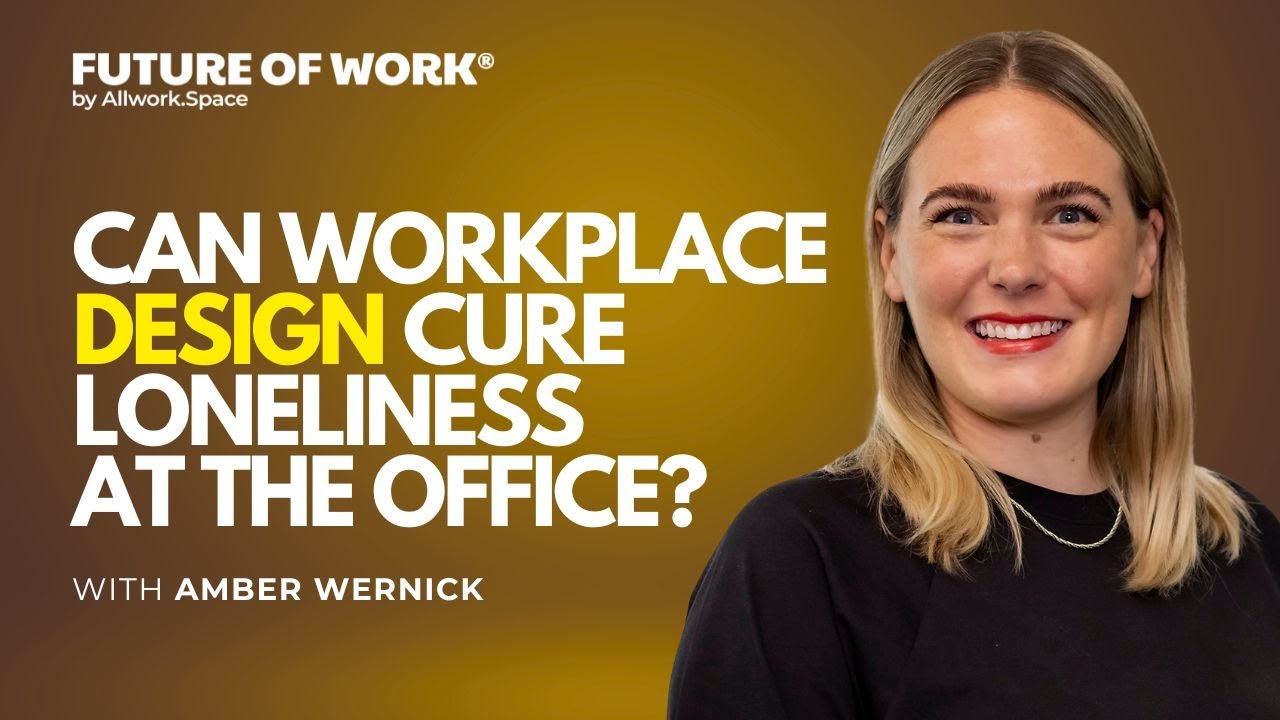
In this episode of The Future of Work® Podcast, we sit down with Amber Wernick, award-winning designer and Practice Development Leader at Perkins&Will. With over 15 years of experience shaping workplace, education, and healthcare interiors, Amber brings a human-centered lens to space design. She unpacks how offices must evolve — from productivity-first environments to spaces that foster connection, belonging, and adaptability. From tackling the loneliness epidemic to designing flexible hubs that accommodate AI, remote work, and hybrid models, Amber shares actionable insights for leaders navigating the next chapter of office life.
About Amber Wernick
Amber Wernick is an award-winning designer and strategist with over 15 years of experience in workplace, education, and healthcare interiors. She collaborates with some of the world’s most creative companies to transform their employee experiences. Focusing on workplace strategy, Amber leads the studio’s visioning, programming, and planning process. As Practice Development Leader, she drives new business growth and fosters strong client relationships. Before joining Perkins&Will, Amber was lululemon’s Workplace Experience Manager and contributed to many notable projects at Clive Wilkinson Architects.

What You’ll Learn
- Why workplace design is central to solving the workplace loneliness epidemic
- The concept of “functional inconvenience” and how it sparks human interaction
- How to design for future flexibility — even in small office spaces
- Why forward-thinking companies are reimagining their headquarters as cultural centers
- Practical design strategies for companies of all sizes navigating hybrid work
- The influence of coworking spaces and third places on corporate design
- How sustainability and modularity are reshaping office infrastructure
- How city regulations are reshaping remote work policy and office strategy
Transcript
Amber Wernick [00:00:00] Design, especially workplace design, really does have the ability to impact people and change lives. I really do believe that. And I think that it’s not just remote workers that are feeling disconnected. It’s definitely people that are showing up in the office, but they’re still feeling alone when they’re there. I think because we’ve dramatically changed the way we’ve worked in the last five years, but we haven’t seen. As much of a dramatic shift, I think, in the design of our office interiors to really like meet the change that’s happening and the way we work.
Frank Cottle [00:00:41] Amber, welcome to the Future Work podcast. It’s really great to have you here. And gosh, Perkins and Will, one of the finest architectural firms in the world, and your role there has been just unbelievable, the new things that you have been doing. We talk a lot about a loneliness epidemic these days. How does design impact that? How can design impact as it relates to space overall?

Amber Wernick [00:01:08] Design, especially workplace design, really does have the ability to impact people and change lives. I really do believe that. And I think that it’s not just remote workers that are feeling disconnected. It’s definitely people that are showing up in the office, but they’re still feeling alone when they’re there. And I think that’s because… There hasn’t been, we’ve dramatically changed the way we’ve worked in the last five years, but we haven’t seen as much of a dramatic shift, I think, in the design of our office interiors to really meet the change that’s happening in the way that we work. So I just feel like a lot of the office spaces are still stuck in the past, designed for productivity and not necessarily, you know, kind of keeping up with, yeah, just the fast-paced changing nature of our work these days. And I really think that, I mean, what we’re recommending to our clients is to focus, you, know, not to focus on productivity necessarily in the office, but on relationship building to really make an impact on this loneliness epidemic, to make people really feel that sense of belonging at work. And so, yeah, I do think there’s lots of ways that workplace design can impact that.
Frank Cottle [00:02:48] You know, it’s funny. My wife and I got hooked on a Netflix program called Mr. Robot. And he’s a cybersecurity fellow, and he works in a cybersecurity office as a technical engineer. Classic, classic cube farm, okay? And everybody is very doggie, you know, up and down looking around and little micro cubes scrunched together, real close, but everybody’s isolated. Everybody’s isolated, so how do you take one of your ideals of functional inconvenience, which I love that idea of functional, I love the term, and some people think it’s functionally inconvenient just to meet. So, you know, I get along with that. But how do you take the idea of functional inconvenience and erase the isolation found in classic cube farms? And I’ll also comment that the office environment this fellow is working in is not big. I’ll call it 5,000 square feet, maybe, maybe 4,000 or 3,000. It’s not a big office. It’s not a big glamorous corporate headquarters. Design is a statement.
Amber Wernick [00:04:11] Right, right.
Frank Cottle [00:04:12] How do you make something like that work? Because most office spaces thought corporate headquarters for Fortune 500 companies. It’s smaller organizations overall.

Amber Wernick [00:04:24] Functional inconvenience, definitely not my idea, but it’s one of my favorite concepts to implement on any project, like big or small, because it really does change the way people interact in the space. So what it is, it’s really like creating these like minor obstacles for people, but it encourages positive behaviors like social interaction. And so. The main thing, the best example and the main thing that I try to do on all projects is instead of having, classically you’d have like little kitchenettes, like in every little corner of the office so that people, it was thought to be convenient, right? Like you didn’t want to have to walk very far to get water or coffee. But then what we’ve realized over time is people get really siloed in their area of the office, even if it’s small. Like you might not actually. Go to the other side of the floor, right? Because you have everything you need right there. And that can lead to people feeling really lonely. They’re kind of in their area. They only interact with their immediate team. And so when you get rid of those dispersed kitchenettes and you create a big central hub, a communal hub where you have, that’s the only place you have coffee, water, and you pull people together. Uh, there that really creates that, that interaction between departments and between people that you don’t interact with necessarily in the day to day work, but it increases the likelihood of those like chance encounters and, um, and sparks, you know, relationships that you might never have otherwise.
Frank Cottle [00:06:11] Well, you know, in the flexible workspace industry, let’s take co-working centers as an example, one of the design theories has always been to establish a centralized galley, a kitchen lounge. We’d be referred to generally as a lounge for that purpose to draw everybody in there and even have casual work. Or refreshment tables there. And the purpose is to heighten the sense of community amongst people that are not related to each other.
Frank Cottle [00:06:50] Um, and it’s very, very effective, uh, just keeping a, a, uh social, uh community, uh atmosphere going, um, and that’s been used for decades and decades, uh. And it’s, um. Uh, very affective overall, but what do you see the, the, the most aggressive design company or companies using how w what are they doing? Looking for in workspace tomorrow, not yesterday, but tomorrow. What are people trying to design for and how is it changed in the workplace? I used to have an executive assistant set at the desk near my office. Now I have, still have an Executive Assistant, but it’s an AI assistant. Right, right. So AI is changing. The personnel structure in organizations allowing for a lot of change. And one of the most progressive companies doing today that you see.
Amber Wernick [00:07:56] Yeah, I mean, I think it’s like designing for the unknown, because there’s just so like work is changing so quickly, especially with AI, and obviously the increase in remote work. And so I think I think we hear this a lot, but there’s I can talk about some like practical ways to really design for like the unknown and for future flexibility, whether that be like expanding. You know, workspace or contracting workspace easily, or like transforming a space into something else.
Frank Cottle [00:08:32] Else. Let me I’m gonna interrupt I apologize but I interrupt you just said expanding or contracting space more easily. Space usually from a you have a building yeah it’s a surprise you have the ownership of that building let’s call it a landlord go back to an anachronistic term let’s call it landlord and then you have attend it another anachrionistic term but the Hemet generally can’t just… Add and shrink space conveniently on demand, only in a flexible workspace, only in a business or a co-working center does that happen conveniently. Most people can’t just do that, so how do you design that capability in?
Amber Wernick [00:09:17] Yeah. So we’ve had clients that have essentially designed their space from the beginning to be subleased. And so a portion of their floor or maybe one example they did, their ground floor was designed with the intention of subleasing in mind where they could expand into it if they needed to grow. But from day one, it was actually a co-working space that they own or they had the main lease on. But then they were actually creating their own co- working environment within their own office space and their own people could work in it if they wanted just like a change of scenery. So it became this like extra amenity within their on suite. But it gave them that flexibility to grow into it eventually. But day one. It was designed to be a co-working space. So that’s one way that we’re seeing that happen. Then of course, like you mentioned, just trying to get more and more flexible with the lease terms is, I think we’re gonna continue to see lease terms move in that direction of the kind of co- working lease terms that you see. I think there’s gonna be a big change in corporate real estate and the way leases are put together.
Frank Cottle [00:10:46] Well, the flexible work space industry, and again, business, coworking, service, et cetera, are now one of the largest tenant sectors in all property on a global basis. And they’re contributing to that, although they generally are on either a long-term joint venture management contract, as opposed to at least something that looks more like a retail or a restaurant deal. But they’re taking a lot of space, but the buildings themselves aren’t. To the first pioneer at that was Sam Zell with Equity Office Properties going back into the 90s.
Frank Cottle [00:11:25] And he built, I want to say 58, in 58 of their high rises, they built a project called Smart Suites. And he took one floor, put his own property management for the building on that floor. And then they built flex space, spec flex space. And I remember being in a meeting with him and a couple other luminaries of the real estate. And it was Hines had asked him in this meeting, he says, well, Sam, why the heck are you doing this? So what does this? What the heck are you doing? This was in the 90s. And he says, what the heck you doing it? And so he says well, I want to be able to service the entire life cycle of my client, not just the larger life cycle, not just a mature life cycle. I want be able, to do with that. And I think that was one of the most forethinking positions to take as a property owner. And yet we haven’t seen anybody else doing that on scale. Since the 90s. And that is a time that has come. So when you’re designing, not just for a corporate headquarters, but for a building at large, somebody wants to put up a 20-floor building somewhere, 40 floors in Manhattan or something, how are you designing, House, Perkins and Will, designing flexibility into those large structures? Because that has to be in the future, or candidly, that model is going to die.
Amber Wernick [00:12:54] Right. Yeah, I think when it’s a company that’s going to own, you know, that’s building the building, owning the building. Even if they intend to occupy the whole thing, like I said earlier, like we’re talking to them about creative ways to think about expansion and contraction in their own building. And we’re looking at not only like subleasing, you know, certain portions of the building, but you know creating, even if they say they’re gonna be the sole tenant, you know looking at, well what happens if we introduce a multi-tenant corridor? You know, making sure that that works with the building core, the way the building is designed from day one. So that it’s not this like intrusive, it’s on this like entire redesign. If they do end up having to split up the building in a lot of different ways.
Frank Cottle [00:13:57] Well, that wastes a lot of space that takes a lot.
Amber Wernick [00:13:59] Exactly, so like kind of designing that in from day one and not having like critical program in that in that portion so that way it doesn’t take a lot to add it in later. I also, I hope and I’ve started to see it a little bit more in the states but raised access flooring is super popular in Europe and Canada and that’s something where I’m not seeing quite enough of in the States, but I think, I hope that that will become more and more popular because that gives so much flexibility in terms of power, HVAC, reconfiguration to do it under floor versus traditionally above. So I think certain like flexible infrastructure that maybe some other areas of the world are a little bit more, it’s more common. We’re gonna start to see, I think more and more of that. Um,
Frank Cottle [00:15:00] Well, all of those things are more expensive to build. And so there’s a cost. And the only way to offset that cost is through increased efficiency overall. Do you think that the fact that corporate headquarters, or our corporate headquarters? I’ll ask the question. I won’t put it there. Do you thinks corporate headquarters are going to shrink? And Flexibility in corporate design, which will trickle down, there’s always a trickle-down theory to small and medium enterprise design, or even overall building design is going to increase materially, and if so, how?
Amber Wernick [00:15:44] Yeah, I mean, I do, yes, I do think that corporate headquarters are going to shrink. Like we’re already seeing generally a reduction in square footage. And so I yeah, I do think that that is already starting to happen. The just square footage needed overall from from especially large corporate companies is is going down and then I think, yeah, the flexibility, the more flexible kind of, it’s called the kind of the hub and spoke model, right? Like the hubs are decreasing. I think the spokes are definitely increasing.
Frank Cottle [00:16:27] I ask a question, do you think the spokes are increasing in size or increasing in number?
Amber Wernick [00:16:32] I think increasing in number is what is what we’ve been seeing like companies are starting to think about a little bit more of a like dispersed footprint in real estate versus this like centralized footprint for a lot of reasons like attracting talent you know in different areas of the country and I think attracting a lot it is is recruitment like lower commute times and things like that. Just more convenience, right? To get into a hub with others that work together.
Frank Cottle [00:17:08] I think that’s the big foundation of the return-to-office argument. It’s not the office, it’s the commute.
Amber Wernick [00:17:16] Yeah, exactly, yeah.
Frank Cottle [00:17:18] It’s the robbing people of, on average, an hour and a half to two hours a day, 10% of their life almost, just for the privilege of working for you. And the people, the workers are saying, yeah, you know, you’re not that cool. I’m not willing to donate another 10% to my life to you. So
[00:17:42] It’s a huge factor.
Frank Cottle [00:17:43] Build me in spoke, let me go to a third party, let me to a business or a co-working center, let me work remote or put me on a, and that was a recruiting issue well before the pandemic for primarily the tech industry. You couldn’t hire a senior engineer unless you had a flexible place in the 16, 17, 18 time period. That was a major problem. And I think that’s when remote work really started effectively. The pandemic just publicized it.
Amber Wernick [00:18:13] Did into high gear. Yeah.
Frank Cottle [00:18:15] Yeah, exactly. And it really did. And now I don’t think we’re ever going back. The pendulum, I think, will swing. It won’t be extreme. 90% remote work. That doesn’t function well. But I think we’ll end up in a 60-40 rule of some sort of 60 in office, most likely, and 40% out. That changes the profile of commercial real estate randomly because Now, as an operator, as a company, I don’t need 40% of the space that I had before. Right. And so what does that do to the economics of a large building? I see all the leases being downgraded in the large buildings, very few of them being up.
Amber Wernick [00:19:03] Right. Yeah, most of the new projects that we’re starting are, you know, the companies have downsized and are just completely rethinking what the office is for. They’re taking an opportunity with the downsize to, yeah, just like reimagine the office space and have it be something different than it was when it was much larger.
Frank Cottle [00:19:31] Well, I heard a corporate headquarters, a particular CEO that was kind of chest pounding and saying that he considered their corporate headquarters to be a cultural center, not an office, not a workplace. That that was what they were trying to accomplish. And I think that that sounds good and might even be a good idea, a good thought process. Are you seeing that type of thinking across the board? Because I thought this was a one-off.
Amber Wernick [00:20:02] No, we are seeing that, I wouldn’t say necessarily across the board, but yeah, we’re seeing many of our clients, I would say the majority of our client’s wanting the office to be that cultural center that represent the kind of physical manifestation of their brand and culture, even the smaller companies. One of our clients in particular, they are a remote first company, so most of their employees work remotely, and so they’ve downsized their real estate significantly into kind of one headquarters here in DFW, and they’re reimagining it completely to be that communal space. So it’s got training rooms for like onboarding and learning. They’re bringing people in, you know, maybe once a quarter or once a month to do those things. Like big town hall spaces where they have their like all-hands meetings once a quarter with their entire group. You know, they’ve got places, they got like film studios where they’re filming their online training since they are fully remote. So just like totally different like types of space, I guess. Than what we’re used to seeing. But they’re just using their headquarters in a very different way, where it used to be just like desks and desks, desks in offices everywhere. Now it’s like, you know, larger brainstorming rooms where they bring people together. You know, I think they’re only seeing their remote employees every other month. And so it’s those kinds of places where they’re coming together versus Yeah, that kind of like individual heads down workspace that we saw in the past.
Frank Cottle [00:21:56] If I can ask how what’s the size of that company? How many employees do they? Yeah, they’re distributed
Amber Wernick [00:22:03] So they’ve got in DFW, that’s a good question. They’ve got about 500 that will be like hybrid, like coming into the office three to five days a week in that headquarters and otherwise they’re all remote. And I don’t know, there’s thousands, there’s 1000s of remote.
Frank Cottle [00:22:29] OK, thousands. So it’s a large company. Oh, yeah, yeah. It’s a larger company. And its business profile allows that much remote work, that sort of thing. It could be a large contact management company or something of that nature. What about the 2010-2030 person company? We talk about big buildings and big companies and all that sort of thing. And the little guys kind of, I don’t know whether they’re stuck in the past or they’re just left out of the most active design thinking. But I don’t hear from large firms like yourself too many examples of what’s happening in that sector. Are they all going into business and co-working centers and breaking up and so they don’t need space anymore because they only have 10 employees and that worked economically and flexibly. Are they using others? Are they designing the space themselves?
Amber Wernick [00:23:32] Yeah.
Frank Cottle [00:23:33] In the same way, because they don’t have a scale.
Amber Wernick [00:23:36] Yeah, yeah, we’re still designing. We’re definitely designing spaces for 20 to 30 person office. And I’m sure there are some that are going to co-working spaces. But there are still a lot that do want their own space. And they’re thinking about all of this on just a smaller scale. Like we designed, I’ve been doing. Yeah, we designed one recently that was very similar to like a coffee shop kind of feel like where we’re really like the office space because there was only 25 of them, you know, max on any given day coming into the office. You know, we really we really designed a small a small space that felt felt like a coffee shop, you know, it just had this like kind of vibe to it more like a working space, but it was theirs. You know, they still wanted to be able to have their own, their own space that they could, you know, reflect their brand and their culture within it. And they did want to have still a nice size, you know training space to bring people in. The building that they were in just didn’t have one of, a lot of times the building does have like a nice infinity space, right? You don’t need that. But this particular. Um, you know, client did want to have, um, their own kind of larger meeting space that, um on a day-to-day basis, it kind of, it, it functioned as, um kind of a, it opened up to the main, um kitchen area. And so it just kind of functioned does a coworking area, but then they could close, you have this large kind of retractable door and it became a training space when they had their monthly training sessions. So we are still seeing. Yeah, these smaller companies, but just at a smaller scale implement these same ideas.
Frank Cottle [00:25:33] Well, there are two questions that come out of that. That’s interesting. We’ve referenced and you’ve referenced, gosh, a number of times in this conversation, kind of like coworking space, kind of things like that. Do you think that coworking or the old, came from executive suites, the business center, the serviced offices, now rebranded as coworking, that whole evolution that started in the 1970s, I started in 79, so I’m real well. I’m the old guy, if you will. But do you think that that industry has materially influenced the way that corporate design is done today to where corporate design’s trying to emulate it a little bit?
Amber Wernick [00:26:16] I do say.
Frank Cottle [00:26:16] Or the way that larger buildings are trying to rethink the way they’ll have to do leases.
Frank Cottle [00:26:21] And things of nature. On the one hand, that’s one question. And tie that in new design to the old economic model in real estate of total allocable overhead and square foot per person. Okay, people used to say, well, I need, I can only allow 185 square feet per person. I have to keep my total allocable overhead in operations down there. That’s the old real estate department of the 80s, 90s, early 2000s. Old thinking. But a lot of that’s still out there, particularly in places like government. We still see that. But I just asked you seven questions. So we’ll tie that together if you can.
Amber Wernick [00:27:08] Yes, yes. So to answer your first question, I definitely think that co-working has influenced workplace design. And I think a lot of what influenced co- working was kind of the hospitality sector and retail sector. So I think all of that, right? And I think even more now that there’s people working kind of in a hybrid way or remotely. We’re taking influences from those third places that people love to be in, like hotel lobbies and coffee shops and even university libraries where you’re kind of alone together, like you’re in this space where you are with others but you’re working alone, so there’s this buzz behind you. I think people enjoy working in those environments and so we’re definitely seeing those environments influence. Workplace design. And then, let’s see, your other question was, oh, about like, yes, square footage per person.
Frank Cottle [00:28:15] Because creating a highly flexible workspace with a lounge space, meeting space, alone together, blah, blah, all these things is a lot more expensive. Yeah. Yeah, it’s a lot more expensive and
Amber Wernick [00:28:29] Well, actually, what we’re seeing, so what’s also very expensive is a lot of private offices. And so open workspace can be reasonable when you’re not building so many. Some of our clients still, like a lot law firms, for example, will have majority of the space is private offices, that’s very, very expensive, as you know, because you’re Delivering. Um, you know, HVAC and electrical and everything to each individual office. Whereas you can do, you can kind of create that, um, that third place, that, uh, that kind of coffee shop feel and an open environment that, um, is, is a lot of like furniture solutions and not as much, um, like architectural, right? So there’s, there’s ways to do it reasonably, um where it’s not, you know, it doesn’t have to be this like really elaborate, um. You know, Four Seasons Hotel lobby, right? So I think there’s definitely ways to, um, you know to achieve it. But yeah, the square footage per person, I mean we’re, we’re not really, I haven’t used, I haven’t like looked at those metrics in a long time. We’re looking at things like, um, like seats per person. Like how many like work points do we have? Like what are the different places available for people to work from? We’re, looking at like, So I think we’re talking more in terms of work points and less in terms of like allocated square footage per person. And we’re even breaking down for companies like how many work points do you want that have technology at them? Like have a monitor. How many workpoints do you want where it’s just comfortable to work from a laptop at? And how many were points need to be inside of a formal meeting room versus out in the open and kind of a collaborative area. So we’re kind of. We’re breaking it down like that because then they’re able to see at any given point, you know, like what, um, how many people can we fit in the office? How many can come in at one time?
Frank Cottle [00:30:38] Well, you know, there’s… The variety of technologies that measure how many people are in the office, how many warm bodies are at, how many deaths for how many hours, all that sort of thing. That’s been going on for decades. And I think that the private office or even private cube model for each person has proven to only be about 40 to 60% density effective in the past. If you have a hundred or a thousand employees, the likelihood that they’re all sitting at their desk at any moment in time is zip.
Frank Cottle [00:31:18] Yeah, I mean, this is forever. This has been going on. We can go back to the singer design concept and probably do the same thing a little bit. So that’s always been there. But I think that companies today aren’t, while they’re designing, everybody likes a good-looking office. Everybody likes comfortable, nice space, et cetera. As a strategy, a business strategy, has to be deployed today much more than it did in the past. In the past, we built corporate monuments to ourselves. Big, flashy, this and that. The strategy was to announce how powerful and how capable you were as a corporation. Today, space is more of a strategic issue of an operational issue. An office is looked at more like a manufacturing floor in some respects of, you know, here we do this, here we do that, and how it all flows together to get the product out. How How are you seeing strategic thinking evolving in space?
Amber Wernick [00:32:32] Yeah, I mean.
Frank Cottle [00:32:33] Not what you designed yesterday, but what you will design five and 10 years from now. And I think that that’s where we have to point because space, I mean, it’s bricks and mortar, baby. It’s tough to change once it’s designed.
Amber Wernick [00:32:51] Yeah, I mean, we’re asking those big questions about, how will you be working in five years, in 10 years’ time, to the kind of key stakeholders in the early visioning process, and trying to get them thinking strategically from the get-go. And we’re working with… A lot of departments, operations, HR, technology, like within the organizations to really see, like try to forecast and look into the future. If the organization has a strategy arm within it, we’re engaging with those folks and looking at what are they looking at in the future for this organization because. Yeah, we really need to get to know their business and where their business is going in order to best support their business in the physical space.
Frank Cottle [00:33:50] How creative do you see companies being in that regard as they look forward? Are they sitting at their comfort level? Hey, this is the way we’ve always done it. Those most dangerous words in business, right? Yeah. Versus, no, we think our company is going to evolve materially in the future, and everybody will have a partner desk, and the partner of the other partner will be a robot. I mean, that sounds kind of extreme, But how far are people really thinking? Into the future and
Amber Wernick [00:34:24] Yeah, I think I wish they would think to that extreme, farther into the future. We often will give them examples of some futuristic thinking about how work will happen in the next 10, 20, 30 years. But a lot of times, they are thinking more and that like. Five to 10-year range because that’s usually what their lease is for. But even that is helpful because we can kind of prompt them and show them some futuristic videos and examples of what other companies are doing to kind of get their wheels turning a little bit. But it’s really up, Like you said, it’s up to them and just how future and forward thinking are. Are they going to be and just how, especially if they only have a five-year lease, you know, like just how much are they really investing in their office space? And I think we are seeing, like you mentioned brick and mortar, like we are saying and we’re trying to focus more on furniture solutions and like modular solutions within office space and less like built. Um you know jib and you know things glued together and bolted to the floor because the more the more of that you know the more just like ends up not only is it um just like bad for investment because you can’t take it with you when you leave or you can’ t sell it when you don’t need it anymore um but it’s not sustainable either it’s you know it’s ending up in landfills at the end of these leases and so we’re really recommending modular solutions for millwork and for walls and. You know, a lot of the of the office space being able to be, yeah, taken with them at the end of their lease term or recycled, reused by a different tenant instead of just completely, completely demolished at the end of it.
Frank Cottle [00:36:33] No, I mean, that is important in today’s world overall. And I think most companies make that decision based a great part on economics.
Amber Wernick [00:36:46] Thankfully, a lot of that’s starting to come down in price and be a lot more comparable to traditional building.
Frank Cottle [00:36:55] Amber, thank you. You’ve been delightful and I’m very grateful to you for sharing the positions that you and Perkins and Will have established as such a foundational firm architecturally in the world. I’d love to explore some other things with you another time if we have a chance. If somebody wanted to reach you to talk about their own design needs, I’m plugging you here as a firm, how would they do so?
Amber Wernick [00:37:24] Yeah, you can find me on on LinkedIn. I’m pretty active there and then and then by email amber.warnick at perkins and will.com
Frank Cottle [00:37:35] Perfect, perfect. Thank you very, very much, Amber. Really appreciate your time today. Yeah.
Amber Wernick [00:37:40] Yeah, thank you.
Frank Cottle [00:37:43] If it’s impacting the future of work, it’s in the Future of Work podcast by allwork.space.