About This Episode
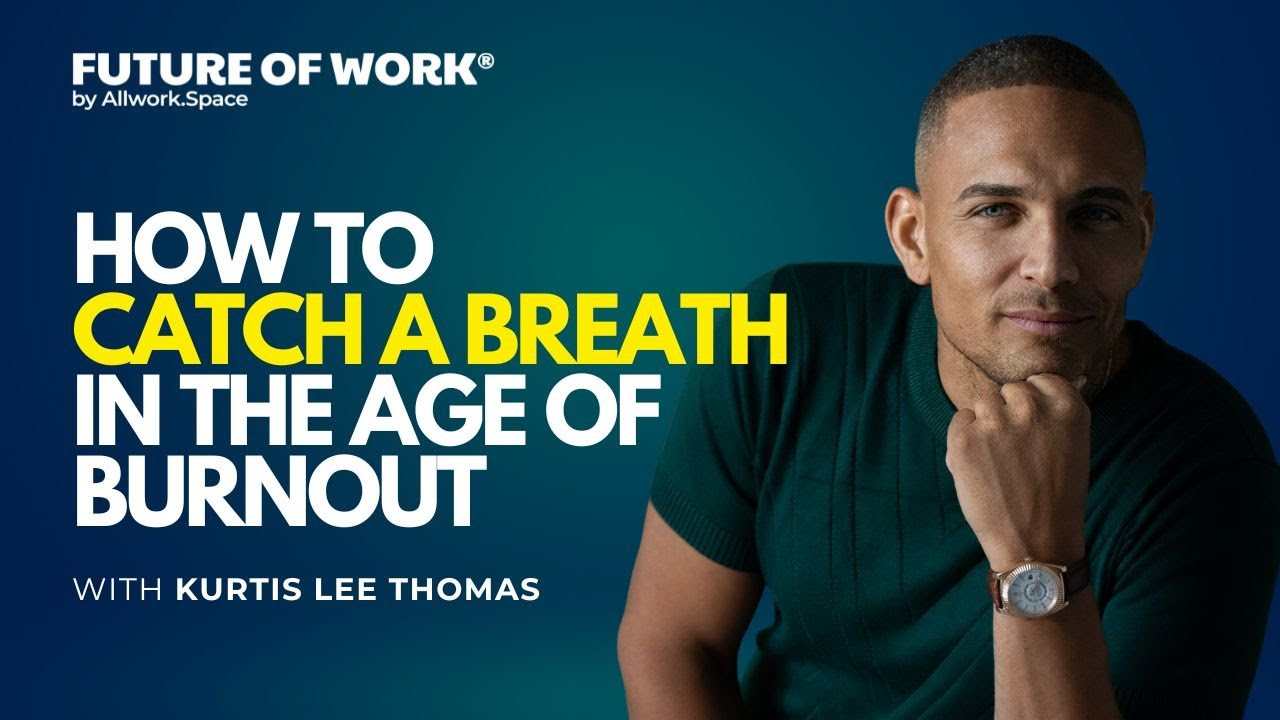
In this deeply reflective and eye-opening conversation, The Future of Work® Podcast welcomes Kurtis Lee Thomas, founder of the Breathwork Detox modality and Just Breathe Foundation. Voted #1 Employee Wellbeing Provider by HR Magazine and trusted by organizations like NASA and Nike, Kurtis shares how breathwork is redefining workplace wellness by tackling trauma, burnout, and stress from within.
Together with host Daniel Lamadrid, they explore why stress costs companies over $300 billion annually, how trauma lives in the body long after it’s forgotten, and why sighing may be the most underrated wellness tool at work. This episode offers practical tools, science-backed insights, and a radical call for leaders to prioritize well-being as essential business infrastructure — not a perk.

About Kurtis Lee Thomas
Kurtis Lee Thomas is the founder of the Breathwork Detox Modality, a powerful method for reducing stress, anxiety, and massively improving mental health.
He’s also the founder of the Just Breathe Foundation, which has worked with major organizations like Nike and NASA, athletes and celebrities to spread awareness on the current mental health epidemic. Kurtis was featured on The Today Show, voted #1 Employee Wellbeing Provider by HR Magazine, and he’s also the #1 International best-selling author of THE WORLD IS YOURS, and HOW TO THRIVE IN THE AGE OF ANXIETY.

What You’ll Learn
- Why burnout is at an all-time high — and what companies are missing
- The surprising ROI of investing in employee mental health
- What breathwork actually is and how it differs from other wellness trends
- How trauma hides in the body and impacts workplace performance
- Actionable breath techniques anyone can use during the workday
- How Gen Z is pushing for a new kind of wellness-centered workplace
- Why “self-care is not selfish” — and why leadership must model it
- The future of workspaces: From phone booths to breathwork booths
- The science behind energy clots and why they matter in your career
- How leaders can spot stress and burnout before it’s too late
Transcript
Kurtis Lee Thomas [00:00:00] Eight out of every 10 employees are experiencing it. US companies alone are spending $300 billion per year in issues directly related to stress and missed work days because of stress. I think it’s the awakening within the corporate culture to realize that implementing mindfulness into a corporation isn’t just making yoga an option on Saturday mornings. It’s much deeper than that and it needs more care.
Daniel Lamadrid [00:00:29] Welcome back everyone to the Future of Work podcast. I’m Daniel Lamadrid, Associate Publisher of AllWork.space. And today I’m with someone who I’ve been looking forward to meeting and exploring their subject matter expertise. Kurtis Lee Thomas, welcome. It’s nice to have you.
Kurtis Lee Thomas [00:00:48] Thank you for having me. I appreciate it.
Daniel Lamadrid [00:00:50] Awesome. Today we’re gonna be talking a little bit about what is going on in the workplace. And as many are calling what we’re living today, the infinite workday. Burnout, stress, anxiety, it’s all coming into this big snowball effect where both leaders and employees, regardless of their level within their companies, are feeling it. They’re feeling it and we’re going to be talking about your breath work detox and how this could help any professional, any leader at any stage in their careers. Having said this, Kurtis, what are you seeing on your side of things in regards to burnout and anxiety? I mean, because there’s a lot of, there’s a lot stats out there and reports, but I think overall what everyone is agreeing with Is that burnout? Is it an all-time high? A out of 10 employees feel exhausted. They’re coming into work not knowing what they’re doing. I can sometimes relate to that. But what are you seeing on your end?

Kurtis Lee Thomas [00:01:57] Yeah, what I’m seeing is that things are catching up to people and, you know, when you go through a lot in your personal life and that’s always going to bleed over into your professional life because wherever you go, there you are. So it’s going to follow you and I think it’s catching up because the world went through a lot with the whole COVID situation and then people’s personal lives and then, You know, the workforce has changed as well. And then now. Companies are downsizing with less employees, but now they’re getting more responsibilities and more burdens and burdens lead to burnout. And the issue is that upper management is not, and they’re part of it as well, but they’re not realizing how significant of an issue it is and the money it’s costing them by not helping their employees manage their stress. There’s a saying that goes, men lie, women lie, numbers don’t. And that’s the reason why you know, are pretty outrageous. You know, eight out of every 10 employees are experiencing it. US companies alone are spending $300 billion per year in issues directly related to stress and missed work days because of stress. So I think it’s the awakening. Within the corporate culture to realize that mindfulness, implementing mindfulness into a corporation isn’t just making yoga an option on Saturday mornings. It’s much deeper than that and it needs more care.
Daniel Lamadrid [00:03:40] Yeah, and I believe, and we’re gonna get into it, but there’s data out there that proves that for every dollar a company invests in an employee for their mental health or wellness, however that may be through yoga, mindfulness, therapy, the ROI is twice as much. And they’re not seeing that, right? For every dollar they invest, they’re getting two in return and they keep their employees happy. Productivity goes up. And I really found something interesting that you just said. It’s not just a bottom down issue, it’s also a top down issue. Currently managers, they’re in charge of making sure that their team is well and they’re all doing what they’re supposed to be doing. But right now there’s also a thing where managers have reached a burnout level that we haven’t seen before and who’s taking care of them, right? And something that you propose and you’ve worked with Fortune 500 companies, including NASA, is something called the breathwork detox. And it sort of talks about how one can find peace and tranquility within their own breath. And I’m curious to find out what this breathwork detox is. Tell me a little bit more about that.
Kurtis Lee Thomas [00:05:02] So first of all, I’ll explain what breathwork is because people might not be familiar with that term. The yogis might know it as pranayama. Breathwork, they’re like, what is that, breathing? Breathwork is an umbrella term like yoga. There’s many forms of yoga, kundalini, yin yoga. So there’s many of forms of breathwork. And what I… Specialize in and I teach, train and certify people to go out there and lead this particular modality that I created is breathwork detox. Breathwork detox is by far the most powerful somatic cathartic breathing technique in the world. So you’re going to get more results than any other breathing technique with this particular technique, breathwork, detox. Now, I do teach other techniques, but those are more used for the maintenance. And what I mean by that is that there’s so much stored stress and trauma that people hold onto. And trying to get rid of that with like a simple nose breathing is like trying to clean your car with a toothbrush. So how I like to give you the analogy, breathwork is like cleaning your car with a power washer. Right. It’s the deep clean that you need in the very beginning. And then once you get all that stuff out of you, well, then now you can go to the, the maintenance, which is the toothbrush and you know, the fine, the fine and that’s particularly that that’s my method of approach.
Daniel Lamadrid [00:06:36] Okay, okay, I mean, it makes sense. And you’ve worked with, you’ve implemented and worked with athletes, NASA, Fortune 500 teams. What do they all have in common when it comes to stress? And then I wanna touch on a little bit on what you mean about trauma, but what do all these people, companies have in comment when it come to stress.
Kurtis Lee Thomas [00:07:04] Yeah. So what I think, you know, the bottom line is we’re dealing with people and it doesn’t matter what company or corporation that they’re in. Um, they’re people at the end of the day. And people are, they, they human, they have issues, they are problems, they have stress, they you know where we are far more alike than we are different. What I learned about the different companies is that working with a more right-brained company like Nike is different than working with a very left-brain company like NASA. So I’m more careful with my words because when I go into companies like NASA or the Capital Group, which is a huge financial institution, they’re very left brain, they’re analytical, logical, they want to see the science, they want see the facts. So when you start talking about you know, trauma and, you know knotty system and energy. They’re like, what’s this guy talking about? Right. So I really dial in and pay attention to how I communicate what I do to these different organizations. But at the end of the day, they’re all humans and they all carry the same, you know, emotions, the same issues. It’s like, we’re all just living out our human experiences and in different vessels with different circumstances, but we’re all experiencing the same exact emotions. That’s how I work with them and, you know, the bottom line is I truly believe we’re far more alike than we are different.
Daniel Lamadrid [00:08:28] Yeah. I mean, kudos on that because I mean what you just said rings true. And I believe a lot of companies, like you said, might think that this sort of stuff is very hippie dippy, if you will. I’ve heard that a lot, but I think we’re at a time and a place in the world and the universe in our lives when we got to seek alternatives to feel better. And I think one of the best things that’s happening right now is the entry, if you will, of Gen Z into the workplace. They’re redefining what work is. They are more prone to adapt and implement these types of strategies. And I’m really hoping and looking forward to seeing how Gen Z continues reinventing the workplace, you talked a little bit about trauma. What do you mean? Is this trauma that employees bring into the workplace from their homes? Is it trauma that initiates within the workplace? I mean, what kind of trauma is it? And how do people how are people carrying it around within the workplace where we’re in their lives?
Kurtis Lee Thomas [00:09:37] So trauma is a bit of a kind of big, scary word. And some would be like, well, I don’t have trauma. I just have stress, but like not thinking you don’t have trauma probably means you have more of it than you’re consciously aware of. And it’s like trying to swim in the ocean without getting wet, you know, it’s, you’re going to but how, let me explain what that is because our definition of trauma and our definition of pain changes as we get older. So for instance, you were younger, you We were kids. If we didn’t get picked in dodgeball and we were last, or we got pushed off the swing, right? Or we got bullied. Now that’s silly stuff to us now as adults, but as a child, that’s traumatic. And what happens is we don’t have the emotional intelligence as children to process those emotions. So what they do is they actually store in the body when your mind can’t process them. You know, the mind always tends to think in the future, but the body holds onto the past. That’s why they say the issues are in the tissues and the body keeps score. So then now this is the reason why the CEO, this manager is going through their day and their lower back is always sore and their shoulders always hurt. And this pain, and then you just learn to live with it, it’s actually a blocked energy inside the body from storage stress or trauma, whatever it may be. But we have the ability to clear that stuff out. We just were never taught. And once I found this technique that directly links to all the energy highways in the body and it begins to clear those things out. That’s when it was a game changer for me because people have, you know, you heard of blood clots and you have a blood clot. You can have a heart attack and you can die. Well, no one’s talking about energy clots. And how does energy cluts affect us? Well, it’s responsible for your fatigue. It’s responsible for your burnout. It’s responsible for your foggy mind and thinking. So when we clear that energy out of the system, all of a sudden you turn back online. And I think that is what people need to understand. If I was to give an analogy, we have blood in our bodies, right? And we know that gets distributed through veins and arteries. Because anatomically you can cut it open, you can see it. How does energy flow through the body? And people don’t understand that. But most people, even science, will agree that humans are made up of more energy than matter. And we all believe in energy, no matter what you wanna call it. So if we all belief in this thing from Western to Eastern medicine, well, how does it get distributed? Just like the blood goes through the veins. Well, it gets distributed through this very intricate energy system in our body called our nadis. There’s 72,000 energetic highways. Our body where the energy flows through and if they get blocked or something gets stuck in there because what’s emotions energy and motion and when that gets stuck just like a river is you know has this water flowing and if something hits there now what does it have to do it has to go in another direction and when your energy starts to go to another direction it’s not supposed to it wreaks havoc on your nervous system makes you feel uncomfortable in your own body you feel anxiety you feel all these, you know, weird emotions. And that’s my biggest discovery. From, you know, over a decade of trying to figure out this life thing, you know.
Daniel Lamadrid [00:13:08] And I think, I mean, what do you think? Because. Employees, some are working remotely, some are in the office, some hybrid. Do you believe that it’s up to an employee to figure all these things out for their own sake, for their good as professionals and continue to grow? Or is it sort of a shared responsibility between employees and leadership? Who? Who should be looking out for these things? And if leaders, whether that be shared or not, what should leaders be looking out for as red flags or warning signs for their employees to either identify that there’s trauma, a specific employee has trauma or that the team is burnt out? What are your thoughts on that?
Kurtis Lee Thomas [00:14:04] So my thoughts on that is leaders are supposed to lead and we leaders bring to their, to their people what’s in their best interest, you know? And I think it is up to the leaders, but I will also say this, you know, as far as the people, the employees, you know, that thing that happened to you in the past may have not been your fault, but your healing is your responsibility. It is their responsibility to realize when they need to, you know, take care of themselves, right? Self-love and self-care is not selfish. And I think the employees need to… So I think, the employees, need to demand this. I think it goes bottom up, top down, because when the employees show the demand, and there’s enough demand, the corporations will give the supply. And And those leaders, that’s why for me personally, I like working with C-suite executives and leaders because if I can change their perspective on mindfulness and mental health, and they have a shift, well now they wanna bring it to everyone. Bring it to the people they love and their family and then their employees. And that’s where I’ve had the most success. I’ll give you an example. I did an event at the Capital Group now. For those who don’t know who the Capital group is. They managed $2.4 trillion in assets. I did an event, 150 C-level executives, and at the end, this guy was kind of waiting in line to speak to me. He came up to me and he said, hey, I was one of the people who was very skeptical to bring you here. And I was like, oh, okay. And he’s like, and he put out his hand. He says, but I need to shake your hand because you just made me a believer. And then he walked away. Come to find out is the co-chair of the entire, you know huge organ And they invited me to go teach their Hong Kong office. And, you know, that’s when you impact the leaders, that’s where I see things really move the needle.
Daniel Lamadrid [00:16:14] Yeah. And it’s funny that you mentioned this because. I don’t know, I mean, I might be closed-minded or left-minded. Like you say, I tend to be skeptical about things, um, through my own fault. And through joining podcast episodes with people like you, I am starting to think more outside the box. It’s something that we need to talk about and explore further, which is why I’m, I’m really. Excited about this episode, I hope we get the word out on how alternative solutions can be helping both leaders, employees and the workforce overall. In this story that you mentioned, do you consider yourself a healer? Do people consider you a healers?
Kurtis Lee Thomas [00:17:07] I think other people would consider me a healer. And I think any real healer knows that they’re not healing anybody. We’re just showing them the way or the tools and the resources within them so they can heal themselves. And I truly believe that.
Daniel Lamadrid [00:17:25] Amazing. Yeah, that makes sense. That makes that makes total sense. What, what do you see the workplace looking like in maybe five to 10 years? What would a well workplace look like in 2030? According to you, what is it that leaders would be We’ve started to implement that we would already see results in in five to 10 years. What are your thoughts?
Kurtis Lee Thomas [00:17:57] Yeah. So, you know, remember when Google set the precedent for workplace culture and they changed the game and you know a lot of people to come and flip flops and they had ping pong tables and they add, you know,
Daniel Lamadrid [00:18:13] beanbags and the slides from one office to another. Yeah, yep.
Kurtis Lee Thomas [00:18:17] There’s like a circus in there, right? It’s like, and you know, that was cool. And a lot of companies started implementing that culture. Well, after COVID, you know nobody wants to go into work anymore. So all those things really don’t matter. And so many people are working from home and the statistics are going up. So what I believe how Google, you know, is like, hey, we need to build really cool offices and workplaces so people want to come to work. I think the shift that we’re going into now is how much do the employees care? I mean, the company care about their employees, right? And how do they show that care? And I think by implementing mindfulness and realizing that it’s not just hustle, hustle, hustle. Really given them the tools and the resources for real mental health, real, real mindfulness and watching them dial in. And I see a lot of studies and statistics where companies will be measuring the HRV, which is the heart rate variability, which is said to be the one main indicator if you’re gonna measure any one thing on someone to see if they have good health or not, it would be HRV. So we’re going to do some technology with that as well so we can go into corporations and show quantifiable results. And I think that’s what it’s going to be about. It’s going to be mental health and actually caring about the employee’s wellbeing. So wellbeing packages are going to skyrocket. And it’s already happened even behind the scenes when we got by NASA, NASA paid us through their health provider. And never before was I ever paid through like Blue Cross. And I was like, this is new. Like I got paid by Blue Cross to do this corporate event and it wasn’t cheap. So I saw that that change is happening behind the scenes. So that’s gonna be a big deal when these insurance companies start recognizing what it is that we do.
Daniel Lamadrid [00:20:19] Yeah. And I think you’re totally right. And there’s data that proves it. Companies now seem to be investing more on the mental health and well-being of their employees. And the, I mean, the well- being industry is skyrocketing. Billions, trillions. If that, I I’m really looking forward to seeing that future that you envision. I do think that somewhere we’re going to get hopefully sooner rather than later. I was wondering if, yeah, sorry, go ahead.
Kurtis Lee Thomas [00:20:57] Wanted to interject is inevitable. It’s not, it doesn’t, it’s not an option. It has to happen because people are going to start burning out left and right. And they’re going to leave those companies who are great and paying them well, and they’re gonna go somewhere else from where else was somebody who actually cares about their wellbeing. And I see it right now. There’s people in corporate rooms, you know, I just hired one girl, she was making 450,000 a year, took a tremendous pay cut because she wants to be a part. Of the vision of what we’re doing. And there’s so many people like that. There’s nurses that burned out that I go and certified. They were teaching breath work full time now. Coaches training, like it’s inevitable. They have to do it. It’s just a matter of who’s gonna be the leader of the movement like Google was back in the day.
Daniel Lamadrid [00:21:44] That’s amazing, yes. And I think ping pong tables and all these types of things, employees right now are seeing right through that. That’s not something they want, especially now that more and more companies are mandating return to office and trying to convince employees that they’ll have beanbags and focus rooms and this and that. They don’t care. I mean, we can all be playing ping pong and still be burnt out, right? It’s the healing from within that people, companies mostly need to focus on right now.
Kurtis Lee Thomas [00:22:19] A company retreats will skyrocket too. That’s going to be a really big thing.
Daniel Lamadrid [00:22:23] Company retreats. I hope so. I hope. Do you think we could take our listeners through a little mini reset, something they can do within their workspace, either if they’re working from home or at the office, at their desk, at their commute? Is that something you think we could do together right now?
Kurtis Lee Thomas [00:22:47] Yeah, so I’ll give you one of my favorite. This is a good one to do at home, and I’ll tell you why. I believe this is actually the most underrated breathing technique out there. And it’s called the PSY. So think about this. The body is the most advanced biomechanical machine on the planet, right? What does the body do when it’s pinned, has all this pent up stress and pain and tension? It goes like this, it goes like and then when it needs to release it goes. It does a sigh of relief. The sigh is the body’s natural pressure release valve when pain, tension, and stress accumulate to the highest level.
Daniel Lamadrid [00:23:35] And we tend to do it not consciously, right? I mean, we tend do it without even knowing. Well, exactly. How to use it.
Kurtis Lee Thomas [00:23:41] Now, now what if we did it consciously? It not only has the same effects, it actually has better effects because if you do three of them in a row, every sigh that you release, you’re releasing a layer of stress. So if someone was to sit here and I like to do it, you can do in the mouth or in through the nose. I like do in through nose, out through the mouth with the sigh, always out through mouth with a sigh. You fill yourself up. One, two, three. But it has to be a loud and obnoxious release, right? So let’s do it even more louder and more obnoxiously. One, two, three. So you do those in a row and like I already feel my mental state shift, I already felt energy flow through my body just from those two that I did. So do three of those in around. Now the reason why I say it’s good to do if you work at home, you could do it in the workplace. But what I noticed was when people do it and they’re like, uh, people like, whoa, what’s wrong with you? The reason why they do that is because naturally when someone does a side, they know that They’re stressed. So, but really they’re releasing the stress and I think that’s a super powerful one. Now, one to do if you’re in the workplace is very easy. It’s called the box breathing. Navy SEALs use this.
Speaker 3 [00:25:07] Yeah
Kurtis Lee Thomas [00:25:08] Yeah, so pretty much there’s gonna be an action at the top of the breath and the bottom of the breathe. So let’s just say you go in through the nose for four seconds, everything’s four seconds. Four seconds in through nose, one, two, three, four. Now hold it for four second. Now release it for four seconds and at the bottom of the breath, hold it for 4 seconds. Now breathe in for four seconds. Hold it for four seconds. Release it for four seconds and at the bottom of the breath, hold it for 4 seconds and you repeat that box breathing and is that normal?
Daniel Lamadrid [00:25:54] Is that because I got dizzy? Is that normal?
Kurtis Lee Thomas [00:25:57] Well, yes, because your body hasn’t been trained with the CO2 and whatnot. But the more you do that, you won’t get dizzy because your lung capacity will expand. You’ll balance more of the oxygen CO2 in your body and you’ll be able to go much longer, actually.
Daniel Lamadrid [00:26:16] That’s amazing. And I used to do yoga, Bikram yoga, they now call it hot yoga because of many reasons. And we used to do these exercises a lot. And yes, the more the more I did them personally, the the more experienced I would be in holding in and the lung capacity that you say. Kurtis, I mean, I think the work that you’re doing is amazing. Hopefully we can reach a point. And I think, like you said, let’s think that it will be inevitable where these kinds of exercises, breath work, all these alternative solutions to mental health and wellbeing can be adapted into workplaces where maybe in the future we don’t just have phone booths, but we have breathwork booths and people can go in and sigh as loud as they can in there, right? Or where it’s normal to just hear someone sigh in the office and not make a big deal out of it. I truly hope that we get to that point. Where can our listeners, leaders find more of the work that you’re doing? How can people reach out for whatever reason that may be?
Kurtis Lee Thomas [00:27:33] Yeah. The easiest way would be to go to our main program suite landing page, which is breathworkdetox.com. So just type in breathwork detox.com and then that will come up. And then you can do a virtual event. We do virtual events every two weeks and people log in from all over the world that they want to kind of taste the Kool-Aid of the breathwork detox modality. And then there’s a free consultations. If somebody wants to get certified and become a teacher, we do live in person trainings or virtual trainings. So we have a whole program suite, so they can just go there and just peruse that. And then if they wanna contact me on Instagram, my name’s Man From The Stars, one word, Man From the Stars. I’m pretty good with getting back to people if they have questions.
Daniel Lamadrid [00:28:18] Awesome. That’s amazing. Quick question before we take off. Are you seeing a trend? Have you identified a trend in regards to either regions or countries that are more open to adapting breathwork exercises, for example? Is this happening more in the US? Are people or companies more prone to accepting this in Europe? Is there something that you’ve identified so far? I know, and I’m going to assume, sorry to cut you off, that maybe where you’re from in Utah, this is something that more people are open to. And maybe people in other states think more skeptically. Have you?
Kurtis Lee Thomas [00:29:03] Identified a trend? I’m curious. Yes, because I’m from both East Coast and West Coast, you know, from LA and in Rhode Island. And it all starts on the West Coast. Right. And if you think about it, you Know, all the yoga and the vegan and the smoothies, like people used to make fun of that stuff back in the day. It was all like California, Beverly Hills type of thing. And then slowly that just became culture all throughout. And eventually, hitting New York City and the East Coast. And so just in the United States alone, it comes from the West and then goes to the East. And I saw the resistance in the very beginning when I first started this in the East coast, but West coast, they were more open to it. And now the whole entire country, there’s this breathwork boom that’s happening right now. And as far as other countries, we’ve served about 27 different countries from people logging on from all the virtual. I haven’t ventured too much into international breath work. That is actually what I’m doing this year. So I’m moving into the UK and Australia and we’re gonna start testing those markets to see if we can really expand this thing globally.
Daniel Lamadrid [00:30:17] Oh, that’s amazing. Maybe maybe we can catch up sometime in another episode and see what you’ve discovered. That’s amazing love that. Let’s do that. Awesome. Kurtis, thank you so much for joining us. Thank you for the work that you’re doing. I really hope that we get to talk soon and explore further. What other things and trends you’re finding and seeing And to our listeners out there. If you’re feeling the pressure. Remember that wellness isn’t a luxury like Kurtis said it’s It’s infrastructure for modern work. It’s our bodies. Kurtis, thank you so much for coming on board and I hope to talk to you soon. Thank you, everyone. And if you enjoyed this episode, leave us a review or share it with a friend who needs to catch a breath. That’s all for today. Thank you. If it’s impacting the future of work, it’s in the Future of Work podcast by allwork.space.