



As 2025 progresses, U.S. companies are steadily increasing their office attendance expectations—but employee compliance remains low, exposing a widening gap between policy and practice.
According to the Flex Index Flex Report Q3 2025, the average U.S. firm now requires corporate employees to be in the office 2.87 days per week, up 12% from the low point of 2.49 days in mid-2024. This rise reflects two main changes: fewer companies allow zero office days (dropping from 32% to 24%) and more firms demand three to four office days weekly (increasing from 21% to 30%).

However, despite this upward push in policy, actual employee attendance has only inched up 1-3%, signaling persistent resistance or flexibility in how employees choose to comply.
Polarized Work Models and Structured Hybrid Dominance
The data highlights a polarized landscape:

- 34% of firms mandate full-time in-office presence
- 24% have no weekly minimum office attendance
- Very few require just 1 or 4 days per week (2% and 3%, respectively)
Structured hybrid models, where firms set a minimum number of office days, remain dominant. Now 80% of companies with structured policies use a “minimum days per week” approach, up from 74% last year. Among these, three-day in-office schedules have surged from 56% to 67%, typically clustered around Tuesday to Thursday, with Fridays rarely required.
Size and Industry Divide in Flexibility
Flexibility remains more prevalent among smaller firms:
- 67% of companies with fewer than 500 employees offer fully flexible policies
- These small firms employ half of the U.S. workforce and are responsible for most employment growth
- By contrast, large enterprises and government agencies have shifted towards stricter in-office mandates, with federal government flexibility dropping 23% year-over-year
Industries leading in flexibility include Technology (94% offering flexibility) and Insurance (92%), followed by Financial Services at 82%.
Fortune 100 Firms Tighten Office Mandates, But Flexibility Persists
While large firms have increased office time demands — with 45% requiring 4-5 days per week — 71% of Fortune 100 companies still offer flexible policies, mostly hybrid. However, the move toward office-heavy models among these giants contrasts with the more flexible norms of smaller companies.

Business Impact: Flexibility Drives Faster Growth
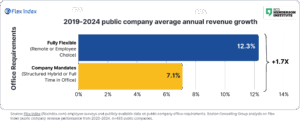
Crucially, joint research with BCG shows that firms embracing full flexibility grew revenues 1.7 times faster than their mandate-driven peers between 2019 and 2024, even after adjusting for industry and size.
Flexible companies maintain a 34% growth advantage, tying workplace policy directly to business performance — not just employee satisfaction.
The Road Ahead
The coming months will test whether companies maintain or escalate office mandates amid a softening job market — and whether employees’ attendance behavior shifts accordingly. The ongoing tug-of-war between policy and practice will shape workplace norms and competitiveness in the post-pandemic economy.