
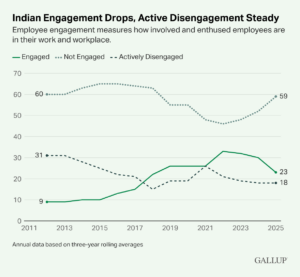
Employee engagement in India fell in 2025, with 23% of workers reporting they feel engaged at work, marking the country’s lowest level in four years.
The figure remains slightly above the current global average of 20%, but represents a retreat from the stronger engagement levels India posted in recent years, according to Gallup.

Gallup defines engaged employees as workers who feel emotionally connected to their work and workplace. Employees categorized as “not engaged” typically put in minimal discretionary effort, while actively disengaged workers tend to feel frustrated and disconnected from organizational goals.
Productivity Concerns Continue to Grow
Gallup estimates that workplace disengagement currently costs India roughly $351 billion annually in lost productivity, equal to about 9% of the country’s GDP.

Despite the recent decline, India’s workforce engagement levels remain significantly improved compared to a decade ago, when the country ranked among the least engaged labor markets globally.
The latest data suggests many workers are no longer actively frustrated with their jobs, but are increasingly detached or unclear about their role within organizations.
Managers Saw the Sharpest Drop
The decline was especially pronounced among managers.
Manager engagement fell from 39% in 2024 to 30% in 2025, a steeper decline than among individual contributors, whose engagement dropped from 24% to 19%.

The report points to shrinking management ranks as one possible factor. Fewer managers may now be overseeing larger teams, increasing workload and reducing connection to their own roles.
Previous research has shown that managers play a major role in shaping employee engagement across organizations, accounting for much of the variation in team performance and workplace experience.
Leadership Support Becomes More Important
The findings arrive as companies continue reorganizing work structures, flattening management layers and reassessing workforce strategies.
Gallup’s data suggests many disengaged employees are not fully disconnected from work, but instead lack stronger communication, role clarity and support from leadership.
The report found that organizations focusing on manager training, support and leadership development may be better positioned to improve engagement levels as workplaces continue evolving.