
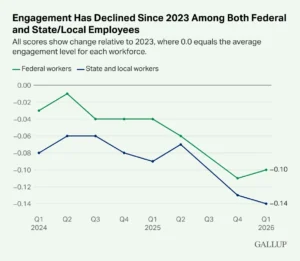
Federal workforce reforms introduced in 2025 coincided with sharp declines in employee engagement, job satisfaction, and workplace trust across U.S. government agencies, according to new analysis from Gallup and Bureau of Labor Statistics data.
The research found federal workers experienced larger drops in morale and larger increases in burnout and job-search activity than comparable state, local, and private sector employees during the same period.

Workforce Cuts Coincided With Engagement Declines
Federal employment remained relatively stable through 2024 before beginning to decline in mid-2025 as reforms reduced hiring and increased retirements and voluntary departures.
At the same time, workplace sentiment deteriorated.

By Q2 2025, engagement among federal employees had fallen six percentage points more than among state and local government workers. Job satisfaction also dropped sharply, with federal employees significantly less likely to report high satisfaction levels during the peak disruption period.
Burnout climbed as well. Federal workers were up to nine percentage points more likely than state and local peers to report high burnout levels during 2025.
The number of federal employees actively searching for new jobs also surged early in the year before gradually easing later in 2025.
Trust and Leadership Became Key Dividing Lines
The analysis suggests workplace culture and leadership heavily influenced how workers responded to the reforms.

Federal employees reported lower levels of trust in leadership, weaker feelings of organizational connection, and declining perceptions around respect and wellbeing during the transition period.
Workers who still felt supported and connected to their organization were less likely to experience severe drops in engagement or satisfaction, reinforcing the growing future-of-work focus on management quality during periods of disruption.
Signs of Stabilization Emerged By Late 2025
While the reforms created significant short-term turbulence, many employee experience measures improved by late 2025 and continued stabilizing into early 2026.
By Q4 2025, job-search activity among federal workers had largely returned to levels comparable with state and local government employees, while engagement and burnout gaps narrowed considerably.