
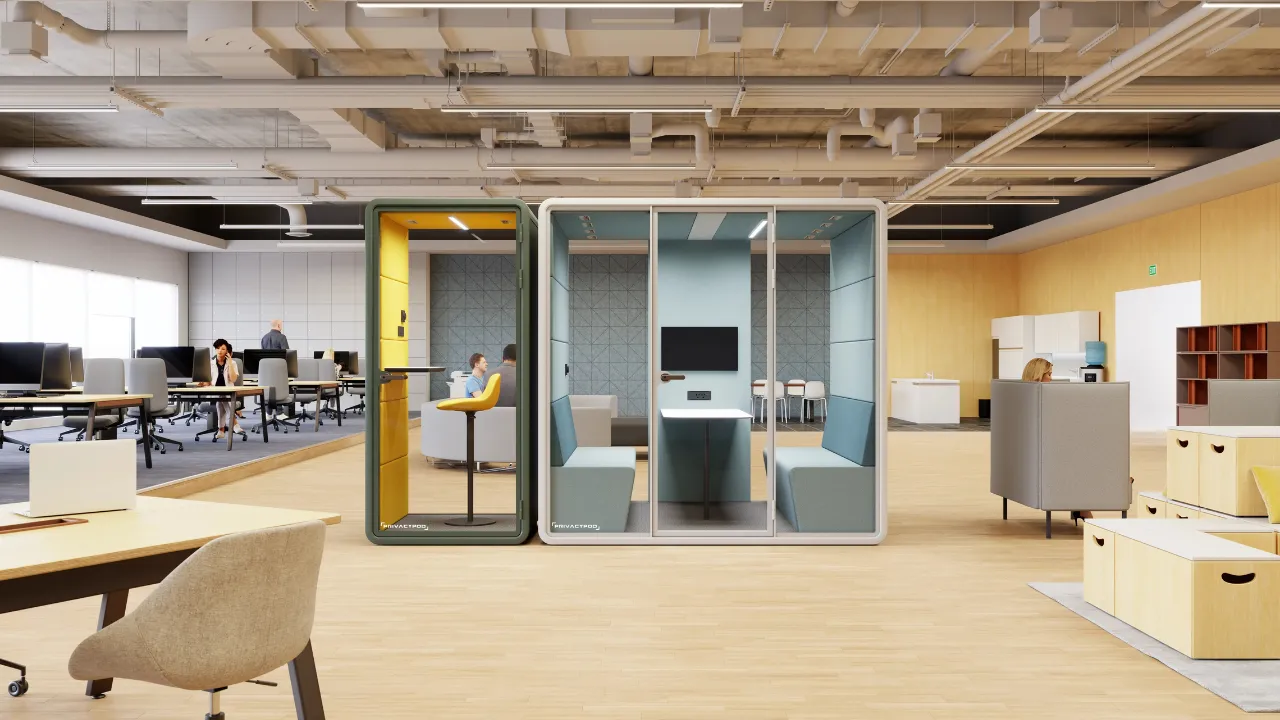
Open offices were sold on a simple promise. Knock down the walls, raise the energy, and people will collaborate more. That logic dominated workplace design for two decades. Then a strange thing happened. The workers in those offices started fleeing them.
First it was to coffee shops. Then home. By 2024, the open floor that was supposed to spark collaboration had become the place people went to avoid doing focused work. And hybrid work made it worse, not better. The two or three days a week people came in were precisely the days they needed quiet space they could not find. A call from the floor was a call everyone could hear. A meeting in the kitchen was a meeting that interrupted three other teams.
The paradox is this: Open-plan offices were never built for the work modern offices actually need to support. And the loudest demand in workplace design right now is for somewhere to be alone and quiet.
The data is hard to argue with
The numbers tell the same story across multiple research sources.
Leesman, which has surveyed more workplace users than nearly anyone, found that fewer than one in three employees believe their open office helps them do their best work. The same research describes noise as “statistically the strongest” predictor of poor workplace performance. A Flokk study cited in workplace acoustics research found that noisy open offices can drag productivity down by as much as 66 percent, with 70 percent of open-plan workers reporting acoustic concerns.
Spacestor’s 2026 Workplace Trends report named the underlying behavior shift directly. Employees who once took calls at their desks now instinctively seek privacy. The tolerance for ambient office noise dropped sharply after years of home offices, and it has not come back.
Their research also found only 19 percent of office workers feel positive about returning full-time, with workplace experience cited as a major reason.
Workers consistently rate access to quiet, focused space as one of the highest predictors of workplace satisfaction.
Gensler’s Global Workplace Survey has flagged the same gap. Workers consistently rate access to quiet, focused space as one of the highest predictors of workplace satisfaction. And it is one of the lowest-rated aspects of most open-plan offices they evaluate.
So workplace strategists know the problem. The harder question is what to do about it.
The fixes that didn’t work
The first wave of solutions tried to retrofit acoustics into the existing footprint. Ceiling baffles. Felt wall panels. Sound masking systems. These help with background noise, but they cannot create a private room. A phone call still happens in the open. A confidential conversation can still be overheard. A video meeting still leaks into the desk area next to it.
The second wave was construction. Add more conference rooms. The problem is that conference rooms are slow, expensive, and inflexible. Custom buildouts run $200 to $400 per square foot and take three to six months. By the time the drywall is up, the team has reorganized, the headcount has changed, and the rooms are either underused or overbooked.
The third wave was personal. Noise-canceling headphones, focus apps, hot desk policies that let people pick a quieter spot. None of these solved speech privacy. None of them gave anyone a door to close.
What was missing was infrastructure that could move at the speed of the work.
Why modular privacy made sense
Office pods filled the gap because they sit in a category between furniture and construction. Drop in without permits. Plug into a standard outlet. Move when the floor plan changes. The good ones offer real acoustic separation, not just visual privacy.
That is what shifted the conversation. Pods stopped being an amenity and started showing up on workplace strategy decks as standard infrastructure. The category matured. Acoustic specifications got serious. Vendors started certifying products against ISO 23351-1 for measurable speech privacy, ASTM E84 Class A for interior panel fire performance, and UL Listed for electrical components. The handful of brands doing this seriously, including PrivacyPod, Framery, and a few others, started getting specified into workplace projects the same way conference rooms used to be.
What workplace leaders should actually evaluate
For anyone looking at pods now, the questions worth asking are practical, not aspirational.
Acoustic certification
Ask for ISO 23351-1 test results, not marketing claims. A pod that delivers around 30 dB of speech reduction is performing in line with a well-built phone room. Anything less than 25 dB is likely letting your call through the wall.
Ventilation
A sealed pod with no airflow becomes uncomfortable in fifteen minutes. Look for full air exchange every 30 to 60 seconds and quiet brushless fans, under 35 dBA when running.
Lead time and modularity
Quick-Ship programs on standard configurations should land in one to two weeks. Made-to-order with custom finishes and add-ons typically runs eight to ten weeks. If a vendor cannot tell you which configuration sits in which bucket, that is a flag.
Use case mapping
A four-person meeting pod is not the same product as a one-person phone booth, and pricing reflects that. Most offices need a mix: more one-person phone booths for calls and focus, fewer larger meeting pods for small team work.
ADA accessibility
The newer pod lines on the market include accessible variants with near-flush entry and structural ratings that comply with ADA requirements. Worth asking about, since accessibility is increasingly being written into workplace standards rather than treated as an exception.
What 2026 is making clear
The category is still evolving. The trends I am watching for the second half of the year are around accessibility as a baseline rather than an add-on, sustainability claims that hold up to actual certification (GREENGUARD, FSC-certified panels), and a wider range of pod finishes that let teams match their brand without dropping into full custom production.
NeoCon and Design Days are right around the corner. The conversation on the show floor this year is going to look different from five years ago. Pods will not be a curiosity in the back of a booth. They will be at the center of the workplace strategy conversation, because the offices that work in 2026 are the ones that finally took the desire for quiet seriously.
Open-plan was never wrong as an idea. It was just incomplete. The companies figuring this out now are the ones giving their people both. Energy when they want it. A door to close when they need it.