





We all need to earn money to survive.
But to many workers, it’s not ok for this to come at a cost to their morals.

Now, there’s an emerging, dystopian, modern-era moral quandary some workers are having to face that could have dramatic career consequences:
Do I want to work for a company that directly supports AI or data centers?

The Hidden Environmental Cost Behind the AI Boom
To provide some environmental context to this push-back on data centers, they are not without pollution.
They consume massive amounts of energy — often powered by natural gas plants and diesel backup generators that emit nitrogen oxides and fine particulate pollution linked to asthma, heart disease, and respiratory illness. Some large facilities now operate on-site gas turbines continuously, increasing local air pollution concerns.
These facilities can even bring the local temperature up by 28 degrees. Data center expansion could also drive electricity bills up by more than 50% in some states by 2030.
Because these data centers get so hot, they have to be cooled with fresh water. Only about 0.5% of Earth’s water is easily available fresh water, yet the world’s roughly 11,000 data centers are consuming massive amounts of it to cool AI and cloud infrastructure.
Large centers can consume 5 million gallons of water per day each, with thousands of data centers already operating in drought-prone regions. As AI demand accelerates, the industry’s growing water footprint is becoming a major environmental concern.
Not to mention that the AI programs that these centers power are controversial to many, as younger workers find AI unethical and believe it is lowering the quality of work, art, and communications. Although AI is widely used (half of U.S. adults use it every week), a large percent of people feel as though it does more harm than good, and that the data centers behind it are not worth the environmental devastation.
Resistance to AI inside companies is active. A recent survey found that nearly 3 in 10 knowledge workers admit to undermining or avoiding their company’s AI tools, with that number rising sharply among Gen Z employees.
The behavior ranges from quietly refusing to use approved systems to deliberately skewing outputs or feeding sensitive information into unapproved public tools.
For some workers, though, the resistance goes beyond avoiding AI tools at work, and extends to questioning the industries, infrastructure, and companies helping power the AI boom itself.
A Clean Energy Worker Who No Longer Wanted To Power AI
One New York City worker named Peter Tallcouch was hired years ago at a Fortune 500 clean energy company that claimed to be “committed to creating greener, smarter and innovative energy solutions.” This company’s goal aligned with Peter’s personal ethics, and made him feel like he was contributing to the greater good.
But then the company pivoted to powering AI data centers. This is not what Peter signed up for. 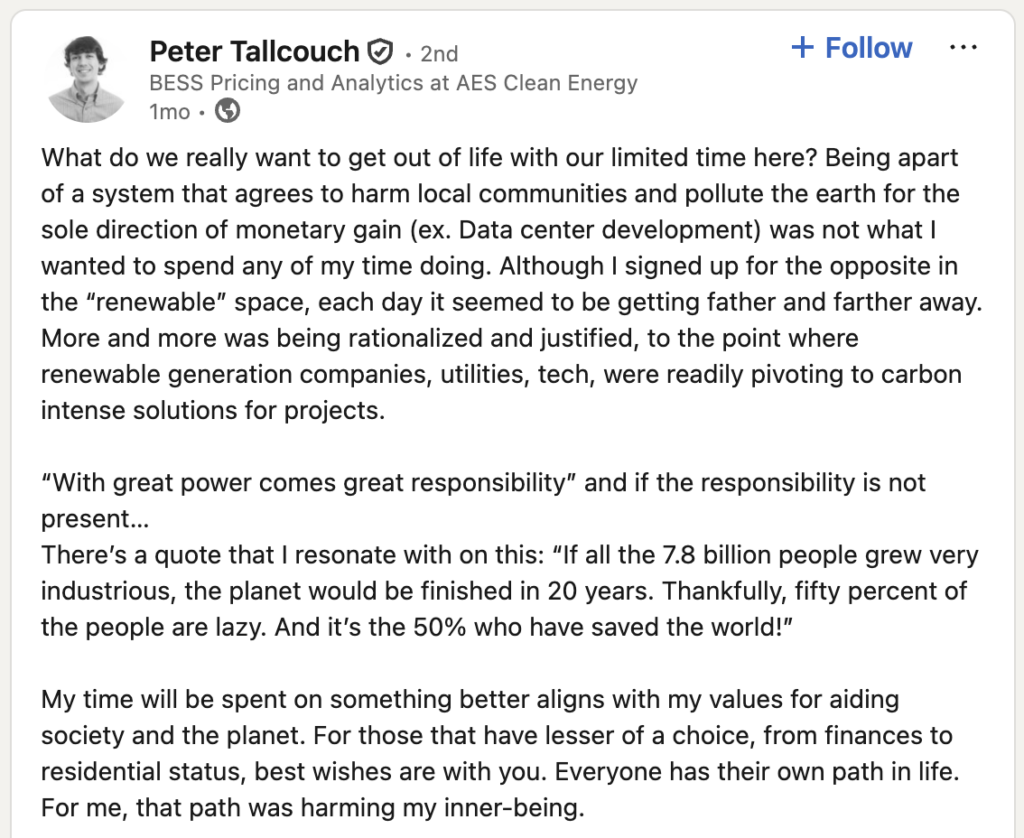 Allwork.Space spoke to Peter about what led up to his decision to leave this clean energy company.
Peter said that he essentially quiet quit. His six figure salary was not worth the personal and ethical turmoil it had caused him.
“The bigger problem kind of just boils down to capitalism and a growth mindset, and a company always having to grow and always having to put their shareholders first — it’s just always going to lead to this problem,” he told us.
In his view, nearly every major financial incentive across the system now rewards data center expansion — from utilities that profit from grid growth, to independent power producers developing new energy capacity, to tech companies driving AI demand.
He also pointed to the role of regulators and policymakers, arguing that when government, energy companies, and investors all support the same expansion cycle, it becomes difficult for companies to move in another direction.
“It’s not just my company that changed up, it’s the entire system incentivized by it.”

When Shareholder Growth Collides With Worker Ethics
He said that he came to the realization that companies only serve their shareholders, and that their goal is to increase their shareholder’s wealth. To him, the objective of companies isn’t to create a useful product for society, or to make the lives of its employees better; it is to maximize shareholder value.
Let’s get into what shareholders are exactly.
They’re the investors who put money into a company, and because they financially back it, their interests carry enormous weight. In many companies — especially public ones — leadership is expected and heavily pressured (and paid in stocks) to prioritize shareholder returns and continued growth.
The pressure has purpose: without their money and investment, the company ceases to exist. In the U.S., corporate law has traditionally placed a stronger emphasis on shareholder interests and shareholder value. While laws vary by state, directors generally have fiduciary duties to act in the best interests of the corporation and its shareholders, particularly in public companies.
Shareholders can influence major decisions through voting rights, board elections, shareholder proposals, and activist campaigns, giving investors significant leverage over company strategy and leadership.
In the U.K., the laws are a bit definitive. Section 172 of the U.K.’s Companies Act 2006 says company directors must act in good faith to help the company succeed for its shareholders or members. In doing so, they are expected to consider more than just short-term profits, including the long-term impact of decisions, employee interests, relationships with customers and suppliers, the company’s effect on communities and the environment, maintaining strong business ethics, and treating shareholders fairly. If a company has broader stated purposes beyond shareholder benefit, directors must also take those goals into account.
AI’s Data Center Expansion Is Starting To Create Moral Tensions At Work
That tension between shareholder expectations and current social concerns is becoming increasingly visible in the AI economy. As companies race to build AI infrastructure and satisfy investor demand for growth, not every worker is convinced those priorities align with their own values, or the kind of future they want to help build.
“If you think they’re going to jeopardize their profits significantly for creating a better earth, you’re gravely mistaken. I felt like I had an internal obligation to do something that was right; I don’t need the $100,000+ — I would rather not be harming people to make money,” Peter said.
He described realizing rising electricity demand from AI infrastructure could increase profits across the clean energy sector. He says the messaging he heard from within his company framed it as a foregone conclusion that data centers would keep expanding, so renewables should simply help power them instead of letting fossil fuels fill the gap.
“I was like — I’m not falling for this,” Peter told Allwork.Space. “If we’re supporting data centers, then we can’t reduce carbon emissions. Data centers being online causes a lot of electricity to be used, and it enables oil, coal, and gas plants to stay online. My company even filed paperwork to un-retire a coal plant.”
AI Expansion Is Complicating Climate Promises
Another example of a company transitioning to supporting AI/data centers is Google, which has taken back some of its climate goals. Microsoft is considering doing the same.
Google’s AI expansion has complicated its climate promises. In 2021, the company pledged to reach net-zero emissions by 2030, but by July 2024 Google reported its greenhouse gas emissions had climbed nearly 50% since 2019, largely due to AI-driven data center energy demand. The company also acknowledged it could no longer maintain its earlier “carbon neutral” status. More recently, Google has shifted toward framing some climate goals as aspirational while investing heavily in nuclear as well as gas plants.
“You’ll see these companies kind of backtracking, based on justifications like ‘the grid can’t run without oil,’ and it’s like…do you not see the wildfires that are happening? Do you not see the droughts? Do you not see how much water is being used to keep these oil and gas plants online? How they contribute to actually needing to use even more electricity?” Peter told Allwork.Space.
Clean energy was originally positioned as a way to replace fossil fuels, but surging electricity demand from AI data centers is straining supply fast enough that coal, oil, and natural gas plants are still being kept online to meet demand.
Supply can’t keep up, so energy costs rise, and businesses benefiting from data center expansion are the main supporters of continued high usage.
Workers Are Starting To Question What Their Labor Is Actually Supporting
Peter may be part of the first wave of workers choosing to leave companies tied to expanding AI and data center operations. Whether that becomes a larger workplace trend remains unclear, but skepticism around AI’s environmental impact, labor implications, and exponential expansion is becoming harder to ignore.
For the future of work, this could mean that more workers will increasingly gravitate toward careers they see as more tangible, community-based, or human-centered, including skilled trades, healthcare, education, hospitality, construction, and other professions less directly tied to AI infrastructure and automation.
What sits underneath all of this is a growing discomfort with how the modern economy is being built, and who ends up carrying its costs.
AI and data centers are now tightly woven into everything from energy planning to corporate strategy, even as their environmental footprint becomes harder to ignore. For some workers, that creates a quiet but real conflict between earning a living and feeling aligned with what their work is ultimately supporting.
Where that leads next isn’t clear yet, but it’s already showing up in career decisions and what people are willing to justify on the job.