Singapore’s workplaces are confronting a convergence of disruptive forces — artificial intelligence, an aging workforce, rising business costs, and changing expectations around flexibility — at a time when employee engagement remains a major challenge.
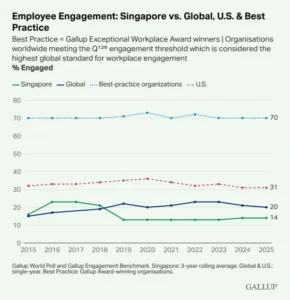
A new Gallup report found that 86% of Singapore’s workers were disengaged in 2025, contributing to billions of dollars in lost productivity. While leaders expressed confidence in their own organizations’ ability to navigate change, they were significantly less optimistic about Singapore’s overall workforce readiness.

AI Implementation Is Accelerating, but Workers May Not Be Prepared
Business leaders largely believe they can capture the benefits of AI while managing its risks, with 85% saying they are confident their organizations can successfully use the technology. However, many raised concerns that the workforce may not be keeping pace.
One emerging challenge is what leaders described as a growing divide between experienced professionals and younger workers. As AI takes over repetitive entry-level tasks that traditionally served as training grounds, organizations may need to rethink how employees build foundational skills early in their careers.

Despite growing urgency around AI readiness, only a small number of organizations studied had introduced large-scale AI training initiatives, suggesting many employers are still early in their preparation.
An Aging Workforce and Cost Pressures Add to the Strain
Singapore’s demographic shift is creating another long-term challenge. More than 37% of the country’s workforce is now aged 55 or older, up from 29% in 2014, increasing pressure on organizations to transfer knowledge and develop the next generation of talent.
At the same time, Singapore’s high cost of living and expensive business environment are limiting organizations’ ability to invest in workforce development and increasing the importance of retaining skilled employees.
Hybrid Work Divides Leaders as Companies Rethink Engagement
Flexible work remains one of the most polarizing workplace issues. While many leaders say hybrid arrangements support employee engagement, opinions varied more sharply than on any other issue studied, reflecting an ongoing divide over whether flexibility strengthens or weakens culture and performance.
The report concludes that organizations will need stronger engagement systems, better manager development, more strategic HR functions, and clearer approaches to developing talent if they want to remain competitive in an increasingly uncertain workplace environment.