As the way we work continues to evolve, so does the office.
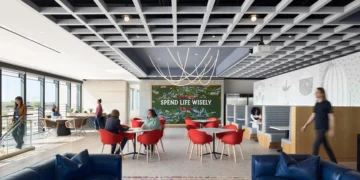
Today’s workspace needs to balance workers seeking to connect and collaborate both in person and on screen, with teammates doing focus work. At the same time, it needs to support an increased emphasis on wellbeing and neurodiversity, while remaining flexible and adaptable to meet shifting workplace needs.

Achieving privacy — both visual and aural — and quiet comfort within activated, open floorplans has been elevated in priority. It’s now as integral as coffee bars, lounge areas and wellness rooms in supporting today’s office worker.
Additionally, planners seek to provide a sense of control and comfort that many people discovered at home and are reluctant to give up in the office.

Manufacturers are responding by delivering new options that help carve out quiet zones for heads down work or retreat amidst buzzy social and collaborative work areas, accommodating the rhythm and flow of work as employees cycle through varied activities and settings throughout the day.
New solutions were on display earlier in June at NeoCon and Design Days, the annual gathering of the commercial interiors industry in Chicago.
Pods and booths as flexible meeting and workspace
With distributed workers spending increasingly greater amounts of time on video calls, the need for enclosed, quiet spaces segregated from open work areas has grown.
Today the pod category has expanded from spartan individual phone booths to well-equipped work stations, small huddle rooms up to fully equipped meeting room environments with customizable features. Many provide quick shipping and easy assemble for “plug and play” Day 2 solutions.

Designed to function as a work station, Framery’s Gradus provides power outlets, lighting, monitor stand, and full-size office desk. Its minimalist design allows it to either blend into the architecture or stand out as the focal point, according to Joonas Vartola, CDO of Framery.
Herman Miller’s Bay Work Pod integrates adjustable lighting, ventilation, power, and camera‑friendly backdrops, acknowledging that the office is now a broadcast studio as much as a shared workplace.
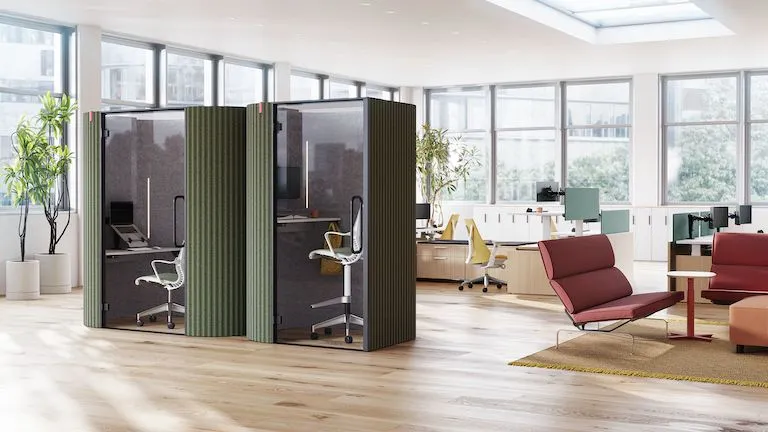
Pods and booths today are available in varied sizes (1, 2, 4 or 6 person), provide a range of comfort and control (vents, fans, air filter, adjustable lighting), sophisticated materiality, and ease of use (power, occupancy indicators). Integrated technology (e.g., reservation systems that connect with Microsoft Teams and Google Meet) provides informative data that can track utilization and meeting length.
Agility and flexibility
New introductions align with broader shifts toward flexibility and modularity. Booths, pods, high-back furniture and creative, sculptural acoustic elements are often freestanding, reconfigurable, and easy to install and break down for relocation. For example, Senator’s Cellpod “acts like furniture and you can take it with you,” noted Chip Popa, director of sales Central Region for the Senator Group.
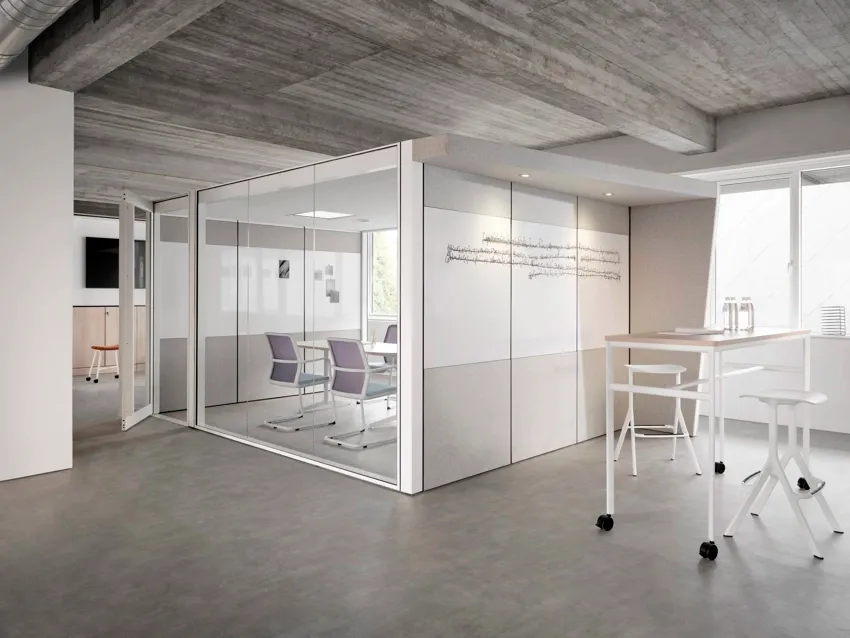
Not only do modular solutions often provide adaptability and portability, they can often be a more economical choice in the long run, providing advantages of a furniture depreciation schedule over drywall construction.
High‑back furniture as soft architecture
Alongside hard‑shelled pods, manufacturers are offering soft seating that does dual duty, creating soft architecture that demarcates spaces while also adding an element of visual privacy. High‑back sofas, winged lounge chairs, and built‑in seating nooks carve out enclosed spaces within open areas.
Acting as movable architecture, pieces dampen sound, narrow sightlines, and create enough psychological separation for 1:1s, quick calls or focused work.
As this category evolves, it embraces greater modularity and hospitality influence — plusher textiles, warmer palettes, and integrated lighting.
One of the most novel solutions was Darran Furniture’s Limousine, a high back sofa that can be raised and lowered like a height-adjustable desk. A winner of the Business Impact award for the value it brings to modern environments, Limousine can be raised for added privacy, then lowered for openness and keeping sightlines visible.
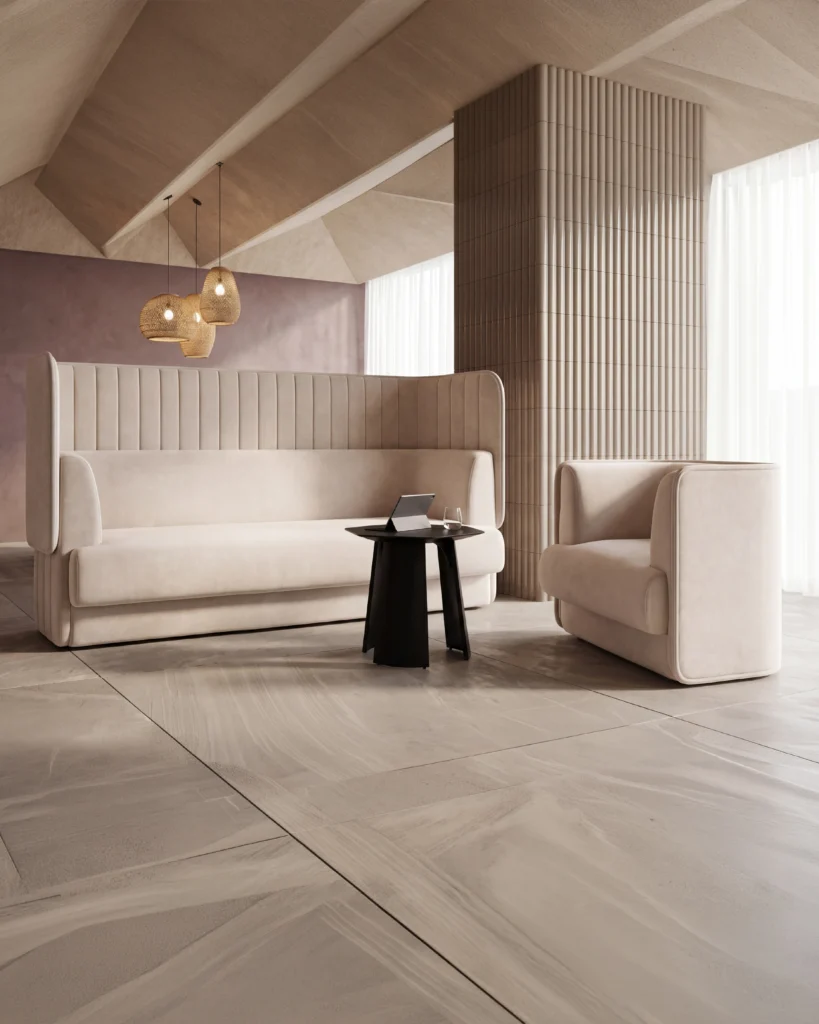
“We designed Limousine as an on-demand privacy solution for the modern workplace,” related designer Brad Ascalon. “It empowers individuals to instantly transform high-stimulation environments into quiet, comfortable sanctuaries. Rooted in inclusive design and neurodiversity, Limousine gives users control over their surroundings and serves as a clear, unspoken visual cue to others that they need uninterrupted focus — an advantage that a static high-back sofa simply cannot offer. Just as importantly, when not actively in use, the collection respects the designed environment around it by maintaining open sightlines and preserving the flow of natural light.”
Beauty and rich materiality that also solves for sound
Rather than simply solve for sound, some products begin as architectural elements, such as ALMA from WVH, acoustic panels that resemble rich, rustic wood. Designed by Mexican-born designer Alfonso Verduzco, the collection won a Best of NeoCon Gold award for Wall Treatment.
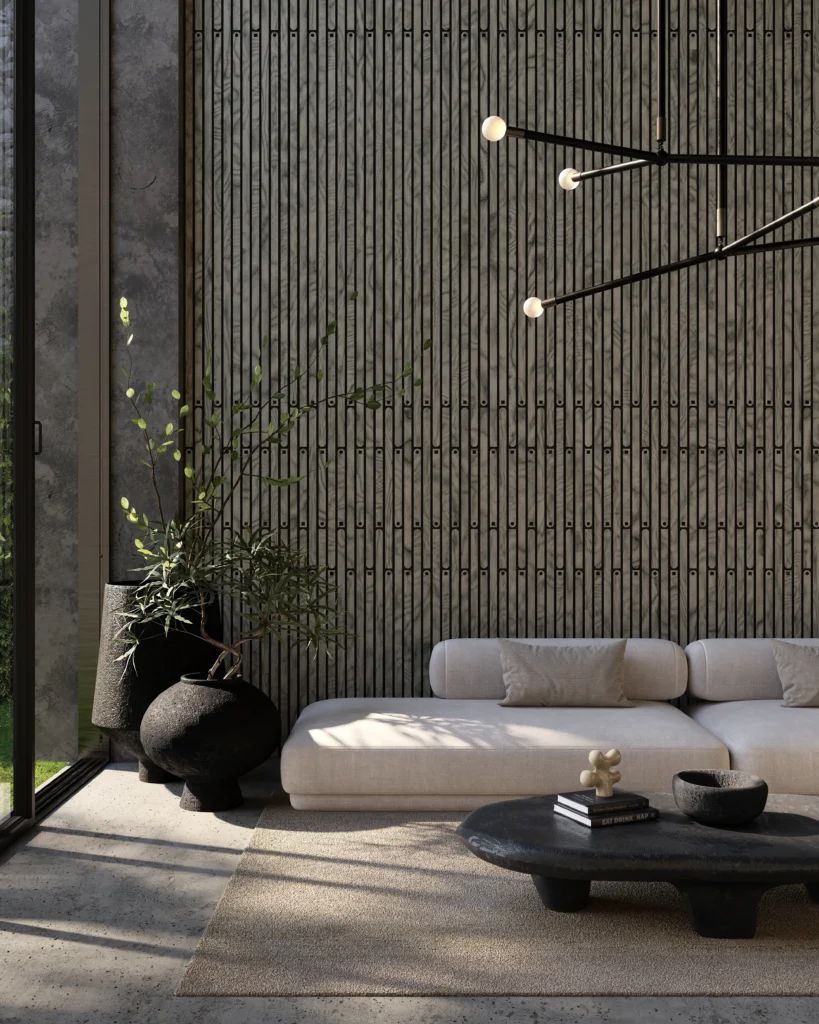
”With ALMA, the intention was never to create decoration for walls. The goal was to design surfaces that interact with light, texture, and space in a way that feels calm, grounded, and architectural,” said Verdezco.
”The inspiration for ALMA comes from materials that have shaped landscapes, architecture, and craft for centuries. The collection translates that material heritage into a contemporary architectural language designed for modern spaces,” he said.
New materials and a fashion-forward approach have elevated acoustic wall panels, greatly expanding the design vocabulary and providing elegant solutions for ceilings, walls, and freestanding elements that can attenuate sound and define space, delivering performance and doubling as visual statements. Seen at the show:
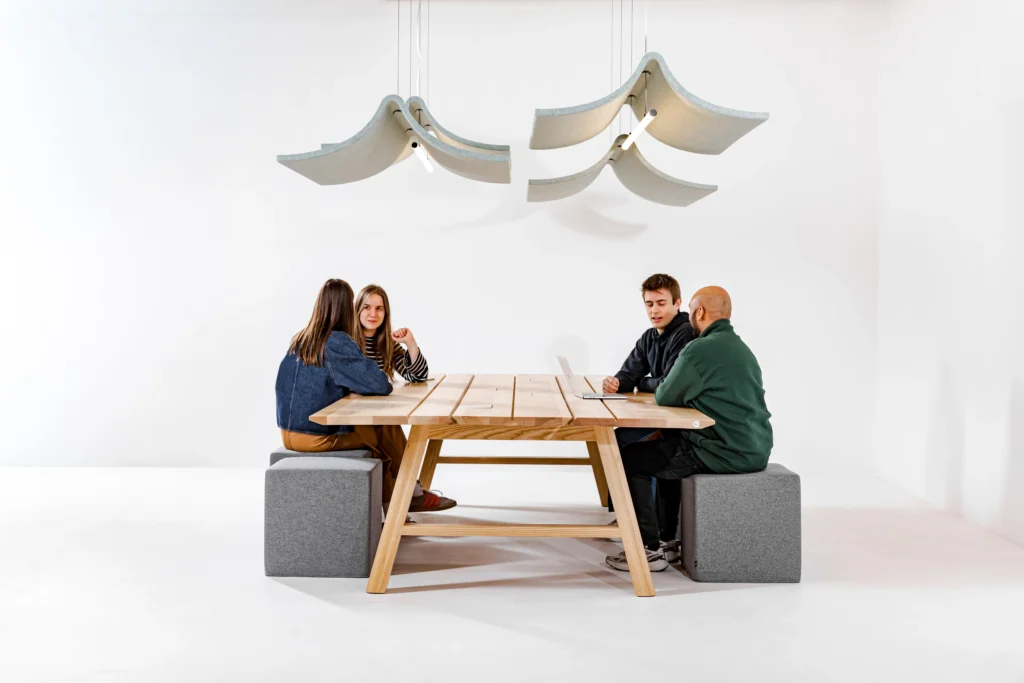
- Sculptural ceiling baffles treated as pattern and texture
- Warm, biophilic materials—wood slats, wool, plant‑inspired geometries
- Integration with lighting, where pendant fixtures are used alongside acoustic surfaces
- Felt clouds, ombré wall panels, PET‑felt partitions
Supporting wellbeing and neurodiversity
Acoustic products respond to a clear shift in how workplaces are being designed today, according to Ellettra de Pellegrin, partner at Slalom, an Italian-based firm that offered a design approach centered on wellbeing and the integration of acoustics and color.
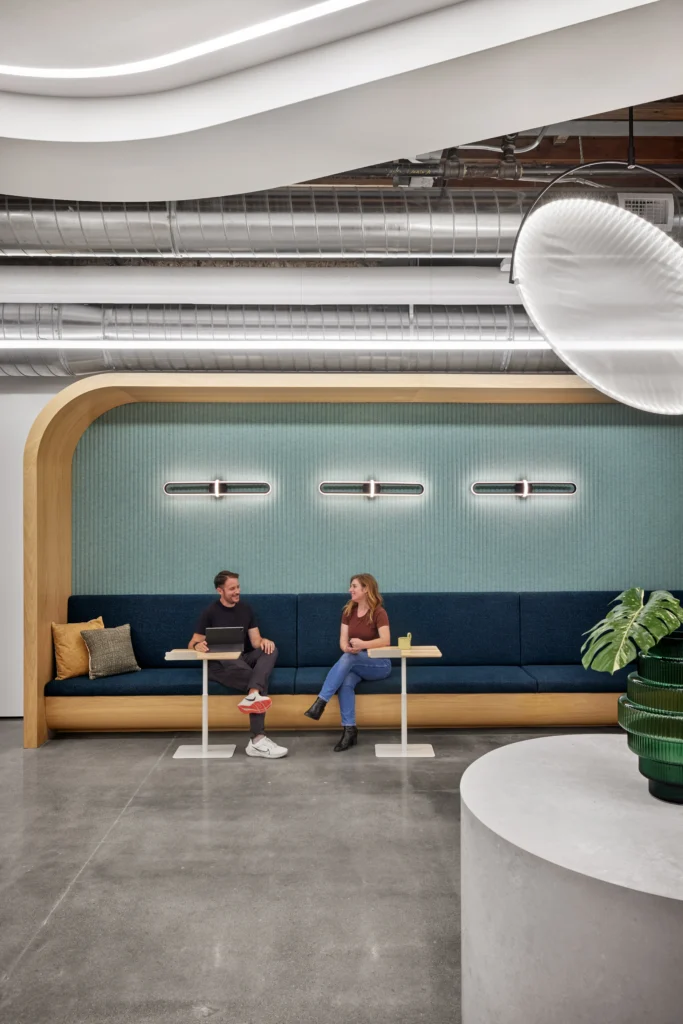
“We saw a growing need for solutions that go beyond function alone and actively contribute to how spaces “feel” as well as perform,” she explained. “These topics are becoming increasingly central to workplace design.”
Privacy for all
At BuzziSpace, designers sought to rethink what privacy means in the modern workplace.
“While many pods and booths focus solely on protecting the people inside, BuzziNest is designed to benefit the entire workspace,” shared Els Kerckhof, Chief Marketing Officer at BuzziSpace. “By combining visual privacy with sound-absorbing materials, it not only creates a comfortable retreat for focused work, calls, or meetings, but also helps reduce noise in the surrounding environment. We believe acoustic comfort shouldn’t be isolated to a single user, it should contribute to a quieter, more balanced workplace for everyone.”
Show don’t tell
Manufacturers sought to convey their message in creative, impactful ways that stood out in in a sea of some 500 showrooms and 55,000 visitors.
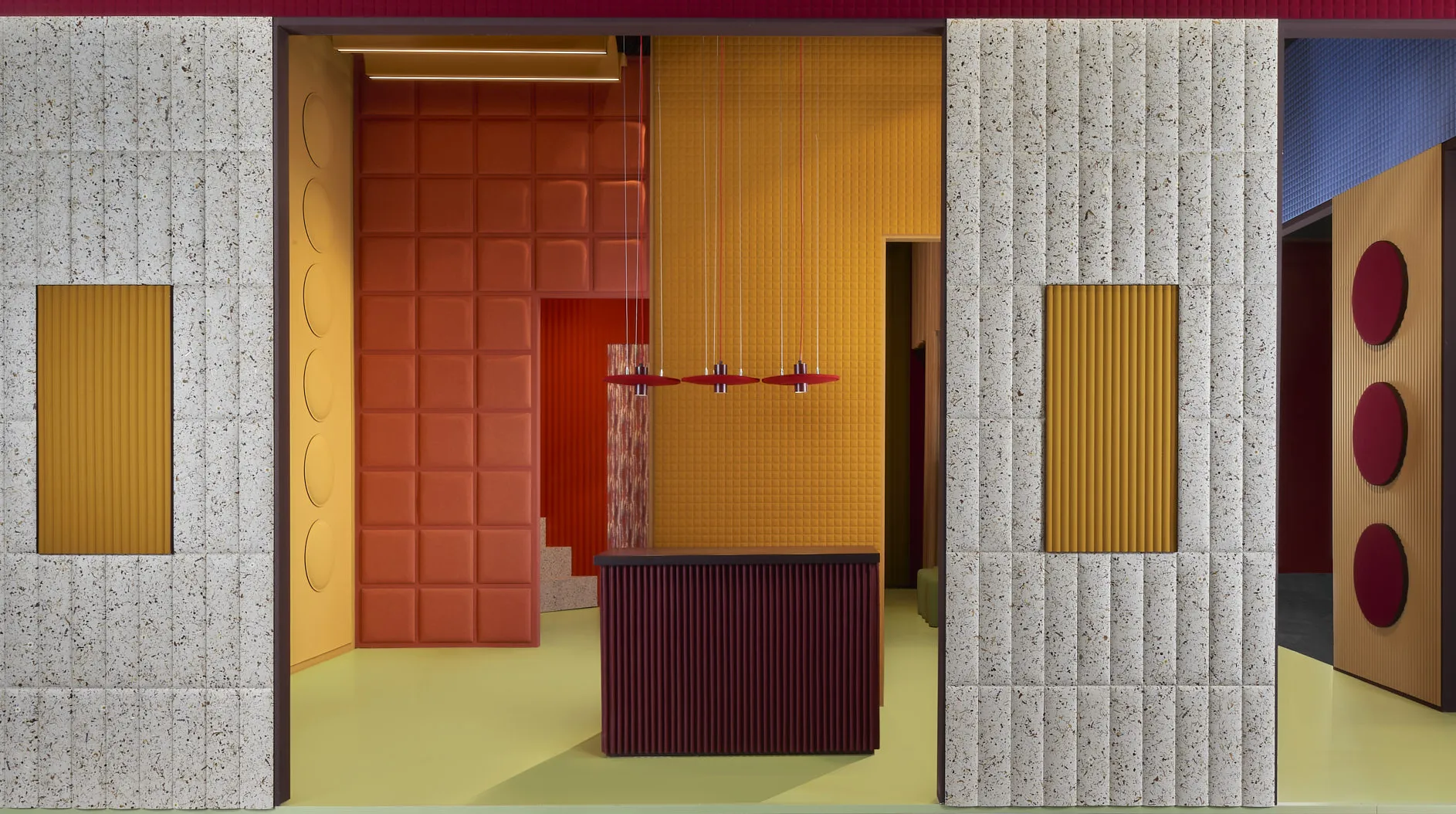
At Turf, visitors began an immersive journey, entering through a throbbing techno beat before experiencing the whisper-quiet of the Hues, a richly colored felt product.
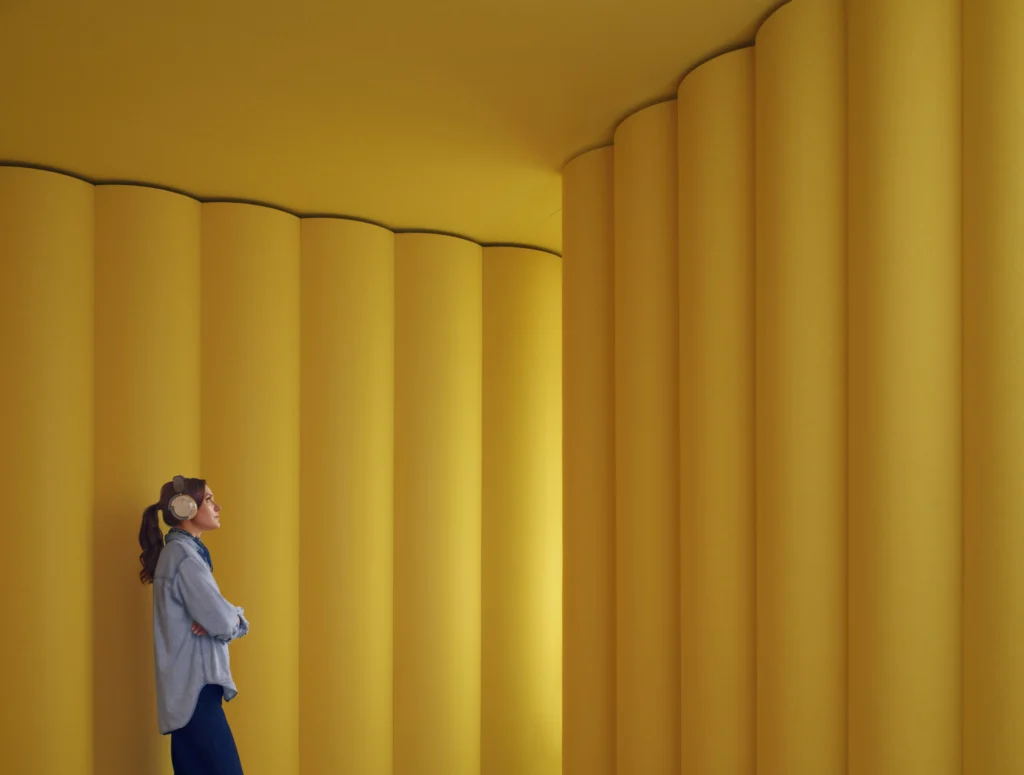
“Turf understands the power of design to influence emotion, perception, and overall well-being – put simply, design has the power to affect how we feel,” said Robert MacMeccan, president of Turf. “Our goal with the Hues expansion was to merge high-performance sound management with research-backed color theory to support this very concept.
“For the workplace in particular, these colors empower designers to craft spaces that improve memory and focus through the integration of neuroaesthetics, while also providing crucial acoustic control and physical boundaries.”
“Ultimately, we are extending sound performance beyond basic function to create balanced, distraction-free zones where people can disconnect from the bustling office and enter an area that is their own,” he added
Designed by Elizabeth Von Lehe, ASID, NCIDQ, Principal, Senior Interior Design Leader, CannonDesign, and infused with early 90s/2000s design and cultural influences, the showroom explored Neoretrofutureoptimism, leveraging nostalgia as an inspirational tool for comfort. It was awarded Best Mid-Size Showroom for the IIDA Showroom and Booth Design Competition.
It was dramatic. And soothingly quiet.