




The U.K. labor market is weakening on two fronts. Between May and July 2026, 1.78 million people were unemployed, putting the unemployment rate at 4.9%, while another 9.12 million working-age people were economically inactive, neither working nor looking for work.
Men are bearing the brunt. Their unemployment rate stands at 5.3%, compared with 4.5% for women, and the headline figures likely understate how many have stepped away entirely. The more pressing question for employers is why so many men struggle to stay in work, why others have left altogether, and what can be done to stop more from following.

Why Economic Inactivity in the U.K. Affects Men Disproportionately
Unemployed men are out of work but actively seeking a job, while economically inactive men are neither in work nor seeking work. For employers, that distinction is important because economic inactivity is not only a recruitment issue; it is also a retention challenge.
Among U.K. men, long-term sickness is a major driver of this inactivity. According to the U.K.’s Office for National Statistics (ONS), in the second quarter of 2026, around 1.28 million men were economically inactive due to long-term sickness, accounting for around 34% of overall male economic inactivity.

Occupational patterns are also relevant, with men and women remaining concentrated in different parts of the economy. Men are more heavily represented in physically demanding sectors such as construction, manufacturing, and transport, where poor health, job loss, or difficulty transferring skills can increase the risk of leaving the labor market altogether.
The factors contributing to male economic inactivity can begin much earlier in life, with signs already evident among younger men. For instance, in the first quarter of 2026, 553,000 men aged 16 to 24 were not in employment, education, or training (NEET), equivalent to 14.4% of young men compared with 12.5% of young women. Other disadvantages emerge even earlier, with boys performing worse than girls across many major education indicators, such as higher rates of suspension and permanent exclusion, and being less likely to enter higher education by age 19.
Poor Health is a Major Driver of Economic Inactivity in the U.K.
Poor health has become one of the biggest drivers of economic inactivity. Around 2.8 million people are economically inactive because of ill health or disability, up by roughly 800,000 since 2019. Health-related inactivity is now estimated to cost Britain around £212 billion a year.
Mental health is an important part of that picture. Government research into employee health and sickness absence found that anxiety, depression, stress, and burnout were among the conditions contributing to time away from work. Participants also identified workload, lack of support, and workplace pressures as factors that could exacerbate existing mental health problems.
The longer someone is away from work, the more difficult it is to return. A U.K. government review found that 96% of people absent for four to six weeks return to work, but after a year fewer than half do. Around 300,000 people with a health condition leave work each year, which is why the proposed Workplace Health System places greater emphasis on preventing workforce exits in the first place.
For men, occupational hazards are another important factor in male workforce participation. Men’s Health: A Strategic Vision for England notes that men are more likely to work in higher-risk industries such as construction, engineering, agriculture, and waste management, where physical dangers, irregular hours, and musculoskeletal problems can make remaining in work more difficult.
Why Male Economic Inactivity Looks Different in Britain
The U.K. is not alone in experiencing declining male workforce participation. Allwork.Space recently reported a similar long-term trend in the U.S. In the U.K., however, the problem is compounded by domestic pressures including rising long-term sickness and disability levels, and the structure of the U.K. benefits system.
One in 10 working-age people in the U.K. now claims sickness or disability benefits.
Critics of the current system argue that some features can make returning to work feel financially risky, particularly if claimants fear losing support should a job not last. Yet many people receiving health and disability benefits still want to work. Department for Work and Pensions research found that around 200,000 recipients believed they could work immediately with the right job or support, while more than one million believed they could do so in the future if their health improved.
How Masculine Norms Prevent Men From Seeking Support
Employees can experience a gradual decline in their health or wellbeing. Economic inactivity can therefore begin long before someone ultimately leaves the workforce.
This is particularly relevant for men, who are less likely than women to seek professional guidance and support, meaning mental health difficulties may remain undisclosed for longer. The reasons are multifaceted, but social expectations around masculinity are one important part of the explanation.
These societal norms often emerge early in life. Research suggests that expectations around emotional control and self-reliance can become established during adolescence. Separate research into adult men’s help-seeking, published in the International Journal of Psychology, found that traditional masculinity is associated with more negative attitudes toward seeking psychological support. A World Health Organization (WHO) review of men’s mental health identifies similar barriers associated with masculine norms, including difficulty expressing emotions.

How Employers Can Help More Men Remain in Work
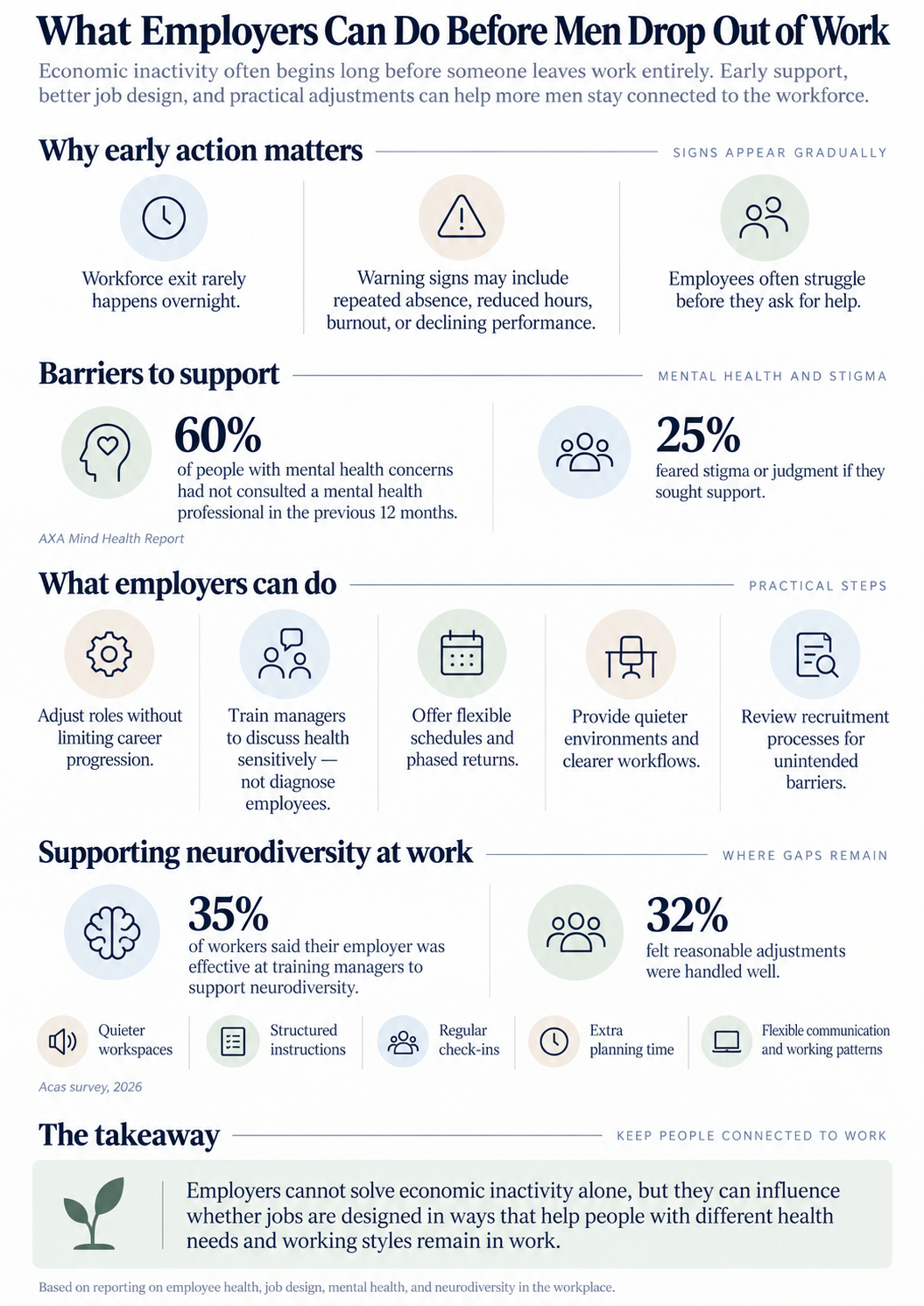
For employers, a lack of requests for support does not mean intervention is unnecessary. Warning signs can emerge through repeated absences, reduced hours, changes in performance, withdrawal, burnout, or difficulty managing responsibilities. Recognizing these patterns allows employers to start conversations earlier and, where appropriate, explore adjustments that may help an employee remain in work.
 Identifying the warning signs, however, is only part of the challenge. Early intervention also depends on creating the conditions in which employees feel able to open up. If men believe that acknowledging difficulty will be interpreted as weakness, affect how they are perceived, or carry negative career consequences, they may be less inclined to speak up.
A psychologically safe environment, where seeking help is treated as normal rather than exceptional, can make it easier for men to come forward before difficulties escalate.
Neurodivergence is another area where workplace culture can make a difference, particularly when managers lack the confidence or training to respond effectively. A 2026 survey by Acas, an independent, government-funded public body in the U.K. that provides free and impartial advice on workplace rights, rules, and best practices, found that 35% of employees considered their employer ineffective at training managers to identify and make reasonable adjustments for neurodivergent employees, while 32% considered them effective.
In response, Acas recommends practical measures including clearer instructions, regular check-ins, additional planning time, and greater flexibility for employees. Although these recommendations are not specific to men, they highlight how workplace practices can affect an employee’s ability to remain in work.
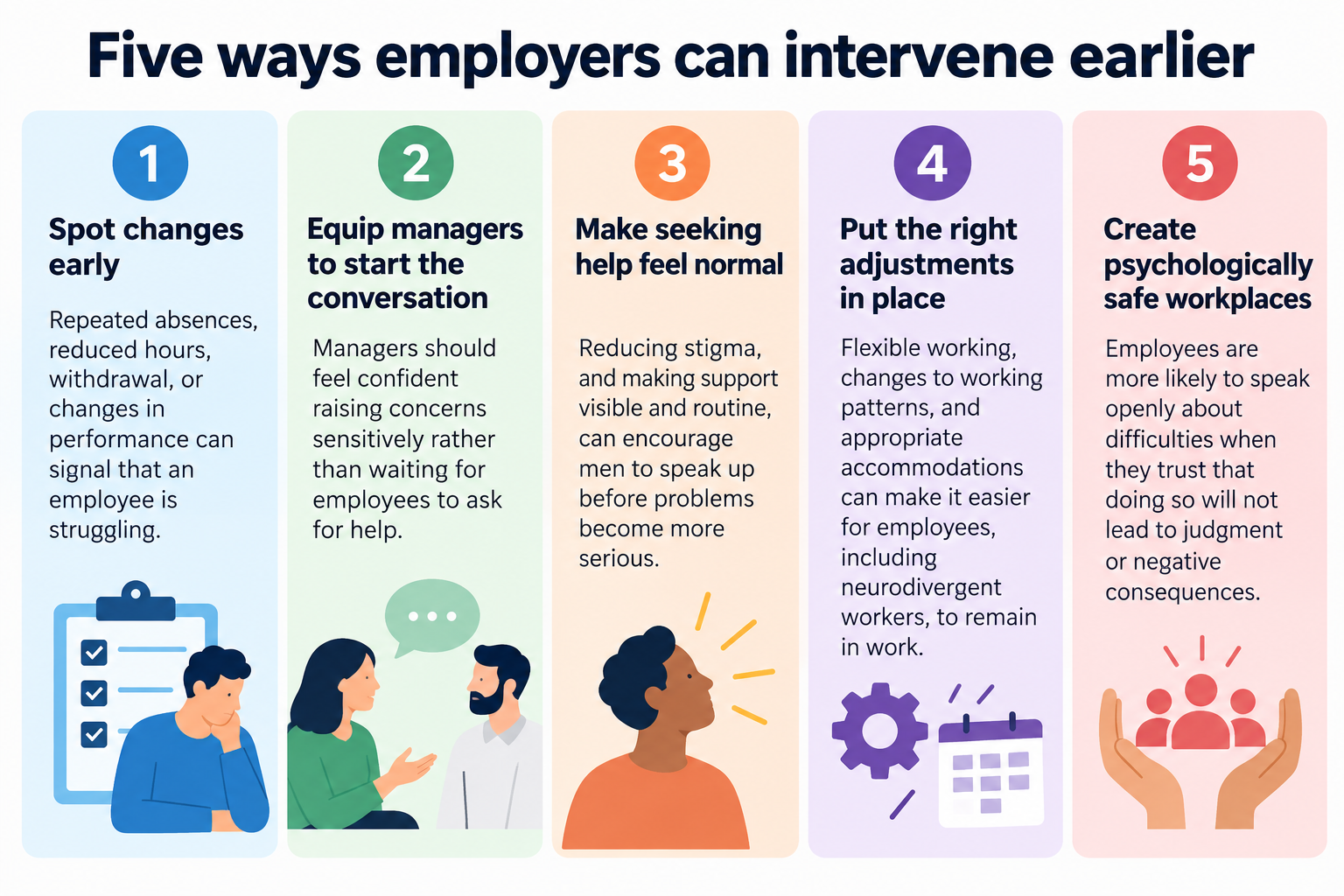 The key actions for employers can be summarized in five practical steps:
- Spot behavioral changes: Repeated absences, reduced hours, withdrawal, or changes in performance can signal that an employee is struggling.
- Equip line managers to start conversations: Managers should feel confident raising concerns sensitively rather than waiting for employees to ask for help.
- Normalize seeking help: Reducing stigma and making support visible can encourage men to speak up before problems become more serious.
- Put appropriate adjustments in place: Flexible working, changes to working patterns, and suitable accommodations can help employees remain in work.
- Create psychological safety: Employees are more likely to speak openly when they trust that doing so will not lead to judgment or negative consequences.
For employers, the challenge is therefore not simply to recruit people back into work. It is to identify problems earlier, act before absence becomes prolonged, and reduce the risk of men leaving the workforce altogether.
While many employers are rightly focused on recruitment, they cannot afford to overlook the people already in their workforce. Better awareness of why men leave their jobs, combined with earlier intervention and appropriate support, could help prevent avoidable exits.
Addressing economic inactivity is therefore as much about retention as recruitment. That means recognizing problems before they set in, creating workplaces where men feel able to speak up, and adapting work when circumstances change.