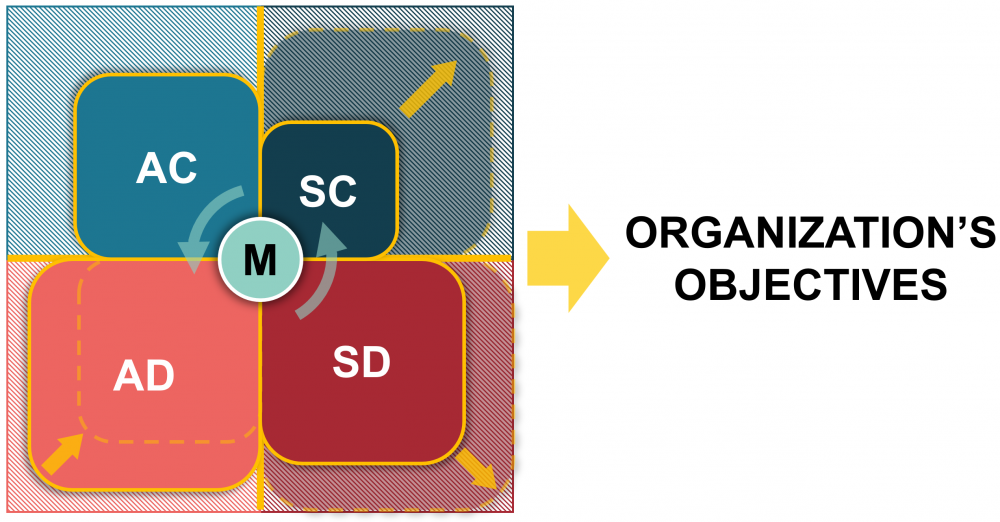


- The Full Spectrum Workplace (FSW) is a dynamic model that categorizes work based on location and concurrency, offering different environments to optimize organizational objectives and performance.
- The FSW emphasizes that workplaces are ecosystems of various work quadrants, unique to each organization and changing over time, with a focus on creating synergies rather than making trade-offs.
- This model promotes the strategic crossing of work environments to maximize collective performance and innovation, rather than strictly dividing between office versus remote work.
The article was written by workplace provocateur Dr. Agustin Chevez for Work Design Magazine.
What’s the optimal workplace for your organization?

That’s a question many of us are still pondering in the aftermath of the pandemic. It’s also the title of a paper by Harvard Business School researchers offering a framework for organizations to align their strategic needs with their working environment.
The framework is based on what the authors consider to be two key organizational features: size and growth orientation. If the organization is small, their recommended workplace is either coworking or fully remote depending on whether the organization’s growth orientation is driven by creativity (bringing people together) or execution (undisturbed efficiency).

On the other hand, if the organization is large, they suggest an office/campus or hybrid with flexible space, depending on their growth orientation.
The framework is based on robust research and revolves around a nuanced approach of when to be together and when to be apart.
So, what’s there to improve? The actual workplace.
The Full Spectrum Workplace
The Full Spectrum Workplace (FSW) framework aims to find the optimal environment for organizations to fulfill their objectives, but provides direction upstream from current property solutions which evolved when the notion of work and its context were different to what they are now.
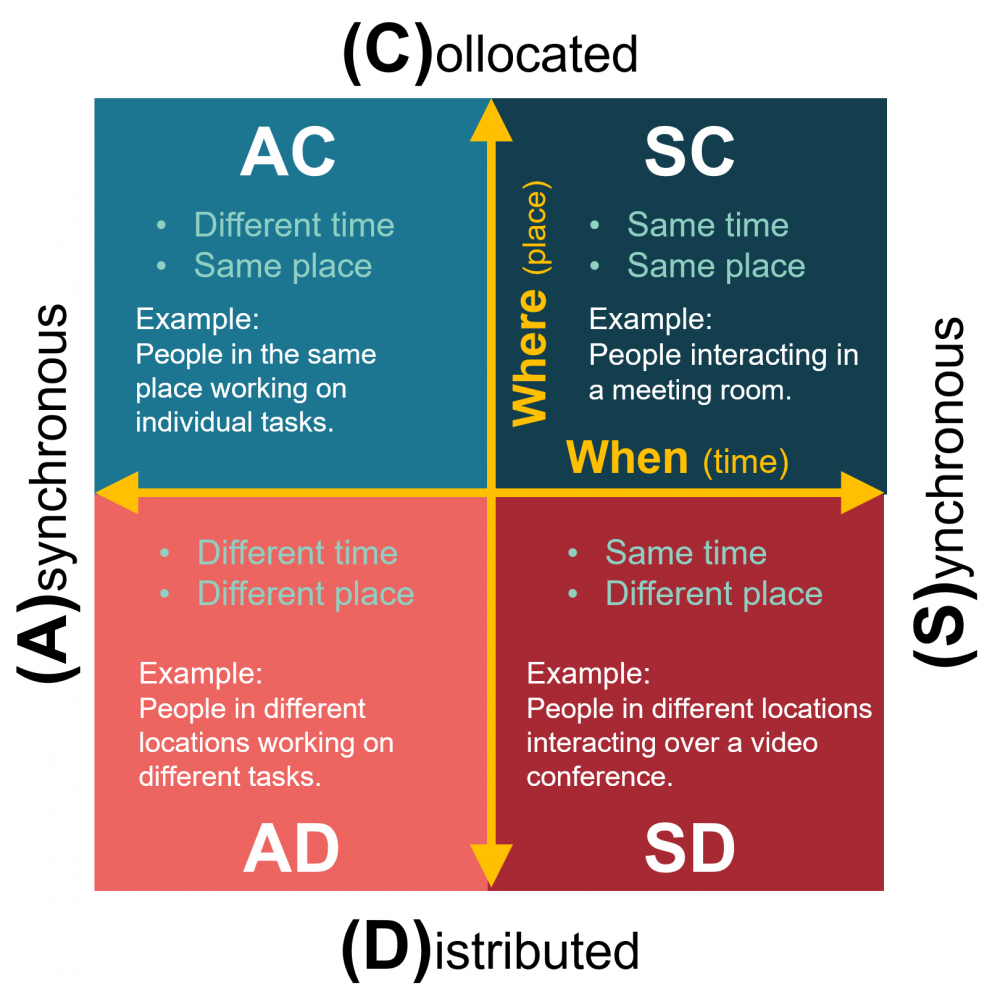
The FSW is based on two key dimensions of work: where it is done and when it occurs in relation to others.
All work activities of any organization can be distributed among the four quadrants created by the combination of location and concurrency as depicted in Figure 1 below.
Beyond the Office and Hybrid
In the “office mindset” the two top quadrants are grouped as “the office” and the lower quadrants are represented by ancillary places where work could occur, see Figure 2.
But that doesn’t make sense in the FSW. Firstly, because given the opportunity, the new context of work can generate new environments that do not inherit the way the office is commercialized, nor its metrics of success which often lead to undesirable side effects — such as the workplace managed as a cost (not as an asset) and presenteeism (employees feeling pressured to be at the office).
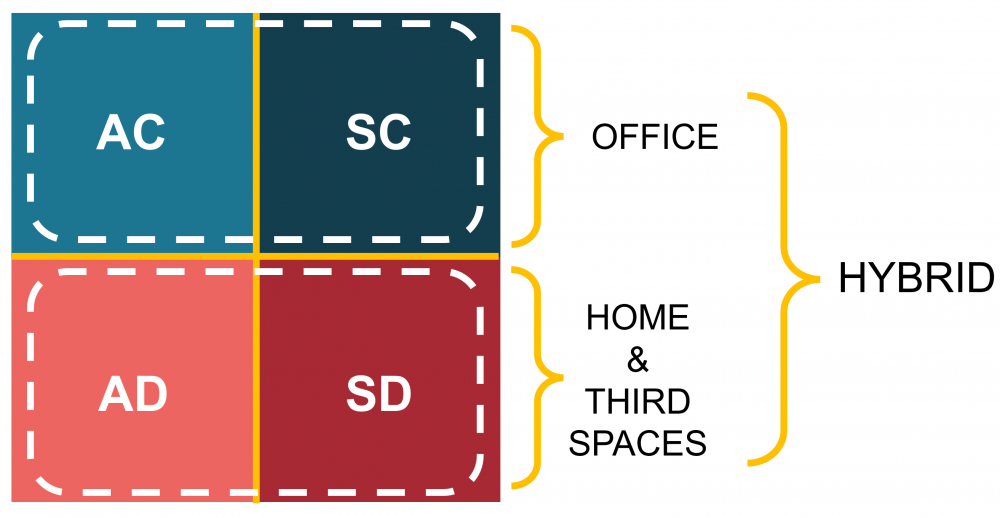
Secondly, the concept of hybrid should no longer apply to the workplace because it highlights the differences between the environments where work happens.
This could be useful when looking at work from the perspective of the office, but it is not when thinking about the future of the workplace.
Think about this: we don’t say GREEN is “hybrid YELLOW and BLUE,” it is GREEN. Getting hybrid right is not the same as getting the workplace right. We can get yellow and blue right, and not achieve green.
The Three Principles of FSW
The full-spectrum workplace is built upon three key principles.

1.The workplace is an ecosystem of work across the four quadrants:
The workplace comprises the four combinations of locations and concurrency — not just one, or two. Each contributes to different types of work, and their cumulative value is realized when measured as a whole.
2.Each organization has a unique and dynamic FSW setting:
The optimal distribution of work across the quadrants emerges from the intrinsically unique combination of the organization’s objectives and the way they are achieved through its management and organizational culture.
Not only do no two organizations have the same configuration, but also each organization’s configuration will change through time.
3.Crossing quadrants is as important as each quadrant:
The strength of FSW lies in identifying the opportunities to create workflows across quadrants and generating synergies across them.
Management (M) is at the center of the FSW because it modulates the distribution of work across the quadrants, as shown in Figure 3 below.
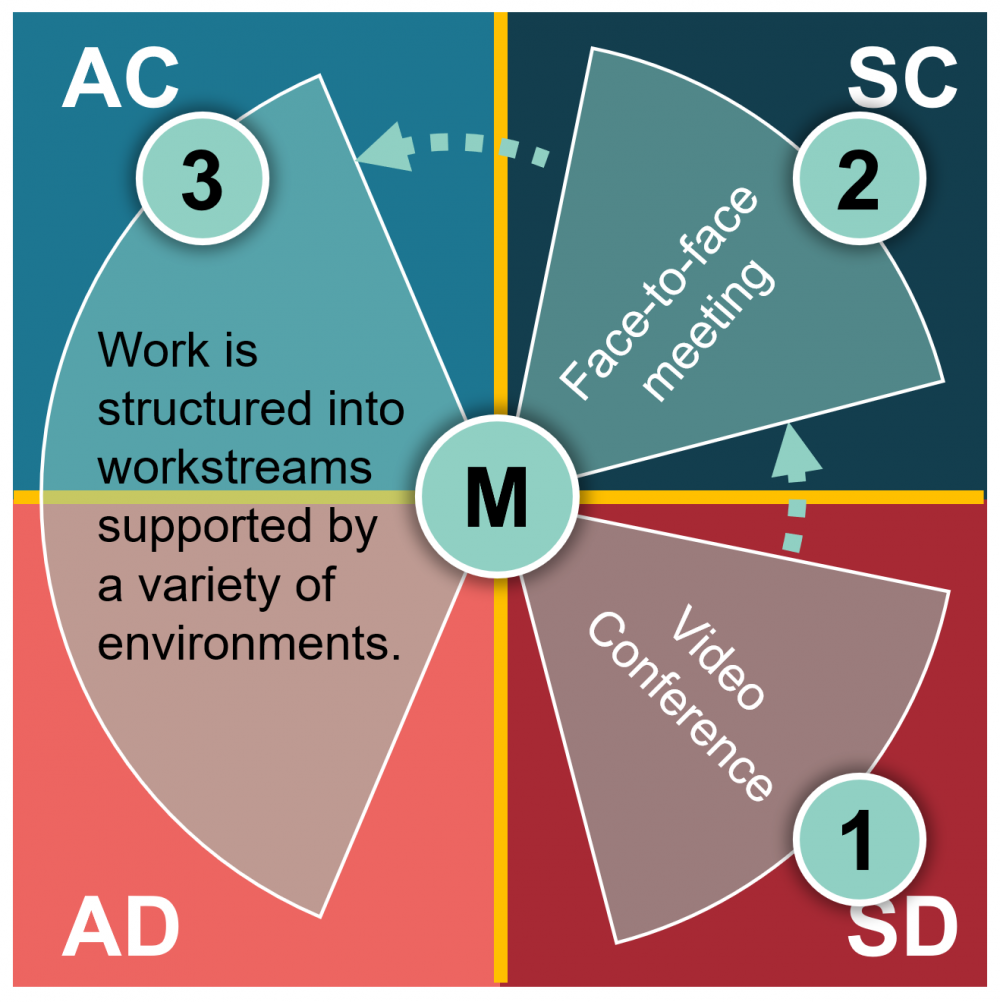
The above example illustrates how a project team could be (1) briefed in a Synchronous Distributed environment such as a video conference; followed by (2) a Synchronous Collocated face-to-face meeting and then progress work to occur in (3) a variety of environments.
Synergies, Not Tradeoffs
On the size/growth orientation framework, the authors argue that the resulting workplace comes with difficult trade-offs. Decisions on size will result in a trade-off of collaborative creativity versus individual productivity; and decisions on growth orientation on the agility to change an expand versus coordination.
In the FSW, using different quadrants (environments) do not result in trade-offs, but synergies. For example, research suggests that “organizations should be redesigned to intermittently isolate people from each other’s work for best collective performance in solving complex problems.”
Working Asynchronous Distributed (AD) and Synchronous Collocated (SC) can be better for innovation than only rallying employees back to the office, Figure 4.
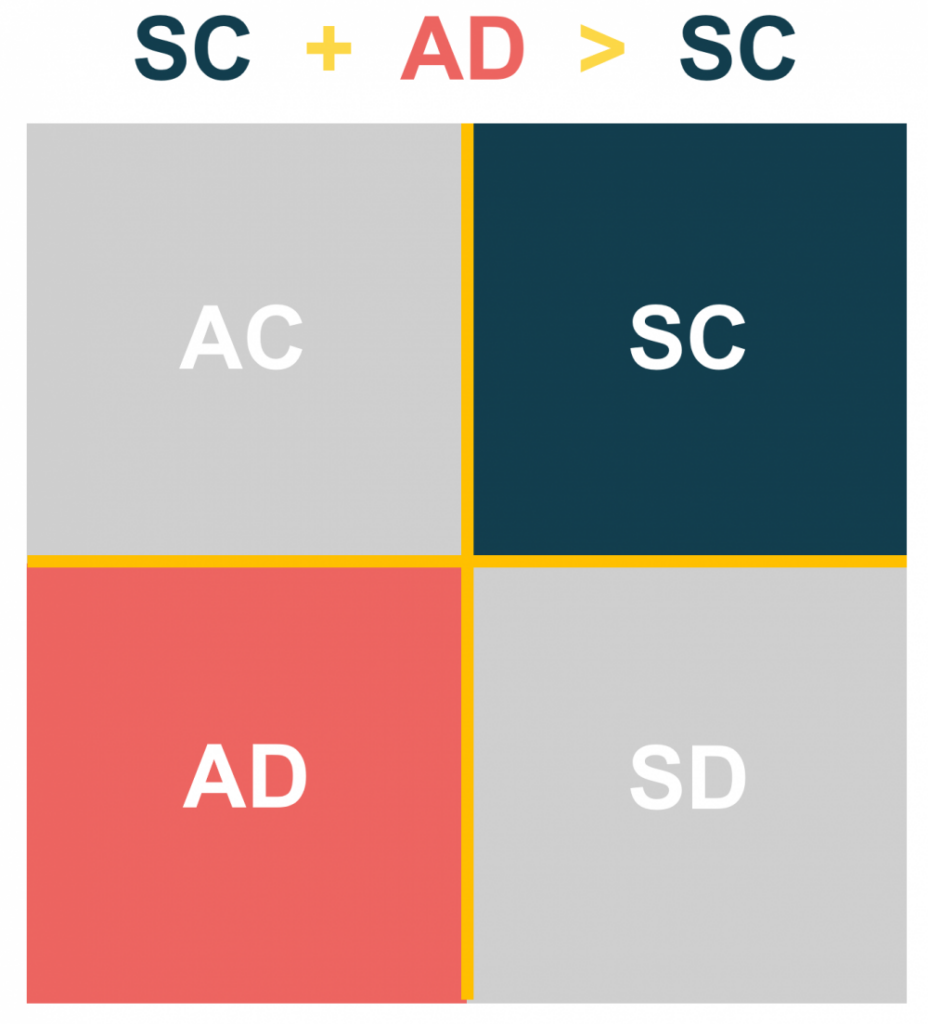
The view that no one quadrant is inherently better than another and that most tasks are composed of a series of communication processes that benefit from different quadrants (therefore no compromises, but synergies), is comprehensively explained in A theory of media synchronicity.
Getting the FSW Framework to Work
The FSW shifts the value proposition of the workplace upstream, before it is committed to the office and secondary environments.
This framework requires a rethinking of allocation of work with its place based on location and concurrency. It’s an inherently dynamic model, with varying and shifting configurations just like the nature of the organization, its culture, its objectives, and the tasks required to fulfill them, see Figure 5.