



About This Episode
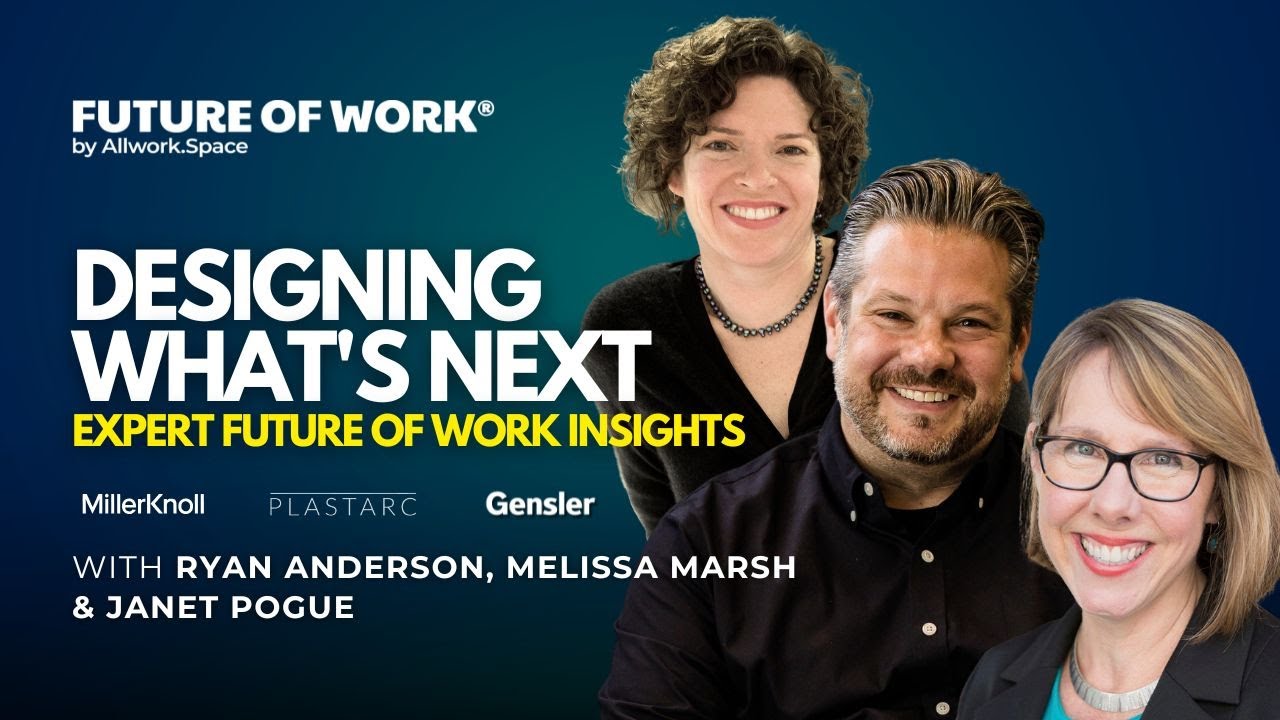
In this enlightening episode of The Future of Work® Podcast, we delve into the evolving landscape of workspaces and organizational strategies. Our esteemed guests—Ryan Anderson, Vice President of Global Research and Insights at MillerKnoll; Melissa Marsh, Founder and CEO of PLASTARC; and Janet Pogue McLaurin, Global Director of Workplace Research at Gensler—bring a wealth of experience and insight into how workplaces are transforming to meet the needs of a dynamic workforce.
The conversation navigates through topics such as combating social isolation through co-living spaces, designing culturally attuned environments for distributed teams, leveraging data and AI to enhance employee experiences, and reimagining urban spaces in the wake of telework trends. Each expert shares practical examples and forward-thinking ideas that are redefining the purpose and design of work environments.

Whether you’re a business leader, HR professional, or design enthusiast, this episode offers valuable perspectives on creating inclusive, flexible, and engaging workplaces that align with the future of work.
About Ryan Anderson, Melissa Marsh & Janet Pogue
Ryan Anderson serves as Vice President of Global Research and Insights at MillerKnoll. With three decades of industry experience, Ryan leads research initiatives that focus on designing spaces to support healthy, inclusive, and productive communities. He hosts MillerKnoll’s About Place podcast and contributes to publications like Forbes, The Wall Street Journal, and NPR.

Melissa Marsh is the Founder and CEO of PLASTARC, a consultancy specializing in social research, workplace innovation, and real estate strategy. Combining her expertise in social science and architecture, Melissa advocates for data-driven, people-centric design solutions that enhance occupant satisfaction and performance.
Janet Pogue McLaurin is the Global Director of Workplace Research at Gensler and a Principal at the firm. With over 40 years of experience, Janet has been instrumental in leading Gensler’s global Workplace Surveys and the Workplace Performance Index (WPIx), focusing on space effectiveness and employee experience. She is a Fellow of both the AIA and IIDA.
What You’ll Learn
- Combating Social Isolation: How co-living and multifunctional spaces can address loneliness and foster community.
- Designing for Diversity: Strategies for creating culturally attuned workplaces for globally distributed teams.
- Data-Driven Workspaces: The role of data and AI in enhancing employee experiences and building trust.
- Urban Transformation: Insights into how telework is reshaping cities and the utilization of office spaces.
- Customized Workplace Solutions: The importance of tailoring work environments to organizational culture and evolving work practices.
Transcript
Host [00:00:00] Welcome to the Future of Work podcast, where we explore what’s next in work, workplace, and the human experience. You’re listening to a future of work expert insights, a special format where we bring together the most thought-provoking insights from our top guests around a single topic, shaping the future of Work. In this episode, that topic is design, specifically how workplace design is evolving to support connection, performance, and wellbeing in an era defined by flexibility and choice. We’ve curated conversations with three of the sharpest minds in workplace strategy. Each with a unique take on how the spaces we work in can be reimagined for what people really need. Let’s begin. In a world where technology connects us more than ever, many workers are feeling more isolated than before. So what happened to community and how can we rebuild it? We asked Ryan Anderson, VP of Global Research at Miller-Knoll, how technology has reshaped our workplace relationships and what role design now plays in bringing people back together. How has technology unintentionally fragmented our sense of community at work? And what role does workplace design now play in rebuilding it?
Ryan Anderson [00:01:17] With technology as the primary enabler of this concept of an atomized individual, if you look at the user interfaces of most of our software and the availability of all of these hardware devices, they promote maybe inadvertently, but us doing most of the key activities we want to do by ourselves, physically removed from others, whether that’s watching movies, streaming, as opposed to being in a theater. Or whether it’s taking video calls individually versus being in a room. And so I don’t ever want to appear to be a Luddite, but we have to recognize that the natural force of technology is to cause a degree of physical separation and to be optimized for individual use cases. So whereas that community building and that kind of communal experience you described in the past was a necessity today, it’s a design challenge. Like we actually have to figure out what it looks like. To enable people to really thrive in different community moments because it doesn’t happen organically with the way that our behaviors are evolving. But as it pertains to this concept of relationship-based work or planning for relationship- based work, that’s a framework that we’ve been talking about lately. It’s a new construct, but it’s just drawing on really good design principles. And it acknowledges that, in particular, when it comes to workplace, people are voicing a strong need to spend more quality time together, to balance the use of technology with interpersonal experiences and interactions that are very difficult to achieve on video or on chat, et cetera. And so when we look at the copious amounts of research that either we’ve done or our thought partners have done, we consistently see terms like community, camaraderie, you know, in-person meetings, collaboration, as The reasons that people cite for being together, but when you peel it back a little farther, it’s just they want to have quality relationships and exist within a broader community at work because that’s what companies and organizations are. They’re social networks and you don’t want everybody operating like freelancers. You want people to come together with some sort of shared sense of purpose.
Host [00:03:30] Ryan Anderson helps us rethink how design can rebuild the workplace community technology has pulled apart. He explores how relationship-based work is redefining space and why we need to design with connection in mind. Our next guest builds on this by showing us what high-performing workplaces actually look like and how even small companies can create them. When we talk about workplace design, it’s easy to focus on flashy campuses and tech giants. But what really separates high-performing spaces from the rest? We sat down with Janet Pogue, Global Workplace Research Leader at Gensler, to explore what makes a workplace truly work, and why even the smallest companies can design for performance, focus, and well-being. What sets high- performing workplaces apart from the others? And how should companies of any size think about workspace as a performance tool?
Janet Pogue [00:04:24] I think it ultimately comes down to the racer and a boat that matches how they race. And that’s really what comes out on top, which is fundamentally workplaces are more similar than dissimilar, right? They all have places that we come together and that we work alone, that we learn, we socialize. But the best workplaces… Actually have a few things that are a little different. You know, they are better equipped, you know, to be able to have some of those confidential conversations, to be to have places to relax and restore in between meetings and just like get your head back in the game from one task to another task. They’re able to think about being able to do deep concentration better. So we have found that there are certain activities that really need to be thought of more intentionally, and they have better experiences. And so they’re not only equipped to be effective and to be functional, but they also have better work experience. Think about it as like two halves of a circle. That’s right. Because that’s a part of the entire experience, It’s the arrival. What you do throughout the day, that connection to nature, right? And being able, so we think about workplaces, not just what’s in the tenant space, regardless of size, but what is the ecosystem of spaces that your employees have access to. So some of those, you know, a large company, a large campus, they may provide everything because they’re building a large corporate campus. But a small tenant, let’s say it has only 15 employees, you know, they need to rely on what is it they’re providing, but what else is in the building that the landlord is providing? What’s across the street? What’s down the street, being able to use the park, the cafe, you know all these other spaces, being able take a walking meeting, you now all, or go to the rooftop of the building that’s shared with all the tenants. For, you know, to eat lunch. Those are all a part of the experience. And when we think about like mixed use developments, we’re now thinking in terms of how can we script the entire experience.
Host [00:07:01] Janet Pogue reveals the real differentiators of high-performing offices, from quiet zones to rejuvenation spaces, and explains why workplace design must consider the entire ecosystem, not just square footage. Then, Melissa Marsh takes this conversation a step further, showing us how trust, data, and employee experience must guide the future of workplace design. In today’s workplace, data is everywhere. From desk bookings to movement tracking to behavioral insights. But are we actually using that data to improve the employee experience? Or are we just watching people work? We spoke with Melissa Marsh, founder of Plastark, and a leading expert in workplace strategy and analytics about how trust, intention, and inspiration from non-office spaces should be guiding the future of work design. How can we use workplace data to create spaces people actually want to be in, not just measure where they’ve been?
Melissa Marsh [00:08:02] You mentioned the work of my organization in making the places that we wanna be sticky and making them desirable, the place that you want to go. And that’s really front and center of what we do. And we’re often looking at the places that aren’t offices as the inspiration for that. How can the office be more like… You know, the yoga studio or, uh, you know an arts and crafts project with your kids or, you know, any other place that people, uh really want to be on their for their own reasons. Um, and on that point of data collection, the way we’re using data processing and maybe even some, some AI, uh features in, in the workplace experience. Um one of the, the rules that we’ve always followed is. If someone is getting something for the information they’re providing, then it’s gonna be worthwhile. And if someone isn’t getting something as an individual for that information being collected on them, there’s going to be a legitimate point of resistance. So you wouldn’t stand on a street corner displaying your location status to the world around you or to the internet if it were not for the purpose of getting an Uber or a Lyft ride. If by displaying your location, you get a ride pickup more quickly, then definitely you’re gonna do it, right? And so I think what’s crossed the boundary in the place of the workplace experience technology is that more data is being collected than is being used to improve the experience for the employee. And that is what makes it feel unfair, um, manipulative or… Or otherwise problematic from an employee trust perspective is because we’re not using this technology in the ways that we could to actually build a better experience for people within the place, in this.
Host [00:10:09] Melissa Marsh challenges us to rethink workplace data, not as surveillance, but as a tool to create spaces people actually want to be in. She shows how inspiration from non-office spaces and a foundation of trust can help organizations design for wellness, retention, and flexibility. It’s a fitting close to a conversation all about designing not just where we work, but how we work together. Thanks for listening to this Expert Insights episode of the Future of Work podcast. If you found it insightful, share it with a colleague, leave us a review, or check out our show notes for links to each guest’s full interview. Until next time, keep asking not just where we work, but how we work better together.