



- The suburban office is having a resurgence on account of new “close-to-home” preferences brought on by the pandemic.
- Owners of suburban buildings in particular also now recognize that amenities are expected by their tenants, especially if they want to lure them out of urban areas.
- This next iteration of the office should be less about planning specifically around COVID, and more about designing to serve long-term employee needs brought on by this cultural shift.
This article was written by Morgan Toth and it was originally published in Work Design Magazine.
With vaccine rollout picking up speed, people are talking about returning to work and what the new office will look like. Part of that conversation is being led by employees’ desire (or lack of it) to even go back into an office. While the current sentiment seems to be that employees overwhelmingly do not want to return to an office full-time, reasons to come into an office fall mostly around collaboration. For employers it’s about retaining culture. To address both of these, and account for new “close-to-home” preferences brought on by the pandemic, companies are looking to move their new hybrid workforce into suburban office spaces.

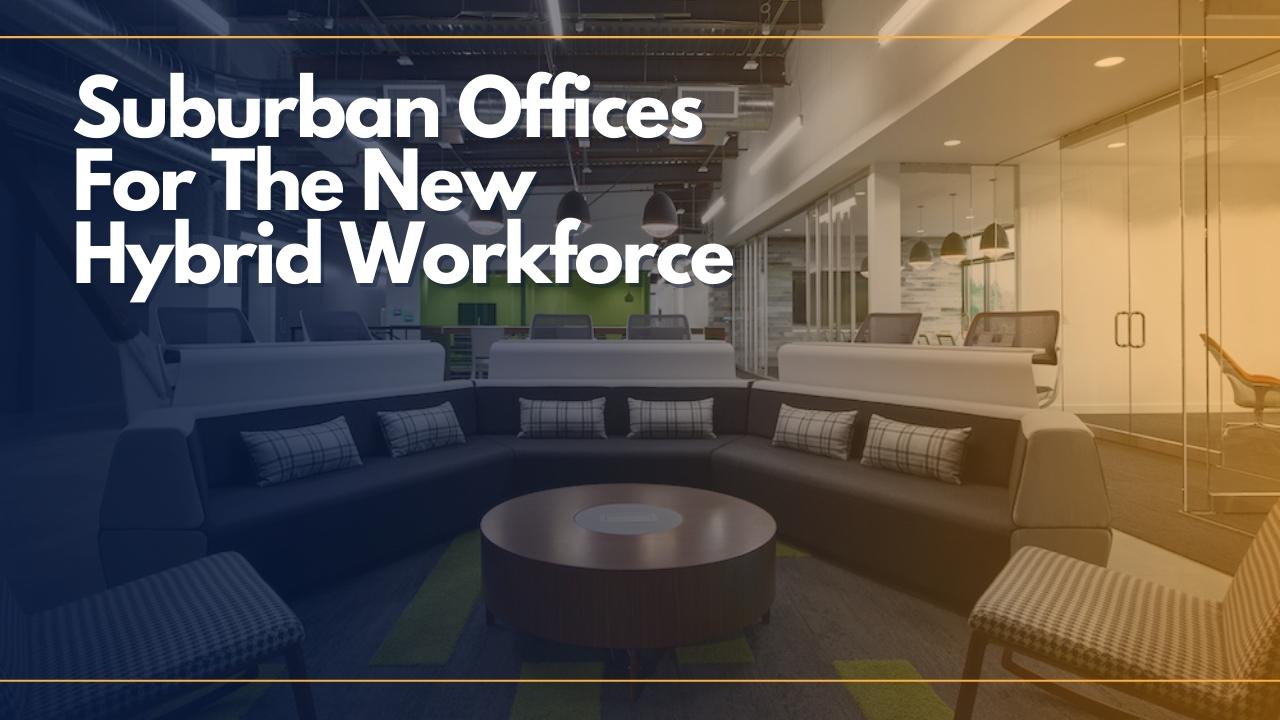
Though developers have long focused on heavily populated, major urban cores for commercial office spaces, there has been an uptick in suburban developments this past year. From location convenience to support easy commutes and schedule flexibility, to increased space for comfort and diversity in types of work areas, the suburban office is having a resurgence. For designers, this provides an opportunity to renvision the outdated office space for its new, constantly evolving, future.
New Interest in the Outdated Suburban Office
Traditionally, suburban offices have been known for their formulaic layouts of hard-walled offices around the perimeter, with uninspired workstations packed in the center. Their location was often viewed as unexpected (aka boring) for creative industries, and one that could not support all of the diverse wants and needs of the emerging Millennial workforce. There also used to be a sense of inconvenience when it came to lack of public transportation or lack of walkability for lunch or coffee spots typically found in an abundance in downtown areas.

Enter the pandemic, and none of these pitfalls are really the case these days.
Designers are proving every day that any space or building can be “cool” through creative design strategies and a willingness from landlords to let them do more than the standard SAT ceilings, carpet and paint. Owners of suburban buildings in particular also now recognize that amenities are expected by their tenants, especially if they want to lure them out of urban areas. So they are looking for innovative ways to redesign these spaces while adding amenities, and even develop more offices in a suburban area that already has nearby services.
In the past, suburban areas have typically been less expensive per square foot, but some strong markets are seeing rates even higher than they are in the downtown core. This is a good incentive for building owners to make capital improvements that have long been on hold, and thus attract tenants who are seeking solutions to their own changing employee base — employees who are unwilling to commute and less inclined to spend a full day in the office.
Work as a Community
This next iteration of the office should be less about planning specifically around COVID, and more about designing to serve long-term employee needs brought on by this cultural shift. Unlike most of what’s been done this past year, this isn’t about temporary solutions: we’re designing the new workforce.
For instance, the need to accommodate employee mobility has only been building since companies and employees both learned remote work could be successful. But what’s been lost is a sense of community and work culture. Collaboration is the top reason employees cite for considering returning to an office part of the time, which means it’s essential to design offices to grow community building.
Going against much of what was thought to be necessary at the beginning of COVID — separation — and much of what was seen in traditional suburban offices — cubicles — the new office should create points of connection and spontaneous collaboration. That connection is truly paramount. Increased technology throughout the office allows employees to work anywhere the days they’re in, while having the ability to engage with those who choose to work remotely.
To encourage collaboration, meeting rooms may be reallocated for open areas with tables, whiteboards and various seating that is comfortable like living rooms. It could also mean that rather than departments being grouped together, the entire office is come-and-go, open for use by anyone, anywhere — a complete shift from traditional suburban office setups.
Due to their location, building amenities are also critical to attract companies further out of urban cores. These may include things like conference centers (for sharing and renting among tenants), fitness areas (to allow tenants to stay onsite versus drive somewhere else) and outdoor activity areas (for recreation and dining), all connected by walking paths. These types of enhancements help put these properties on equal footing with what the competition in downtown offers. Once they’re on level ground with the competition, their extras can put them over the top. One of which is parking. With the workforce being more mobile, there could be a spike in people using their cars as the main mode of commuting, versus public transportation, making ease and parking convenience a big selling feature for the burbs.
Space as Representation of Status
Traditionally, workspaces were designed with hierarchy in mind. The corner office represented a person’s status at the company. A cubicle did, too. In outdated suburban offices, many of these floorplans still exist, whereas many downtown offices (depending on industry) have been updated with the times and trends of recent years.
This outdated way of looking at space planning also creates the confines that employees are now looking to escape. If they know they can work from a kitchen table with natural light, versus a dark cubicle in a sea of dozens, they’ll be less tempted to return to the office, even part-time. If they know their position will never “earn” them the corner office with the floor-to-ceiling windows, perhaps they’ll choose to spend their days at a nearby coffee shop.
By reconfiguring how these spaces look, designers are also redefining what they represent. Hot desks, where employees can come and go when they please, versus having assigned offices or stations, adds to a feeling of equality. Whether in the office or out, employees feel like they’re on equal footing with peers and managers because everyone is working from the same type of space while in the office. Similarly, it helps remind leadership that in order for the hybrid workforce to be successful they must participate.
Suburban owners are realizing that much of their inventory of vacant office space conforms to the old paradigm. Many are now taking proactive steps to prepare these spaces for a workforce with new and different demands.
All Employees Treated Equally
Of course, with a hybrid model comes a few challenges, too.
Regardless of office location, companies are faced with deciding whether individual teams or specific staff get different desk setups/amenities if they will be in the office more frequently than others. Whether this is by choice or by the function of their work, it does raise the question of equality throughout the office landscape.
In some cases, the simplest solution is to provide a standard desk setup for all, but potentially more storage for personal items for the individuals who will inhabit the office more often. Like with everything else these past 14 months, there needs to be flexibility and a willingness to adapt as solutions are tested. Especially as we move into a world of hybrid work, it’s important to recognize that these are working models themselves.
As we move into another new mode of working, more companies are looking to create a “home base” for employees that provides community when they need it, while giving them the flexibility to stay home when they don’t.
Designers know that spaces can be powerful conduits. With the new office, the goal is to entice employees back in and inspire them when they’re there. Suburban offices are in many ways a blank canvas to help do this. There is ample opportunity to build out these spaces and incorporate amenities to especially serve the new workforce’s changing needs. While offices in urban areas will in no way disappear, the suburban office feels especially important now because it meets many employees where they already are, and where they have been throughout the pandemic: home.
Seating should be comfortable, almost mimicking the diversity of options in a person’s home. Being able to bounce between a desk and a lounge chair, a couch and a floor pillow, gives employees choices to work how they need. This less-structured approach to office design creates a freedom reminiscent of working remotely, while focusing less on the traditional notion that sitting at your desk equates to productivity.