

Young Americans are becoming far more pessimistic about the job market than older generations, creating what researchers say is the largest age gap in job market confidence of any country measured.
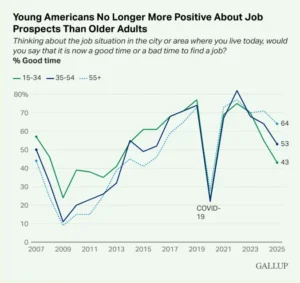
According to new Gallup data, 43% of Americans ages 15 to 34 said in 2025 that it was a good time to find a job locally. That was 21 points lower than Americans ages 55 and older, an unusually wide divide for a major economy.

Younger Workers Are Growing More Negative
The shift is recent. Younger Americans were historically more optimistic about job prospects than older adults, but that flipped in 2024 and worsened again in 2025.
Since 2023, optimism among younger Americans has dropped 27 points. By comparison, confidence among adults ages 35 to 54 declined 15 points over the same period, while older adults saw only a modest drop.

The steepest declines were reported among young women, college-educated young adults, and people not yet working full-time jobs.
AI Anxiety and Entry-Level Pressure
The findings arrive as artificial intelligence continues changing entry-level hiring across industries.
While the Gallup data did not directly measure AI concerns, researchers noted that many of the most pessimistic groups are also the workers most exposed to uncertainty around automation and white-collar entry-level work.
Highly educated young adults searching for full-time employment showed some of the weakest confidence levels in the survey, suggesting growing anxiety about breaking into the workforce at a time when companies are slowing hiring and experimenting with AI-assisted workflows.
The U.S. Stands Out From Other Advanced Economies
Other wealthy countries have also seen softer job market sentiment in recent years, but most still follow the traditional pattern where younger adults remain more optimistic than older generations.
Across OECD countries overall, adults ages 15 to 34 continue to report stronger confidence in local job markets than adults over 55.
The United States now stands apart because older Americans remain relatively upbeat while younger workers have become sharply more negative about their prospects.
A New Workplace Divide
The data points to a growing disconnect in how different generations experience the labor market.
Older Americans, many of whom are already established in their careers or leaving the workforce entirely, remain comparatively positive about job conditions. Younger workers entering the labor market face a very different reality: fewer openings, heavier competition, and growing uncertainty about how AI may change early-career work.
As companies continue rethinking hiring, automation, and workforce planning, younger workers appear to be feeling the pressure first.