
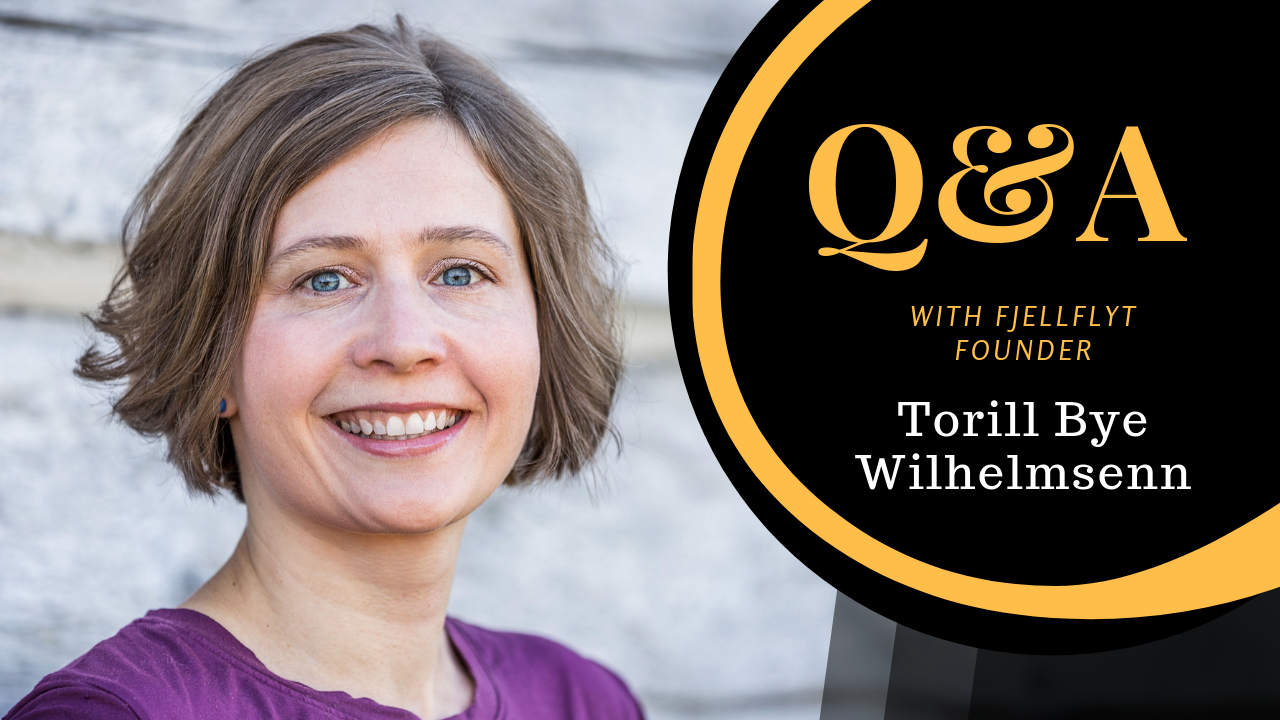
In 2015, after a year spent researching and recruiting members, Torill Bye Wilhelmsen opened a coworking space in rural Norway.
An early pioneer of the Norwegian coworking movement, Wilhelmsen now says that coworking across the country has “exploded”.

Allwork.Space spoke with Wilhelmsen about the challenges of starting and growing a rural coworking space.
Rural coworking is on the rise, with a growing number of spaces around the world now bringing coworking to small towns.

Within the workspace industry, rural coworking spaces face different challenges than those in mid-size towns and large cities, including educating local communities about what coworking is, and bringing broadband access to people who may not otherwise have it.
In 2015, Torill Bye Wilhelmsen opened Fjellflyt, a coworking space in rural Norway designed to help people from rural and urban areas launch and run sustainable businesses. An underlying focus for Wilhelmsen and the Fjellflyt community is to support each other in creating lives and work they are passionate about.
Allwork.Space spoke with Wilhelmsen about what rural coworking looks like in a Norwegian mountain town, her work with people whose family businesses go back generations, and the challenges of getting local municipalities to recognize the value and potential impact of coworking. Here are the highlights of our conversation.
Allwork.Space: Can we start with some background about Fjellflyt?

Torill Bye Wilhelmsen: We were one of the early Norwegian spaces. We opened in March of 2015. That was quite early when it comes to coworking in Norway, so I guess we’re behind as a country. There weren’t many rural coworking spaces in Norway at all a few years ago.
We chose a niche of creative businesses. We have actors, we have animators, we have a copywriter, several graphical designers, some programmers, an illustrator, we have someone doing project management for museums, one mountain lodge business and a farmer doing ecological, small-scale farming.
Our town is only 3,500 people, so there are not a lot of entrepreneurs to recruit from. But we have really strong traditions here for mountain tourism, farming and crafting.
We are surrounded by six national parks. This is called the National Park Region of Norway. It’s the most alpine mountains we have, so my municipality and the neighboring municipality have 2,000 meter mountains, but we’re in the valley so it’s very lush green during the spring — and perfect conditions for small-scale farming. We have entrepreneurs, but they don’t identify as entrepreneurs. We wanted to create something for people who used the digital tools available to us.
Allwork.Space: So you saw a need for coworking in your community. Will you tell me about that? What was the inspiration for the space?
It comes from working with entrepreneurs working all over Norway. My business also runs courses for people who want to run their own business, no matter where they live. I saw the need for this community online, where you can meet people, but I really think you have to pair an online community with a community in your local area or region. That’s why I decided that the next step was to give something back to the local community.
It was also quite a selfish decision. I wanted a place where I could also get that support from other entrepreneurs. I built a home office in my garage — my husband also owns his own business — so we have a really nice home office. Going from the home office to the coworking space, we’ve increased the revenue, the well-being and taken a step up with our businesses.
We just recruit people who are working in home offices. We haven’t stolen one single person from the more traditional coworking space, which isn’t a coworking space, it’s offices.
Allwork.Space: One of the important aspects of rural coworking, in general, is giving people access to broadband. Is that also an issue in Norway?
Actually, that was a huge issue. At the home office, we didn’t get the fiber connection. We had so many quarrels with the broadband supplier who said we were getting fast speeds, but we never got the speed they promised. Now we have good WiFi and a good connection if you want to plug in. That internet connection is part of the success of the space.
Allwork.Space: How did you go about finding and connecting with people who were working from home?
That was interesting because we didn’t have a large network, so we had to track people down. We spent a year trying to find enough people before we opened. It was our friends, and our friends’ friends.
One thing that’s quite special about our space is that we’ve recruited a lot of people that have moved here. We have six different businesses in the time we’ve been opened who have moved here, and it’s brought 15 people to the local community and even more people are coming in the next month.
We haven’t really managed to get a lot of customers or coworkers from the local community — it’s mostly people who have moved here. It’s like when we were students studying abroad, and all the other people studying abroad from other places tied together. It’s kind of like that.
Allwork.Space: You’re still working to connect with the people who already live there?
Yes, in different ways. It’s a different mentality when it comes to the belief that someone can be an entrepreneur, or start their own business. Even if a lot of local people are really entrepreneurial, as farmers and craftsmen. They do entrepreneurial things like run shops and they have family businesses in the mountains; they guide, and run lodges and hotels, but they don’t consider themselves entrepreneurs. Some of them have been running family businesses for generations.
Allwork.Space: Are people moving in from the larger cities or from the surrounding, smaller towns?
They’re moving from larger cities. That’s the scenario the local municipality and region is working towards, so I wish they were a little more open to working with our team on that particular feat.
Allwork.Space: Is Oslo the nearest city to you?
We’re four hours from Oslo. The whole National Park Region, which is six municipalities, doesn’t come to more than 18,000-19,000 people. It’s quite a large area. If you drive from one end to the other, it’s two hours. So it’s really sparsely populated. The largest town that’s known is Lillehammer, which is two hours away, then two more hours to Oslo.
Allwork.Space: You mentioned that coworking in Norway is still relatively new — that in 2015, you were one of the pioneering spaces. What is coworking in Norway like now?
Now it’s thriving. It’s kind of exploded. I feel like it’s a bit like the wild west. Tons of spaces are opening. They call themselves a coworking space, but when you look more closely, it’s not a coworking space, it’s just a shared office.
We also have people opening coworking spaces and calling them a hub. In Norway, a hub means that you have to have a governmental organization helping entrepreneurs in some way. But they are more like coworking spaces. They’re privately run, they have some startups, they have some smaller businesses and they may have some consultants come in. But they’re not a hub. I think the confusion is quite widespread when it comes to the knowledge about the coworking movement and the different types of spaces.
I got so many questions when we first opened about why we couldn’t just move into the old dairy in town, which has been refurbished as a shared office space. Everyone wondered why we didn’t just move in there. They said that, if I moved in there, I wouldn’t have to share a desk with people — I could have my own office.
But we wanted a coworking space. We want to connect without walls. We’re really active in different ways. We have a coworking visa and I’ve been an ambassador for something called the Nordic Startup Awards. They also rate coworking spaces and we were rated one of the best coworking spaces in the Nordic countries.
Allwork.Space: There’s an interesting distinction and, even in our industry, the difference between coworking and shared workspace is not always clear. I’d love to hear your thoughts on the difference between the two.
Our main aim when we opened was to create the community. That’s why we worked for a year before we opened. We invited people for dinner in our home, we’ve had wine and cheese evenings, we’ve gone on trips together, we’ve taken our families on outdoor adventures, we make dinner in the evenings, the adults have gone on mountain biking or kayaking trips, or other social activities.
We’re also quite interested in each others’ businesses — business strategy, current projects. We want to know what people are working on and how we can help each other. We did a lot of projects together in the beginning. That was a benefit for some of the newer members, that they could get customers right out of the gate just by becoming part of the coworking space.
Allwork.Space: What are you working on right now, and what challenges are you working with?
Right now, we’re going international, so there are several challenges. The biggest challenge locally is to educate the local community and especially the local and regional government about the world of coworking and rural work, and the opportunities that lie there for our region.
We’re a really popular tourism region, so many activities. And the quality of life is so high here. A lot of people work in regular businesses and they don’t change their jobs very often, so the workforce is really stable and healthy. It’s something that more people could benefit from. People are really happy here, and the costs of living are low, and the possibilities if you like to be outdoors are tremendous.
People come here to relax and go on adventures and do amazing things. We could also be a really attractive region for remote workers and people in that space. But when we have meetings with the local government and region, they say, “We hear what you are talking about and we find it fascinating.”
Allwork.Space: Then that’s it. They don’t take it any further?
Yes. The education piece is really important to me, so we can welcome more people to coworking and connect with that world.
Allwork.Space: That’s a common challenge. You can’t just focus on the community aspect when you’re dealing with municipalities. You have to talk about economic impact and attracting more people to the area. A lot of spaces are trying to figure out how to collect data around that.
I’m thinking about writing something for the bigger newspapers in Norway about the rise of coworking and remote working, because I just don’t get people here in the region listening to me. They just don’t have the knowledge. One of the questions they have when I meet with them is that, if people can be remote and take their work with them, why would they want to be here? They think people would rather leave the area.
Allwork.Space: You’re also working on a coworking-focused event in Norway in September?
We’re starting a festival in the mountains. It was called Coworking Heaven, but Norwegians were like, “What the heck is coworking?” so we renamed it Slow Business Adventure. It’s for people who value their lifestyle and business development — people who don’t want to sacrifice their health to run a business. They want to have a comfortable business and they want to have a life. We have people coming from all over the world for that.
With the festival, we can use our beautiful area, with all the national parks, as a playground for entrepreneurs. It’s the only event I’ve found that’s focused on networking between like-minded entrepreneurs and coworkers, where the conference hall is outside.