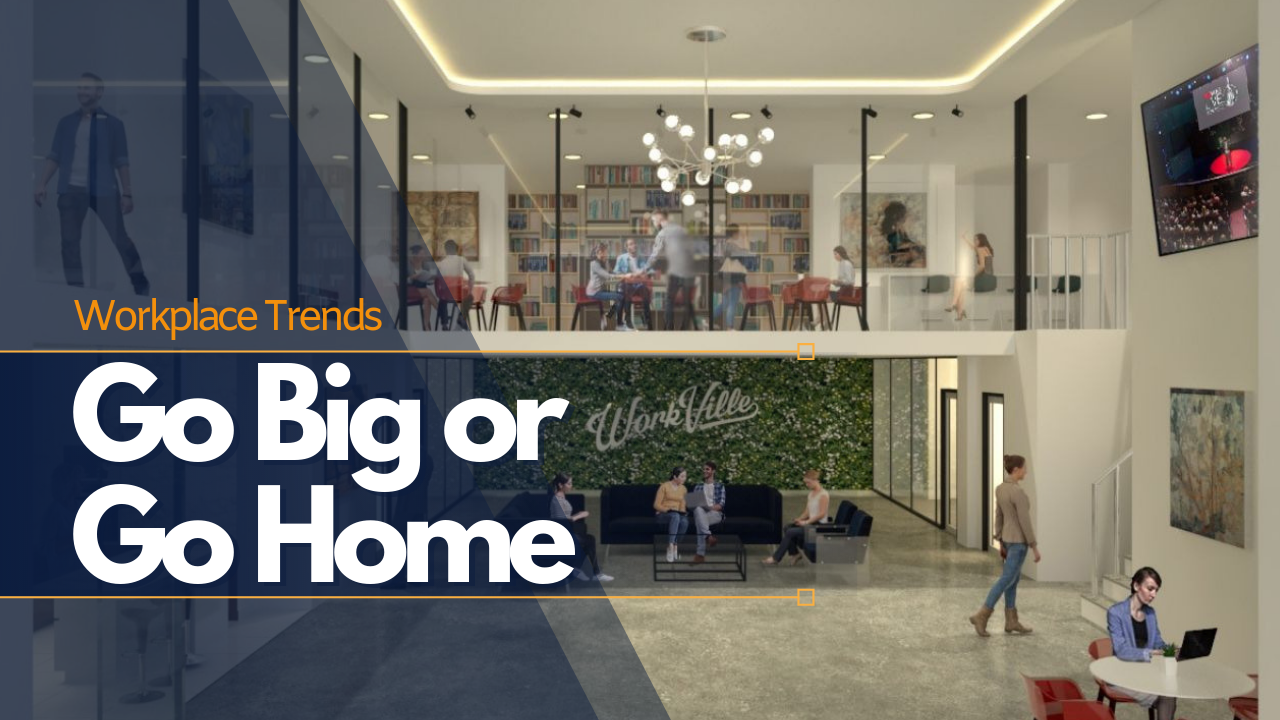
- The commercial real estate landscape is changing quickly, and coworking operators must adapt to stay ahead of the curve.
- Two diametrical companies that are doing just that are WeWork, and the independent coworking space Workville.
- Here’s how these two brands are finding new ways to accommodate the larger office needs of their coworking members.
It can be difficult to zig when others zag. Some coworking spaces have done two or three real estate deals and made a few bucks. Others have done hundreds of deals and now control large percentages of urban markets. But if there’s been one unifying theme for the entire coworking community, it’s that the commercial real estate landscape is changing and changing quickly.
Coworking operators that want to scale their businesses must meet the needs of their larger tenants who are demanding even larger spaces. Staying small is no longer a viable option if the goal is to be one step ahead of their growing customer needs.

Traditional real estate leases and capital requirements are no longer conducive to larger companies wanting to become agile for their workplaces. Specifically, mid-to-large size companies are shifting how they conduct their business — and it isn’t by signing twenty-year leases anymore. According to Forbes, 81% of executives consider agility to be the most important characteristic of a successful company.
These same companies are eagerly staying away from a real estate industry that is well-known for “restrictions, regulations and a complex bureaucracy of decision making.” According to a recent report by useFYI, 40% of companies with 10,000 employees or more now employ remote workers with high levels of CEO participation.

Coworking operators must now adapt and can take their cues from two companies who are navigating these waters with almost diametrical stories. One is a billion dollar behemoth and the other is a much lesser known but equally as innovative “mom-and-pop” shop.
The first operator is WeWork — once coined as “primarily a landlord for freelancers and companies.” But their recent shift in catering to mid to larger size tenants is something of note — for which WeWork will design, furnish and customize full floors of branded office space. Aptly named “headquarters by WeWork”, it’s a division with a focus on attracting and retaining larger “Fortune 500-ish” enterprises and their employees.
The second coworking operator is New York City based Workville — which is also revamping their space offerings. They started out a few years ago in a crowded market renting out desks and smaller offices for tech startups wanting to access just the right amount of office space for their needs.
Co-founder and CEO, D.J. Dashti unveiled to Allwork.Space their plans to open up an entire new building — solely dedicated to one company per floor. 315 W 35th street will become the home for “companies who want the autonomy of their own office space with the benefit of outsourcing office management” and want the “visibility and exposure” that is needed to grow.
“As companies are starting to scale, they need us to be included in their office management — an extension of their team,” added President/COO Sue Bernstock. “It’s more than just helping companies, it’s about forming strategic partnerships so that we take a proactive approach in building an authentic community,” she added.
Alongside WeWork and Knotel (a competitor also positioning itself to become a flexible provider of workspace to larger companies), the smaller, more organic Workville is certainly bucking the trend. The team at Workville plans to open a ground floor, members-only lounge. “Members will have their own private floor and still have the benefit of a welcoming, energetic member lounge to work from throughout the day,” Dashti said.
A theme emerged when speaking to tenants who are employed by larger companies within Workville: their organic growth model is working. “Workville has the flexibility of a coworking space, but if I need to scale — they are here to help,” said Larry Lowe, the head of Sales for Job Today, an app-based job seeking company headquartered in Luxembourg, Germany.
Although coworking companies make up 18% (up from 6% in 2017) of all real estate deals in Manhattan, there are still some instances with tenants growing at breakneck speed where coworking spaces have not been able to keep pace. Workville is certainly aware of this issue.
“I’m here to be the face of the business and not here to manage the office,” said Shaka Arnon, the general manager of a larger sports technology startup, WSC Sports. “Last year we doubled in size and ten-fold in the last three years — so we need to keep finding bigger space,” Arnon added.
The saying “Go Big or Go Home” is definitely resonating with WeWork and Workville. Though there are risks to leasing larger and more elaborate spaces exponentially, for some, it’s so far been a proven risk to take.