
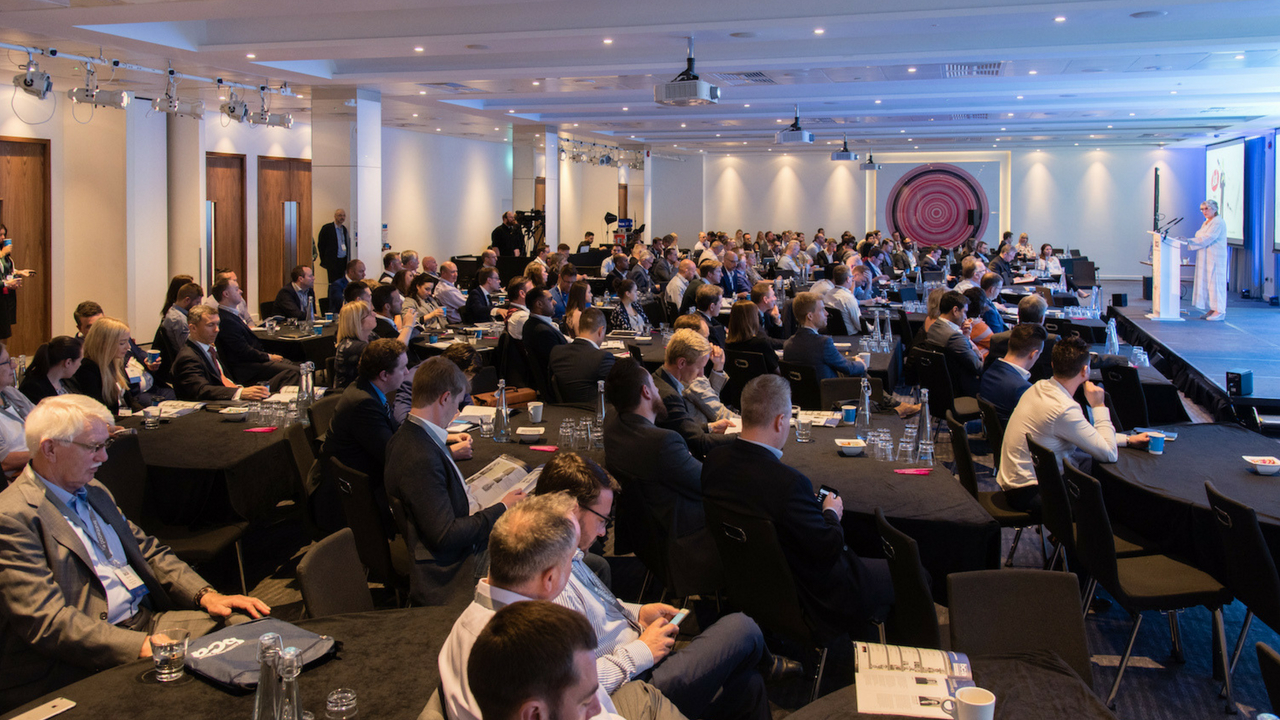
- The BCA Conference took place Tuesday May 15th at etc.venues in London.
- The programme was dominated by technology and innovation as they relate to the flexible workspace industry.
- The conference urged operators to not forget their roots, especially as corporate coworking becomes more mainstream
On Tuesday 15th May, over 300 people gathered at etc.venues in London for the 2018 BCA Conference.
It was the 28th annual conference held by the Business Centre Association, and the packed programme was dominated by technology and digital innovation — which reflects the current emerging trends, challenges and opportunities facing today’s flexible workspace industry.

Jennifer Brooke, Executive Director of the BCA, raised a few smiles when she recalled taking over the association in 1999 at a time when “fax was still the leading technology and everyone used Hotmail.” Fast forward to today, and technology is continuing to shape, knead and lead the way we do business, and the way workspaces are designed around business needs.
Technology aside, there were plenty more trends and innovations — and surprises — on the agenda. Amongst them, Jennifer Brooke announced her intention to “take a back seat” from the BCA and step down as Executive Director at the end of the year. For those familiar with the BCA and Jennifer’s leadership over the past 20 years, this is the end of an era, but in Jennifer’s words it’s the start of “a new chapter” for the BCA as it continues its evolutionary journey.

“I am looking forward to seeing our members thrive over the coming years, whatever the shape of things to come,” she added.
1) Corporates Are Big Business, But Don’t Forget Your Roots
Keynote speaker Emma Jones, founder of startup network Enterprise Nation, urged workspace operators to focus on ways in which their spaces can help small businesses connect with each other — especially at a time when the number if new startups is dropping and business confidence is waning ahead of Brexit.
“The UK is now home to 5.5 million small businesses,” she said. “We’re in a great position. Our job now is to make sure they get the support they need to grow — that’s how we get a healthy economy.”
Enterprise Nation is based in workspace operated by The Office Group, and Emma appreciates first-hand the massive value of a connected community. “Get business support plugged into your property,” she urged. “Community builds value for all, and you can be a much-needed voice for your clients.”

2) IWG’s Richard Morris – “We’re not even scratching the surface”
CEO of IWG plc (UK), Richard Morris, delivered a personal perspective on the industry. “When I joined [Regus], our industry was seen as a little bit niche,” he said. “But over the past couple of years our industry has become so much more relevant to businesses and investors.
“Demand is growing and the workspace revolution is just starting to gather pace. The good news is, we’re not even scratching the surface yet.”
Morris cited research from CBRE that found 69% of millennials would happily trade employment benefits for a better workspace — a stark indicator of the workplace’s ability to facilitate positive wellbeing and productivity at work.
“Technology will continue to play a big part in how we enable clients to access our services,” Morris added. “It’s about connectivity and enabling members of our communities to reach out and connect and do business with one another,” which tied in neatly with Emma Jones’s earlier talk.
“There are fantastic opportunities ahead,” he added. “What we do will become more relevant and more valuable in coming years. Let’s make sure we continue to develop and invest in this important infrastructure.”
3) CBRE: How Landlords View Flexible Workspace
Kevin McCauley and James Pearson from CBRE discussed the growth of flexible workspace and how corporate occupiers and landlords are responding to it.
In some ways, the interaction with flexible space is tiny, or non-existent. “It’s not one size fits all,” said McCauley. “Not every occupier wants to share workspace due to privacy regulations, or because a membership model doesn’t work for them. Identity and brand are important, and you can’t always create a brand in flexible space.”
Based on a CBRE survey of corporate occupiers, flexible leases make up just 7% of their portfolios — which means there’s plenty of room for growth.
And while flexible workspace operators have a valuable opportunity to fulfill that need, they’re not alone: “Landlords are assessing and considering their options,” McCauley noted. “In many cases, they view flexible space as a complement to their existing portfolios.
“Our findings show that 77% of UK landlords are now considering using flexible space — so expect some competition!”
4) Wellbeing is a Bottom Line Issue
Alex Gifford from Steelcase addressed the importance of wellbeing in workplace environments, where long sedentary days sitting and slumping over a desk is the unhealthy norm.
“Work is tougher, it’s more stressful, and we’re suffering as a result,” he said. “Our senses receive 11 million bits of information every second, yet we’re only supposed to handle around 40 bits. We’re overloaded.”
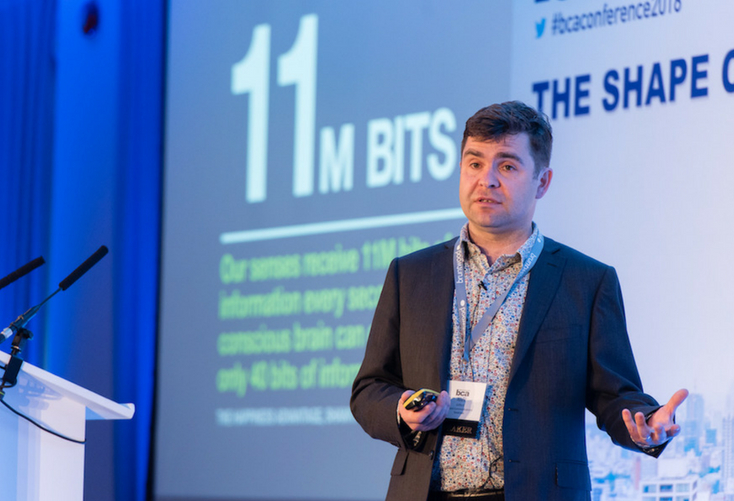
To do our best work, we need environments with “all the right things in place to support our physical, mental and emotional wellbeing”. Workplace related stress, illness and physical injury costs hundreds of billions of dollars every year; quite literally, the wealth of a business depends on the health of its workers.
For Gifford, designing the right workplace is a science; it requires data, measurement, and the need to diagnose problems and form solutions. At a minimum, workplaces should encourage movement, provide natural light and allow easy access to outdoor spaces.
As the workforce ages, due to people living and working longer, operators must work to improve the lighting, acoustics, and accessibility of the workplace. “We need to make a place that people want to be in, that they feel connected to,” Gifford added. “Can we leave the workplace feeling better and sharper than when we arrive? It’s possible, and that’s what we’re working towards.”
5) A Lightbulb Moment for Building Connectivity
William Newton of WiredScore, a rating platform for connectivity in buildings, revealed a number of technological advances that could dramatically shake up the way we access information digitally.
One of them is light fidelity (LiFi) — a technology for wireless communication that uses light to transmit data. Imagine, instead of logging onto a WiFi network or plugging in a network cable, you simply positioned your laptop underneath a light source to get online.
Sounds strange, but it’s plausible, and it poses a fascinating opportunity for serviced office operators. Using LED bulbs, the light source provides connectivity to places where WiFi can’t reach — such as areas out of range, behind thick walls, in basement levels, or in areas susceptible to electromagnetic interference.
It does raise a number of questions, including data security (would it work in an open office?) and energy usage (you’d need to keep the lights on even during bright daylight). However, for workspaces with connectivity difficulties, this — plus the onslaught of 5G — are just two of a number of new technologies coming our way.
At the BCA Conference, the message was clear: flexible workspace is here and it’s here to stay. Yes, competition is building — but so is the potential in which flexible workspace can be utilised and incorporated, for any size business in any size building. There were other messages too — messages that alluded to the industry’s strength, its incredible journey, and it’s commanding position that’s now drawing more interest, more demand and more investment than ever before.
Read more Conference highlights on the BCA Blog
Images copyright BCA | Photography Adrian Pope