
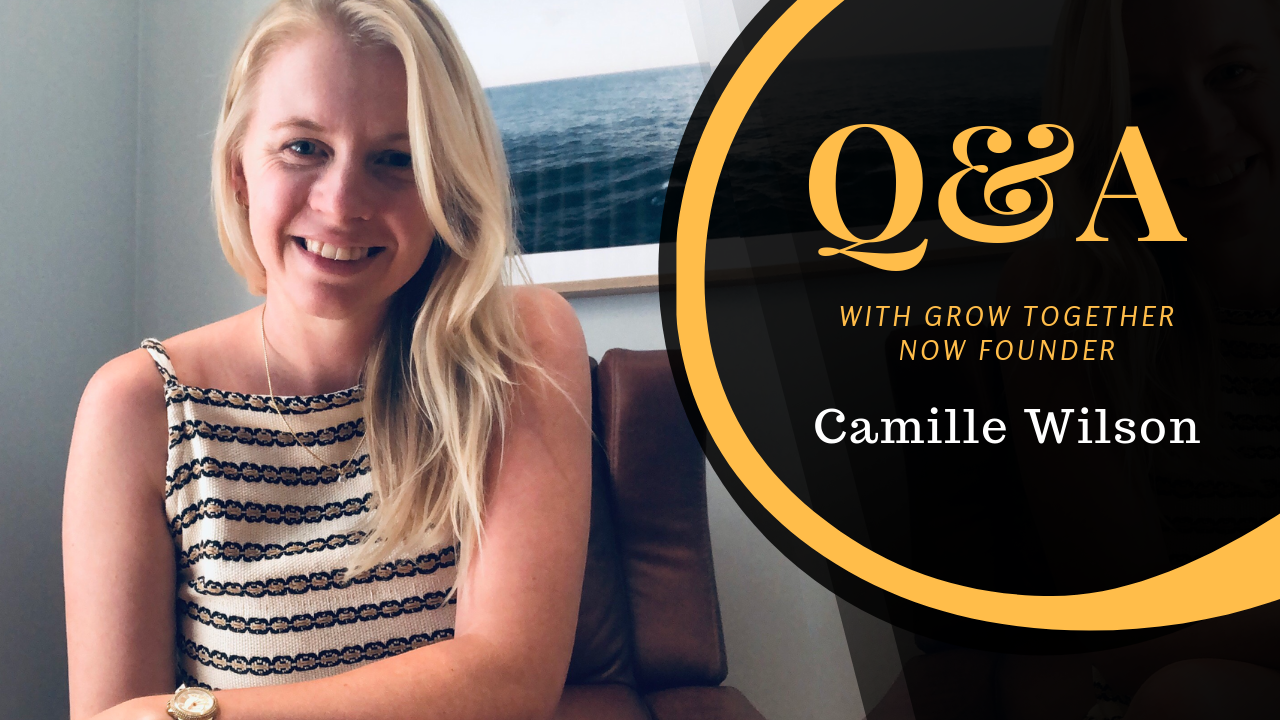
- Grow Together Now is a social startup based out of Hub Australia that helps companies create psychologically safe workplaces.
- Psychologically safe workplaces are environments in which people are comfortable being and expressing themselves.
- Unlike physical safety in the workplace, psychological safety is complex, intangible, at times overwhelming.
Founded in 2018, Grow Together Now is a social startup that’s focused on changing how companies address mental health in the workplace by creating and implementing initiatives that promote psychologically safe environments.
Grow Together Now is part of Hub Australia’s Flexi-Impact program, which aims to support purpose-driven businesses by offering one percent of its total member capacity as a complimentary 12-month membership. For Camille Wilson, Founder of Grow Together Now, being a part of the Hub Australia community has allowed her to “go somewhere, have a space to be creative, and to grow a cause that I am so passionate about.”

Allwork.Space talked with Wilson about what psychologically safe workplaces are, the importance of creating these safe environments, and the different ways in which companies can begin to create psychologically safe workplaces. Rather than just focusing on wellness initiatives in ergonomic furniture, the right temperature, and plants, companies can instead shift their focus to leadership and communications in order to encourage employees to open up.
Allwork.Space: Let’s start with the basics. Tell us about Grow Together Now.

Grow Together Now is a social startup that is dedicated to changing the way we see mental health in workplaces and within our community. I founded Grow Together Now in mid-2018 after I had spent 12 months prior recovering from severe generalised anxiety disorder. At the time I was unwell, I was working for a large bank in Australia and, although they did their best to support me, I noticed that at the end of the day that there was a huge gap between what I was going through and how they thought to best support me.
I have lived with mental health issues since the young age of 16 years old when I was diagnosed with Major Depression. This being an incredibly young age to be diagnosed and given a mental health recovery plan, I was on a personal mission to never let another teenager feel the same way that I did. As part of this quest, I continued on from high school to study a Bachelor of Psychology, from which I hoped to become a clinical psychologist. In my studies, it came to my attention that workplaces were in fact one of the biggest triggers that can make or break a mental health disorder so, instead of pursuing a clinical career to help people once they’ve reached the doctor’s office, I instead wanted to play a preventative role to avoid people getting there in the first place by becoming a human resources professional.
This passion into mental health ebbed and flowed throughout my early 20’s and it was in 2017 when I became unwell again that I remembered why I started working in HR in the first place. After having to leave the workforce in early 2018 as my recovery wasn’t allowing me to go back full time to my job, I was forced to think of an alternative career that I could support my mental health but still see out my vision. This is how Grow Together Now began.
Allwork.Space: In your website, you talk about creating psychologically safe workplaces. What are psychologically safe workplaces and how can companies begin to create one?
I think one of the biggest challenges our workplaces face is that they are disconnected from what psychological safety really means. Although it fits within our workplace health and safety structures, many organisations and leaders don’t connect to its true meaning.
Psychological safety is defined as the extent in which a workplace encompasses “a climate in which people are comfortable being (and expressing) themselves”. It’s a clear definition.
However, we’ve long been taught about the physical safety of our workplace, instead of the much more powerful psychological safety of it. We know how to move boxes safely out of the way from our colleagues; we know we need to make sure our desks are ergonomically friendly; we know if there is a spill, we need a big yellow sign. Physical safety is tangible, it is more practical, and we can see it almost as a yes or no answer.
Psychological safety, on the other hand, is complex. It is broad, vague, and sometimes can feel overwhelming for businesses to handle. Psychological safety can be further defined to look at any circumstance that a workplace has control over that could impact an employee’s comfort in being themselves. Now, isn’t that an opened kettle of fish?
Beside it being broad and sometimes overwhelming, it doesn’t for a moment mean that companies can’t start making initial changes that can overall improve the psychological safety of their workplace. A great place to start is to begin understanding your employees: what makes them feel safe vs unsafe? Is there an inclusion problem? Is it a leadership problem? It is a long-held misalignment with the company values?
To begin to understand how a business can improve psychological safety, it first needs to understand what its employees are thinking and feeling, and ultimately, where the gaps lie.
Allwork.Space: Psychological safety, to a certain extent then, means creating spaces where people are comfortable to speak about mental health issues and their feelings. This, however, remains a challenging issue for many companies and employees. Many professionals don’t feel comfortable disclosing their personal problems or challenges in the workplace for fear of being judged, fired, etc. In your experience, what are the main challenges that prevent companies and individuals in them from openly speaking about mental health?
There are a number of challenges – some much more deep-seated than others. One of the biggest, and most obvious, is the utmost stigmatisation of mental health. It wasn’t until the early 1900’s that we realised that calling the mentally unwell “insane” was the wrong thing to do. It then wasn’t until the 1940’s that we actually introduced a diagnostic manual to understand the different spectrum of those that sit within the mental health arena. That was less than 100 years ago, and although mental health research and attention is on the rise, it hasn’t been until recently that we started to open our eyes to it.
Like psychological safety, mental health is complex. It doesn’t just include those who have the traditional views of mentally unwell that sit within the patient floors of hospitals seeking help, but it also includes those who might struggle without seeking help, and those that are recovering, or even those that are healthy but just need to work on a few things.
Individuals don’t speak up because ultimately mental ill-health is seen as a weakness, as a failure, and as something that we should be ashamed of. Although I am open about my mental illness, there are definitely elements of it in which I’ve struggled to open up about, with fear that people will judge me or won’t see past it when it comes to a new job, a new friendship, or a new opportunity.
Mental health is stigmatised are for a host of reasons, but predominantly because we have been fed this weird sense of fear about it. It is a little bit of an unknown and it isn’t as tangible as our physical health. We cannot test our mental health with a thermometer; we cannot check how our recovery is going through a blood test; we aren’t given the “all clear” after a physical examination from our doctors.
Mental health is an ebbing and flowing process for each individual and each individual experience is so different from the rest. As humans, we like to compartmentalise things. We like to know how things work and where they sit. But, with mental health, we cannot do that, and it scares us.
Allwork.Space: Not only does it scare us, but I believe we don’t fully understand the scope of mental health. For example, I believe companies and individuals struggle to fully comprehend how much battling with day to day issues such as stress and anxiety greatly affect a person’s life. To a certain extent, at least in the professional realm, stress has been normalized and it’s part of work. While it’s normal to experience high-levels of stress every now and then, it should be the exception and not the norm. In your experience, what are the most common mental health issues that affect a person’s life the most?
Anxiety and depression are the most common mental health issues that an Australian adult will deal with in their life. One in four Australians will have a mental health issue in their lifetime, and 1 in 5 over the past 12 months. That means that, even if you have only 20 employees, almost 25% of your workforce are being impacted by mental health issues.
Having a mental health issue, be it from burnout to having a severe mental illness, can have a debilitating impact on life. It affects you physically, mentally, and emotionally. It can cause you to lose performance ability at work, it can impact your relationships, and if help isn’t sought, it can potentially cause a serious health issue that needs formalised medical intervention.
Learning to be more open about mental health, talking about it like our physical health, and building the right skills to manage it is one of the most profound opportunities that a workplace can provide to their employees. There will be a time in the future that there won’t be a question mark in offering mental health initiatives in the workplace. So, the question stands, what is your workplace doing about it?
Allwork.Space: Companies around the world are increasingly adopting wellness initiatives. However, in your website you mention how a clinical focus and wellness initiatives that focus on physical health aren’t necessarily the best way to address mental health. Why is that?
Needless to say, this statement needs some further explaining. It is never to say that addressing wellness initiatives and focusing on physical health is a bad thing. It is a great thing! Companies that encourage their employees to get a better night’s sleep, eat healthier choices, and to exercise more, are positively influencing a person’s body and mind.
The premise behind saying that addressing physical health is not the best way to address mental health is when we start to move past the employees who simply need some minor lifestyle changes to those who are in genuine need for a mindset shift about how they think, behave and process information. It is one thing to hand someone a carrot and a yoga mat, but if that person doesn’t like carrots and is embarrassed that they cannot touch their toes in yoga, then those two things aren’t going to be much use them.
What companies can be doing instead is investing part of their budget to create a paired approach where, in addition to the physical wellness initiatives, there is also a shift in focus to changing the behavioural mindset of the employee, so that when you do hand them the carrot and yoga mat, they understand why you are doing it and then they might be more inclined to use them.
In addition to this, I think companies address mental health by focusing on the “positive” and “fun” side of mental health. Having to deal with serious mental health cases in the workplace is tough and fact is that there’s a tendency to where companies and individuals prefer to avoid these tough conversations entirely.
Employees who suffer from mental illness often suffer in silence, and those who finally speak up are often faced with fear and disagreement from leadership teams. It’s not that leaders within a company don’t want to help, it’s mostly that they simply don’t know how to help.
This is where Grow Together Now comes into it. We help your employees understand themselves, who they are and why they think the way they do, and we help your leaders be the people they need to be when an employee reaches out for help.
Allwork.Space: It comes back to the fact that people need to feel safe and comfortable enough to open up and reach out for help without fear of remediation. How can creating a psychologically safe workplace contribute to this?
There is a vast amount of research that shows how a sense of belonging and meaning impact our mental health. I frequently refer to a framework developed by Martin Seligman that proposes that mental health is impacted by five areas of our life: PERMA (Positivity, Engagement, Relationships, Meaning, Achievements).
Given that at least 4 of those 5 can sit within a workplace, there’s without a doubt a relationship between the psychological safety of the workplace and the respective mental health of employees.
Bear in mind, this isn’t to say that some employees may still be mentally unwell in psychologically safe workplaces, and some employees may remain mentally well in psychologically unsafe workplaces.
Afterall, a combination of factors impact our mental health, but one can’t deny that the workplace is a significant contributor to mental and physical health. Look at today’s wellness trends that focus on the mind-body connection. If one of them isn’t working or functioning optimally, the other won’t either. It’s all interconnected; if someone isn’t happy in the workplace, they will likely find it more difficult to be happy in other aspects of their life.
Allwork.Space: Can you share some examples of how companies can create a psychologically safe space?
Let’s imagine you just finished your annual employee survey. The results are in and it’s not great news: your employees are disengaged. You probably didn’t need a survey to tell you because you’ve been increasingly receiving reports of possible mental health cases from your team. Still, revenue results are strong and you’ve just put your senior leadership through a new course on bringing in new business. Shareholders are happy, but your staff are not. What can you do about it?
There is a clear issue within your workforce and there are a number of ways you can work with it.
You could do a further deep dive to understand the issues that are affecting your team. This will achieve a once off result on what your employees are thinking. But there are other alternatives that instead of providing insights this one time can provide companies with a continual free-flow of information sourced by the employees themselves. Companies can consider investing time, money, and resources to upskill employees and leaders so that they are better equipped to create and encourage open forms of communication.
Such an approach can empower employees to speak their minds. For example, employees can report that they feel stressed out and that they feel their health and safety isn’t prioritised. It’s important to gather that information, but also – and more importantly – to use it to make the right decision. In this particular case, companies might think that if workers need to de-stress that they can host physical wellness activities at the workplace like yoga classes, stress management, massages, etc. But this doesn’t necessarily solve the problem, especially if yoga classes take place during lunch, then they would need to eat quickly or skip lunch. It doesn’t end up being a stress-relieving activity at all. Instead, companies should think about reviewing workload and making sure employees have taken their vacations, for example.
In the end, the opportunity for companies to invest into psychologically safety isn’t just about focusing on the typical and traditional ways of “safety”, but to think innovatively and put the employee at the heart of any design.