
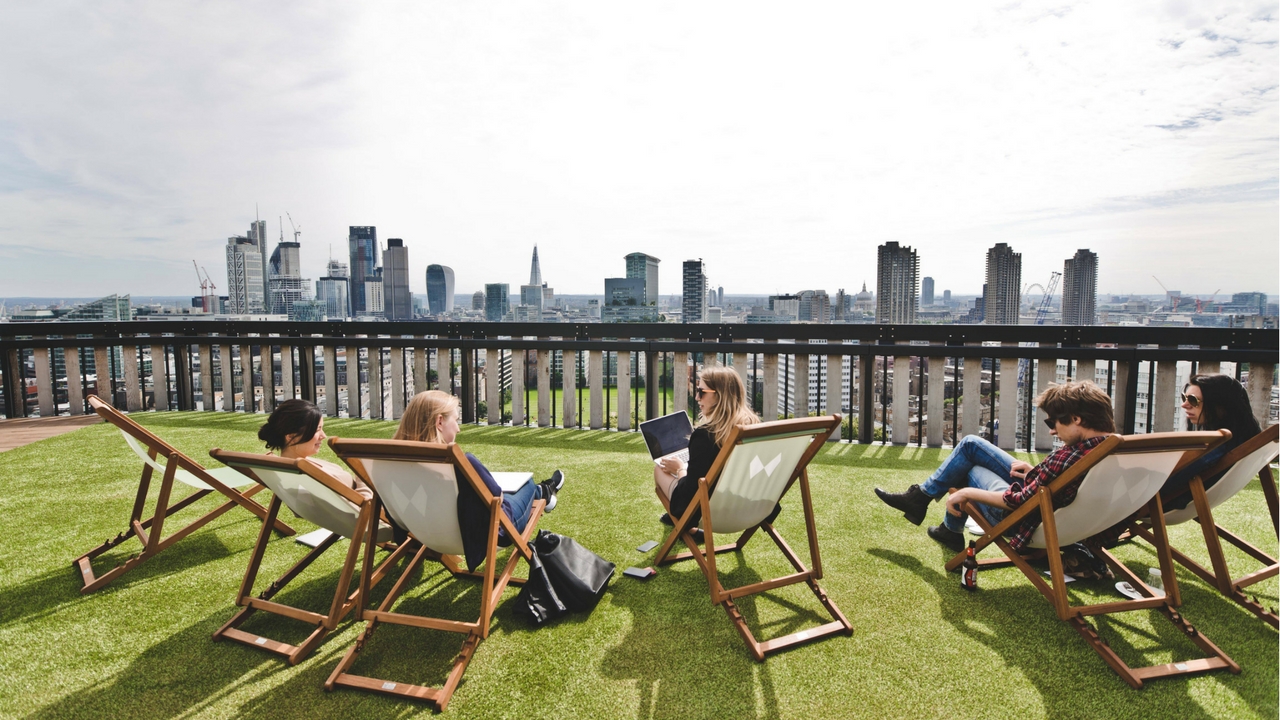
- Wellness and mental health are a top priority when it comes to the workplace experience
- The way an indoor environment is built and designed can have positive or negative effects on stress
- Humans feel safer and perform better in spaces that allow for a certain degree of visibility and have “openings” where one can move around freely
In his research paper “Hotel of Memory: Interpreting Neuroscience to Design in a Memorable Guest Experience”, Alvaro Alvarez states that “there are five physical cues that can make a space more memorable: Depth, Complexity, Landmark, Symmetry, and Repetition.”
This is based on the fact that “our hippocampus is extremely important in spatial memory — any time we enter a new place, our brain interprets our environment and takes physical cues to assemble a mental field map.”

This mental field map strongly influences the way we interact with our surroundings, both indoors and outdoors. There are various research studies that dig into the way humans interact with their surroundings. Wellness and mental health have become a top priority for companies across the globe. Various studies have confirmed that the better a worker feels (both physically and mentally), the better he or she will perform.
While most companies and flexible workspace operators have focused on health through wellness programs, recent studies suggest that companies and managers should also focus on design to improve the workplace experience.

One such research was conducted by Lars Brorson Fich, Peter Jönsson , Poul Henning Kirkegaard , Mattias Wallergård, Anne Helene Garde, and Åse Hansen. “It has long been established that views to natural scenes can have a dampening effect on physiological stress responses. However, as people in Europe, Canada, and North America today spend 50-80% of their time indoors, attention might also be paid as to how the artificial man-made indoor environment influences these mechanisms.”
Their study — titled “Can architectural design alter the physiological reaction to psychosocial stress? A virtual TSST experiment” — aims to answer the questions of whether certain design or characteristics of indoor spaces can make a difference on the physiological stress response.
Taking the classical fight-or-flight behavior as a point of departure, the study used a “virtual version of the Trier Social Stress Test, in which the space is computer generated and properties of the space, therefore, can be systematically varied. We measured saliva, cortisol, and heart rate variability in participants in a closed room versus a room with an opening.”
Their experiment aimed to confirm or deny whether stress responses are modulated depending on whether an escape is possible or not, and how spatial features in the environment might influence the magnitude of a stress reaction. Their assumption is that “the stress response to a stressful event that takes place in an indoor space might be influenced by whether the space offers potential escape routes.”

Using VR technology, the study induced stress in two different settings: a) in a closed room potentially not allowing escape, and b) in a room with three large openings, potentially allowing for escape.
Their findings showed that “participants in the closed room responded with more pronounced cortisol reactivity to stress induction, and continued to show higher levels (of stress) throughout recovery, compared to participants in the open room.”
In other words, stress response can be greatly influenced by how freely a person can move in any given setting.
With this in mind, workplace design can have a positive or negative impact on stress.
Design trends over the past couple of years have favored ‘natural elements’ in indoor spaces, with companies incorporating more plant and more natural wood in the interior architecture and furniture, as well as adding garden and rooftop space.
Synonymous with the study’s finding that stress is increased in closed environments, is the belief that people working in spaces bordered by transparent glass walls, or no walls at all, feel more energized while working. Similarly, visually open environments are perceived to enhance professional performance. This was confirmed in the case study “At Work, In View: The Cognitive Science of Working in Spaces with Transparent Boundaries”.
The takeaway here is that biophilia should play an important role in workplace design. Biophilia can make indoor environments more aesthetically pleasing, but — more importantly — they can also greatly influence our ability to function effectively in a given environment.
While it is simple enough to “bring the outdoors in” by adding plants and wood elements to the workplace, more thought can also be given to how the furniture is laid out, how much space there is to walk around, how many openings there are, and how much visibility individuals have from their particular workstations.
Featured image: The Office Group (White Collar Factory, London)